+
Secretary Chairs 86th Governing Body Meeting at NIH Roorkee
ECONOMY & POLICY

Secretary Chairs 86th Governing Body Meeting at NIH Roorkee

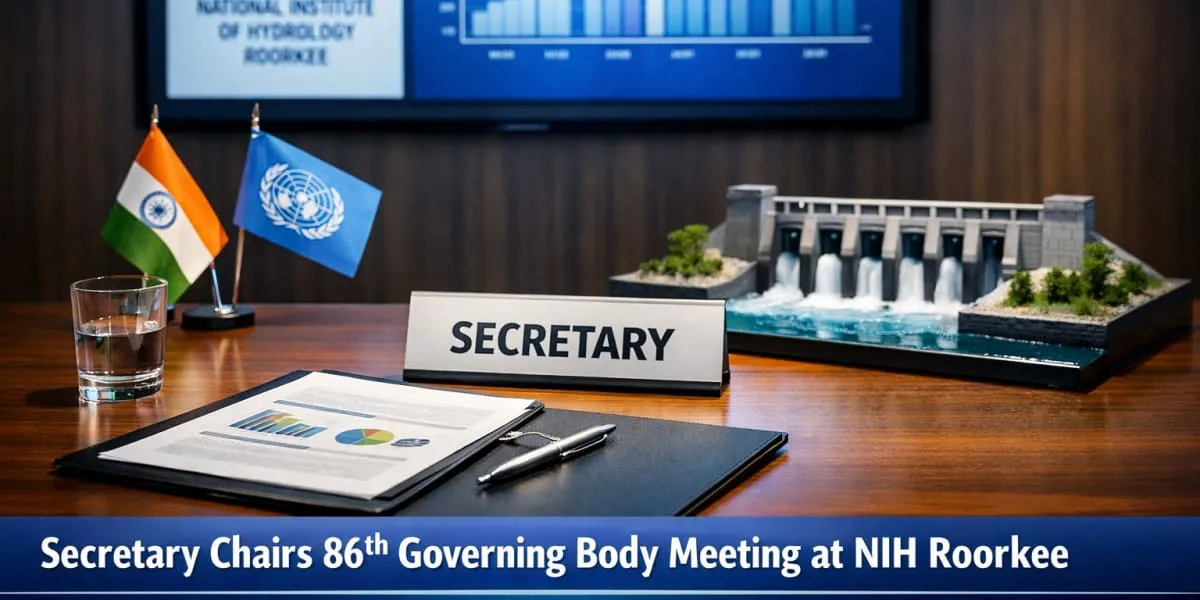
The 86th meeting of the Governing Body of the National Institute of Hydrology (NIH) was convened at the institute's Roorkee campus and chaired by the Secretary of the Department of Water Resources, River Development and Ganga Rejuvenation (DoWR, RD and GR), Ministry of Jal Shakti. The meeting reviewed institutional progress, strategic priorities and the expanding role of the institute as a premier research organisation addressing climate change impacts and sustainable water resource management. Deliberations emphasised alignment with national priorities and strengthening science based solutions for national water security.

Officials reported that during 2024–25 the institute managed 111 research and development studies and 28 sponsored projects, and initiated basin assessments in the Luni River basin and monitoring of Western Himalayan glaciers. A major project under the National Mission for Clean Ganga is assessing environmental flows for priority rivers. The institute highlighted advancement in digital water management through the development of NIH WISDOM, a web based decision support tool for groundwater recharge estimation and management.

The Governing Body noted that the institute conducted 76 training workshops benefiting over 1,845 personnel from government and academia and hosted the Ground Water Conference and a workshop on the National Adaptation Plan with the ministry. Specialised studies under review included research on historical Japanese wells and rainwater harvesting in the Andaman and Nicobar Islands, investigations into higher nitrate concentrations and assessments of climate impacts on wetlands including Rewalsar, Badrish and Wular. These activities were presented as part of efforts to enhance capacity building and technology transfer.

The Governing Body considered a budget estimate of Rs 680 million (Rs 680 mn) for 2026–27 to support expanded research programmes and laboratory infrastructure and reaffirmed plans to evolve the institute into an internationally recognised centre delivering science based solutions for citizens. Members underlined the need to prioritise studies of national importance and to strengthen collaboration with national missions and ministries. The meeting record indicated that performance and deliverables will be monitored to ensure impact on water resource management.

The 86th meeting of the Governing Body of the National Institute of Hydrology (NIH) was convened at the institute's Roorkee campus and chaired by the Secretary of the Department of Water Resources, River Development and Ganga Rejuvenation (DoWR, RD and GR), Ministry of Jal Shakti. The meeting reviewed institutional progress, strategic priorities and the expanding role of the institute as a premier research organisation addressing climate change impacts and sustainable water resource management. Deliberations emphasised alignment with national priorities and strengthening science based solutions for national water security. Officials reported that during 2024–25 the institute managed 111 research and development studies and 28 sponsored projects, and initiated basin assessments in the Luni River basin and monitoring of Western Himalayan glaciers. A major project under the National Mission for Clean Ganga is assessing environmental flows for priority rivers. The institute highlighted advancement in digital water management through the development of NIH WISDOM, a web based decision support tool for groundwater recharge estimation and management. The Governing Body noted that the institute conducted 76 training workshops benefiting over 1,845 personnel from government and academia and hosted the Ground Water Conference and a workshop on the National Adaptation Plan with the ministry. Specialised studies under review included research on historical Japanese wells and rainwater harvesting in the Andaman and Nicobar Islands, investigations into higher nitrate concentrations and assessments of climate impacts on wetlands including Rewalsar, Badrish and Wular. These activities were presented as part of efforts to enhance capacity building and technology transfer. The Governing Body considered a budget estimate of Rs 680 million (Rs 680 mn) for 2026–27 to support expanded research programmes and laboratory infrastructure and reaffirmed plans to evolve the institute into an internationally recognised centre delivering science based solutions for citizens. Members underlined the need to prioritise studies of national importance and to strengthen collaboration with national missions and ministries. The meeting record indicated that performance and deliverables will be monitored to ensure impact on water resource management.

Next Story
Equipment

Kabelschlepp India Installs Robotic VMC in Bengaluru

Kabelschlepp India, part of the Tsubaki Group, has installed a state-of-the-art Vertical Machining Center (VMC) integrated with robotic automation at its Bengaluru facility. The inauguration was held in the presence of Henning Preis, President & CEO, Kabelschlepp Group, Jörg Schulz, Vice President – Production, and Srinivas P. Kamisetty, Managing Director, Kabelschlepp India.The high-precision CNC VMC is designed for advanced milling, drilling, tapping and multi-axis machining. Equipped with a vertical spindle orientation, automatic tool changer and intelligent CNC control system, it en..

Next Story
Infrastructure Transport

Highway Delivery Reset!

Project delays and inefficiencies continue to bedevil the progress of India’s National Highways network. A multi-pronged reform agenda is needed to inject greater transparency and accountability at every stage – from planning and procurement to execution, maintenance and oversight. This article offers key recommendations and reform strategies that government stakeholders – from the Ministry of Road Transport & Highways (MoRTH) and the National Highways Authority of India (NHAI) to state agencies and oversight bodies – should pursue to put highway development on a better track.Decen..

Next Story
Infrastructure Transport

MSIDC Executes ₹37,000 Crore Road Programme

With Rs 37,000 crore worth of road projects under execution across Maharashtra, Maharashtra State Infrastructure Development Corporation (MSIDC) is driving one of the state’s largest infrastructure programmes. Dr Brijesh Dixit, Managing Director, discusses the institutional reforms, execution frameworks, financing strategies and technology adoption enabling timely, high-quality delivery, in conversation with PRATAP PADODE, Editor-in-Chief, CW.With over Rs 37,000 crore worth of road projects underway across districts – many under tight timelines – what institutional and executio..

Advertisement

Subscribe to Our Newsletter

Get daily newsletters around different themes from Construction world.

STAY CONNECTED

Advertisement

Advertisement

Advertisement

Open In App