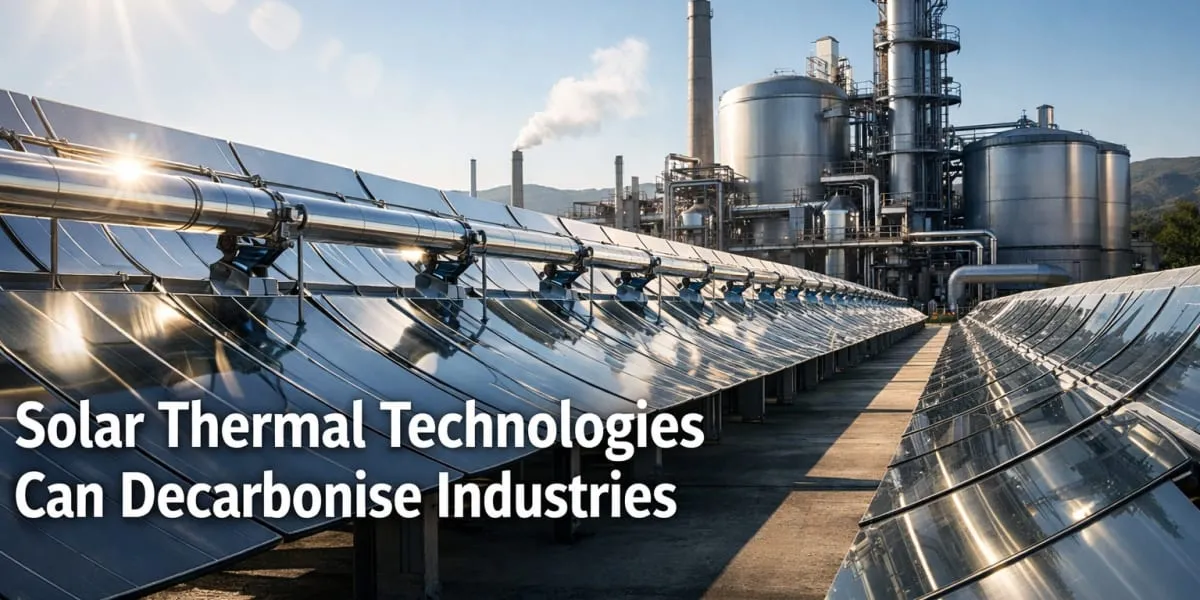
Solar Thermal Technologies Can Decarbonise Industries
ECONOMY & POLICY

Solar Thermal Technologies Can Decarbonise Industries

The Energy and Resources Institute (TERI) has released a policy brief arguing that solar thermal technologies can reduce fossil fuel dependence and support India's shift to a low-carbon industrial economy. The analysis, titled Policy Brief on Solar Thermal Energy for Industrial Decarbonization, was issued by TERI's director general and emphasised the need to empower small and medium enterprises (SMEs) to overcome financial and technological barriers. The report outlines recommendations to speed adoption.

Solar thermal systems collect sunlight and convert it into heat that can be stored and later used for process heat or converted into electricity, unlike photovoltaic panels that create electricity directly. Systems range from solar concentrators for low-temperature heat to higher-temperature installations that can substitute boilers in some processes. The brief highlights the suitability of heat-focused solutions for many industrial needs.

A central recommendation is a National Solar Thermal Mission with dedicated institutional support, long-term financing, fiscal incentives and an enabling policy framework to encourage industrial uptake. The mission would de-risk investments, support demonstrations and provide market signals for manufacturers and service providers. Concessional finance and targeted subsidies are proposed to make projects bankable.

The report urges pilot projects in industrial parks for sectors including food processing, textiles, dairy and pharmaceuticals, supported by shared solar thermal infrastructure and risk-sharing mechanisms. It recommends partnerships with park developers and models that let multiple firms access common facilities, reducing upfront costs and improving utilisation. Pilot projects are seen as a way to build operational evidence and viable business models.

If adopted at scale, solar thermal deployment could cut fossil fuel use in process heating and contribute to national net-zero goals by lowering manufacturing emissions. The brief states that coordinated policy, tailored finance and sustained industry engagement will be required to convert potential into large-scale deployment, with attention to ensuring benefits reach smaller firms. TERI advises a mix of public support and market-led incentives to accelerate uptake.

"Join industry leaders at RAHSTA Expo, India's premier platform for roads, highways and traffic infrastructure. Register now to explore innovations, network with experts and shape the future of mobility."

The Energy and Resources Institute (TERI) has released a policy brief arguing that solar thermal technologies can reduce fossil fuel dependence and support India's shift to a low-carbon industrial economy. The analysis, titled Policy Brief on Solar Thermal Energy for Industrial Decarbonization, was issued by TERI's director general and emphasised the need to empower small and medium enterprises (SMEs) to overcome financial and technological barriers. The report outlines recommendations to speed adoption. Solar thermal systems collect sunlight and convert it into heat that can be stored and later used for process heat or converted into electricity, unlike photovoltaic panels that create electricity directly. Systems range from solar concentrators for low-temperature heat to higher-temperature installations that can substitute boilers in some processes. The brief highlights the suitability of heat-focused solutions for many industrial needs. A central recommendation is a National Solar Thermal Mission with dedicated institutional support, long-term financing, fiscal incentives and an enabling policy framework to encourage industrial uptake. The mission would de-risk investments, support demonstrations and provide market signals for manufacturers and service providers. Concessional finance and targeted subsidies are proposed to make projects bankable. The report urges pilot projects in industrial parks for sectors including food processing, textiles, dairy and pharmaceuticals, supported by shared solar thermal infrastructure and risk-sharing mechanisms. It recommends partnerships with park developers and models that let multiple firms access common facilities, reducing upfront costs and improving utilisation. Pilot projects are seen as a way to build operational evidence and viable business models. If adopted at scale, solar thermal deployment could cut fossil fuel use in process heating and contribute to national net-zero goals by lowering manufacturing emissions. The brief states that coordinated policy, tailored finance and sustained industry engagement will be required to convert potential into large-scale deployment, with attention to ensuring benefits reach smaller firms. TERI advises a mix of public support and market-led incentives to accelerate uptake.

Next Story
Infrastructure Urban

Ion Exchange Wins USD 52.83 Million Supply Contract From Hyundai

Ion Exchange (India) (Ion Exchange) has been awarded an international contract by Hyundai Engineering and Construction Co., (Hyundai Engineering) for the supply of filtration units in the Middle East. The contract is valued at USD 52.83 million and is to be executed over a period of 18 months. The order aggregates to approximately Rs 5.03 bn based on the prevailing exchange rate. Delivery schedules and technical specifications will be governed by the contract terms. The scope covers manufacture and supply of filtration units to be deployed across projects in the Middle East and follows the pro..

Next Story
Infrastructure Urban

3i Infotech Subsidiary Wins Talent Deployment Contract With Krung Thai Bank

3i Infotech (Thailand), a wholly owned step down subsidiary of 3i Infotech, has won a contract from Krung Thai Bank Public Company on nine July 2026. The order covers talent deployment to support application development, enhancement, testing and digital transformation programmes. Roles specified include full stack development, backend development in Java, frontend development using Angular, DevOps engineering, quality assurance and test automation, business analysis and solution architecture. The engagement reflects the subsidiary's continued focus on banking technology services in the region...

Next Story
Infrastructure Urban

HFCL Secures Export Order For Data Centre Fibre Connectivity

HFCL (HFCL) has secured an export order worth US dollar (USD) 51.98 million (mn), equivalent to Rs 4,958 mn, for the supply of optical fibre cable based data centre connectivity solutions through its overseas wholly owned material subsidiary. The contract was awarded by an international customer and underscores HFCL's manufacturing capabilities, technological competence and product quality in global markets. The company stated the award arises from normal business operations and aligns with its export strategy. The scope covers the supply of optical fibre cable based data centre connectivity s..

Advertisement

Subscribe to Our Newsletter

Get daily newsletters around different themes from Construction world.

STAY CONNECTED

Advertisement

Advertisement

Advertisement