




Startup Mahakumbh Showcases Deep-Tech Prowess
ECONOMY & POLICY

Startup Mahakumbh Showcases Deep-Tech Prowess

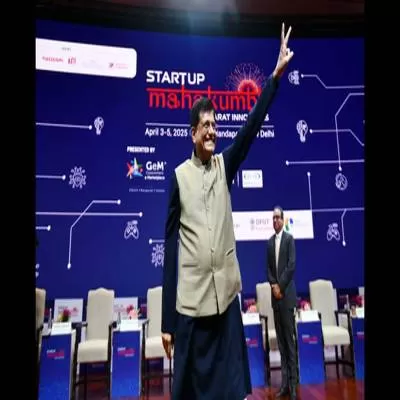
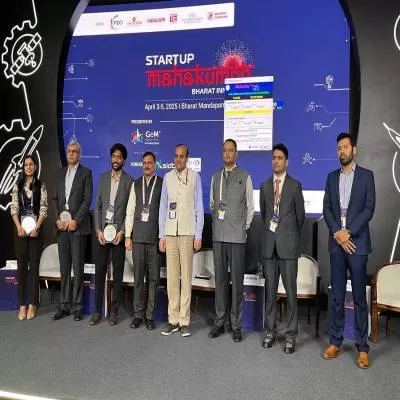
The third and final day of Startup Mahakumbh 2025 culminated in a high-energy celebration of India’s rising prowess in deep-tech, B2B, precision manufacturing, and defence-space sectors. The event cemented India’s commitment to becoming a global innovation hub, echoing the vision of Atmanirbhar Bharat.

A power-packed panel on “Defence Startups: Growth Engines of Viksit Bharat,” moderated by Capt. Vishal Kanwar (Retd.), featured leaders like Ankit Mehta (ideaForge), Prashant C. Jain (L&T), Prithwish Kundu (Green Aero), and Soma Sekhar Vedantam (Meridian Data Labs). The panel focused on indigenous innovation, R&D scale-up, and cross-sectoral synergies to position India as a global technology powerhouse.

Adding to the momentum, NSDC signed an MoU with Pandit Deendayal Energy University (PDEU) to build a Centre of Excellence for skill development in energy and semiconductors—a strategic move aligned with India's semiconductor mission.

In a session on “Opportunities in Defence and Space Tech,” prominent venture capitalists including Ashish Taneja (GrowX), Cdr. Navneet Kaushik (Jamwant Ventures), Girish Shivani (Yournest), Raj Sethia (MountTech Kavachh), and Vinod Shankar (Java Capital) underscored India's unique dual-use innovation potential, need for regulatory agility, and investor interest spurred by robust policy frameworks and changing geopolitical narratives.

Another key discussion, “Fintech Meets B2B,” moderated by Karthik Prabhakar (Peer Capital), delved into financial strategies for enterprise growth. Panelists including Arup Kumar (SIDBI VC), Parthesh Shah (Knight FinTech), and Sonali Jindal (Rezolv) highlighted the importance of long-term capital, academic linkages, and policy-driven incentives to spur indigenous tech development.

Wrapping up, the “zero-one in Manufacturing” session explored founder journeys in advanced textiles, specialty chemicals, and agri-tech. Led by Akshay Sharma (3one4 Capital), it featured insights from Piyush Jalan (Thimblerr), Sachin Santosh (Scimplify), and Shreshtha Kukreja (Whizzo), emphasising first-principles thinking, global compliance (US FDA, EPA), and MSME-led scaling.

Startup Mahakumbh, organised by FICCI, NASSCOM, TiE, IVCA, and others, attracted 50,000+ visitors, 3,000 startups, and 1,000+ investors. With its second edition set for 2025, the event reinforces India’s leadership in strategic and scalable innovation.

The third and final day of Startup Mahakumbh 2025 culminated in a high-energy celebration of India’s rising prowess in deep-tech, B2B, precision manufacturing, and defence-space sectors. The event cemented India’s commitment to becoming a global innovation hub, echoing the vision of Atmanirbhar Bharat. A power-packed panel on “Defence Startups: Growth Engines of Viksit Bharat,” moderated by Capt. Vishal Kanwar (Retd.), featured leaders like Ankit Mehta (ideaForge), Prashant C. Jain (L&T), Prithwish Kundu (Green Aero), and Soma Sekhar Vedantam (Meridian Data Labs). The panel focused on indigenous innovation, R&D scale-up, and cross-sectoral synergies to position India as a global technology powerhouse. Adding to the momentum, NSDC signed an MoU with Pandit Deendayal Energy University (PDEU) to build a Centre of Excellence for skill development in energy and semiconductors—a strategic move aligned with India's semiconductor mission. In a session on “Opportunities in Defence and Space Tech,” prominent venture capitalists including Ashish Taneja (GrowX), Cdr. Navneet Kaushik (Jamwant Ventures), Girish Shivani (Yournest), Raj Sethia (MountTech Kavachh), and Vinod Shankar (Java Capital) underscored India's unique dual-use innovation potential, need for regulatory agility, and investor interest spurred by robust policy frameworks and changing geopolitical narratives. Another key discussion, “Fintech Meets B2B,” moderated by Karthik Prabhakar (Peer Capital), delved into financial strategies for enterprise growth. Panelists including Arup Kumar (SIDBI VC), Parthesh Shah (Knight FinTech), and Sonali Jindal (Rezolv) highlighted the importance of long-term capital, academic linkages, and policy-driven incentives to spur indigenous tech development. Wrapping up, the “zero-one in Manufacturing” session explored founder journeys in advanced textiles, specialty chemicals, and agri-tech. Led by Akshay Sharma (3one4 Capital), it featured insights from Piyush Jalan (Thimblerr), Sachin Santosh (Scimplify), and Shreshtha Kukreja (Whizzo), emphasising first-principles thinking, global compliance (US FDA, EPA), and MSME-led scaling. Startup Mahakumbh, organised by FICCI, NASSCOM, TiE, IVCA, and others, attracted 50,000+ visitors, 3,000 startups, and 1,000+ investors. With its second edition set for 2025, the event reinforces India’s leadership in strategic and scalable innovation.

Next Story
Real Estate

AI: The New Recruit

From getting ideas to evaluating designs, presenting concepts to clients and tracking projects, artificial intelligence (AI) is helping architects work better and faster.“AI allows architects to spend more time doing what only they can do: think critically, synthesise complexity and design with intent,” says Dikshu C Kukreja, Managing Principal, CP Kukreja Architects. “Every minute reclaimed from repetitive processes can be invested in creativity, contextual understanding, interdisciplinary collaboration and innovation – the qualities that define meaningful architecture.”To read the ..

Next Story
Real Estate

Redevelopment 2.0

In 2017, Mumbai identified 160,000 ageing buildings due for structural audit. Close to half of these were in the Western Suburbs. Redeveloping the oldest and structurally weakest of these would help unlock new housing, much needed given the city’s growing population density and constant developed area of 437.7 sq km. At 30,600 people per sq km in 2024, Mumbai’s density was almost thrice that of Gurugram, and 60 per cent higher than Bengaluru’s.Essentially, Mumbai’s realty market has demand. It has capital. It has realty development potential.Fast forward to 2026. Mumbai has 1,094 regis..

Next Story
Technology

Cost intelligence will become a strategic contributor to project success

As India's construction industry accelerates its digital transformation, integrated platforms, AI and connected data are becoming essential to improving cost certainty, project efficiency and sustainability. Ravi Kumar, Sales Director – India, RIB Software India, shares how digital workflows are reshaping project planning, commercial management and decision-making across the construction value chain.India's construction sector is embracing digital technologies at an unprecedented pace. From your perspective, what are the biggest shifts driving this transformation and how is RIB Software enab..

Advertisement

Subscribe to Our Newsletter

Get daily newsletters around different themes from Construction world.

STAY CONNECTED

Advertisement

Advertisement

Advertisement















