+
Supreme Court Quashes 2021 OM Allowing Retrospective Clearances
ECONOMY & POLICY

Supreme Court Quashes 2021 OM Allowing Retrospective Clearances

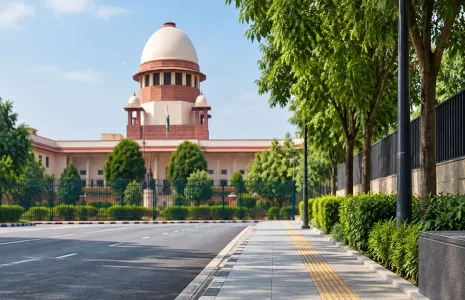
The Supreme Court quashed the 2021 Office Memorandum allowing retrospective environmental clearances for projects commenced without approval. A bench of Chief Justice Surya Kant and Justices Joymalya Bagchi and Vipul M Pancholi delivered a unanimous verdict applying prospectively to protect projects that had already received retrospective clearances from demolition and punitive measures. The court cited examples such as an AIIMS in Odisha, a greenfield airport in Vijayanagar in Karnataka and several common effluent treatment plants central to pollution control.

The court held that post-facto clearances cannot be granted by an administrative office memorandum and must be issued through valid statutory notifications under Section three of the Environment (Protection) Act, 1986. The bench found that the 2021 memorandum established a perpetual amnesty regime, altered the nature of enquiry and the criteria under the 2006 notification, and effectively supplanted dedicated legislation by administrative instruction which was impermissible in law. It concluded the memorandum failed tests of proportionality and reasonableness and violated Article 14 and Article 21 of the Constitution.

The quashing of the memorandum was declared to have prospective effect and the court directed that no further applications under the 2017 notification and the 2021 memorandum should be entertained. The Central government was restrained from issuing future administrative orders to grant post-facto clearances except by way of a valid notification under Section three of the Environment (Protection) Act. The bench clarified that its directions would not fetter the court's power under Article 142 to pass orders necessary to do complete justice in appropriate cases.

The matter had drawn fresh hearings after a sequence of earlier rulings, including a 2025 decision that barred retrospective clearances and a subsequent majority order later in 2025 that permitted them on payment of heavy penalties. The earlier majority had observed that otherwise thousands of crore rupees and vital projects funded at nearly Rs 200 bn from the public exchequer would be lost, prompting a rehearing and the present judgment.

The Supreme Court quashed the 2021 Office Memorandum allowing retrospective environmental clearances for projects commenced without approval. A bench of Chief Justice Surya Kant and Justices Joymalya Bagchi and Vipul M Pancholi delivered a unanimous verdict applying prospectively to protect projects that had already received retrospective clearances from demolition and punitive measures. The court cited examples such as an AIIMS in Odisha, a greenfield airport in Vijayanagar in Karnataka and several common effluent treatment plants central to pollution control. The court held that post-facto clearances cannot be granted by an administrative office memorandum and must be issued through valid statutory notifications under Section three of the Environment (Protection) Act, 1986. The bench found that the 2021 memorandum established a perpetual amnesty regime, altered the nature of enquiry and the criteria under the 2006 notification, and effectively supplanted dedicated legislation by administrative instruction which was impermissible in law. It concluded the memorandum failed tests of proportionality and reasonableness and violated Article 14 and Article 21 of the Constitution. The quashing of the memorandum was declared to have prospective effect and the court directed that no further applications under the 2017 notification and the 2021 memorandum should be entertained. The Central government was restrained from issuing future administrative orders to grant post-facto clearances except by way of a valid notification under Section three of the Environment (Protection) Act. The bench clarified that its directions would not fetter the court's power under Article 142 to pass orders necessary to do complete justice in appropriate cases. The matter had drawn fresh hearings after a sequence of earlier rulings, including a 2025 decision that barred retrospective clearances and a subsequent majority order later in 2025 that permitted them on payment of heavy penalties. The earlier majority had observed that otherwise thousands of crore rupees and vital projects funded at nearly Rs 200 bn from the public exchequer would be lost, prompting a rehearing and the present judgment.

Related Stories

Gold Stories

Next Story
Infrastructure Urban

MyBranch Expands South India Network with 16 Workspace Centres

MyBranch has expanded its South India presence with a 50,000 sq ft flexible workspace network comprising 16 centres across 14 cities in Andhra Pradesh, Karnataka, Tamil Nadu and Telangana.The expansion reflects growing demand for flexible office infrastructure as businesses establish regional teams, satellite offices and operations beyond traditional metropolitan markets. MyBranch’s network spans Bengaluru, Coimbatore, Guntur, Hanamkonda, Hubballi, Hyderabad, Madurai, Mangaluru, Rajahmundry, Salem, Tirupati, Vellore, Vijayawada and Visakhapatnam, with a large office space in Chennai also und..

Next Story
Building Material

Walplast Launches Moisture-Resistant Gypsum Plaster Solutions

Walplast Products Pvt. Ltd. has expanded its HomeSure GypEx portfolio with the launch of GypEx MoistShield and GypEx Gold, two gypsum plaster solutions designed to address moisture-prone applications and improve plastering efficiency.The new products have been developed in response to the growing demand for faster construction processes, improved material performance and consistent surface quality. The solutions aim to simplify interior plastering while addressing specific application requirements across construction environments.“Through HomeSure GypEx MoistShield and GypEx Gold, we are exp..

Next Story
Building Material

Steel Prices Hit Four-Year High on Strong Demand

Domestic steel prices have reached a four-year high amid strong demand and rising raw material costs, according to Enlight Metals, India’s first agentic AI-enabled metal aggregator.Hot Rolled Coil (HRC) prices have increased to around Rs 64,000 per tonne, while Cold Rolled Coil (CRC) prices are at approximately Rs 75,000 per tonne. Meanwhile, domestic steel consumption grew 7 per cent year-on-year to around 70 MT during April–August FY27, reflecting continued demand from major steel-consuming sectors.The price movement has been driven by sustained demand from infrastructure, construction a..

Advertisement

Subscribe to Our Newsletter

Get daily newsletters around different themes from Construction world.

STAY CONNECTED

Advertisement

SPECIAL OFFER
QR Code