Tamil Nadu Tops Infrastructure Ranking Among Large States
ECONOMY & POLICY

Tamil Nadu Tops Infrastructure Ranking Among Large States

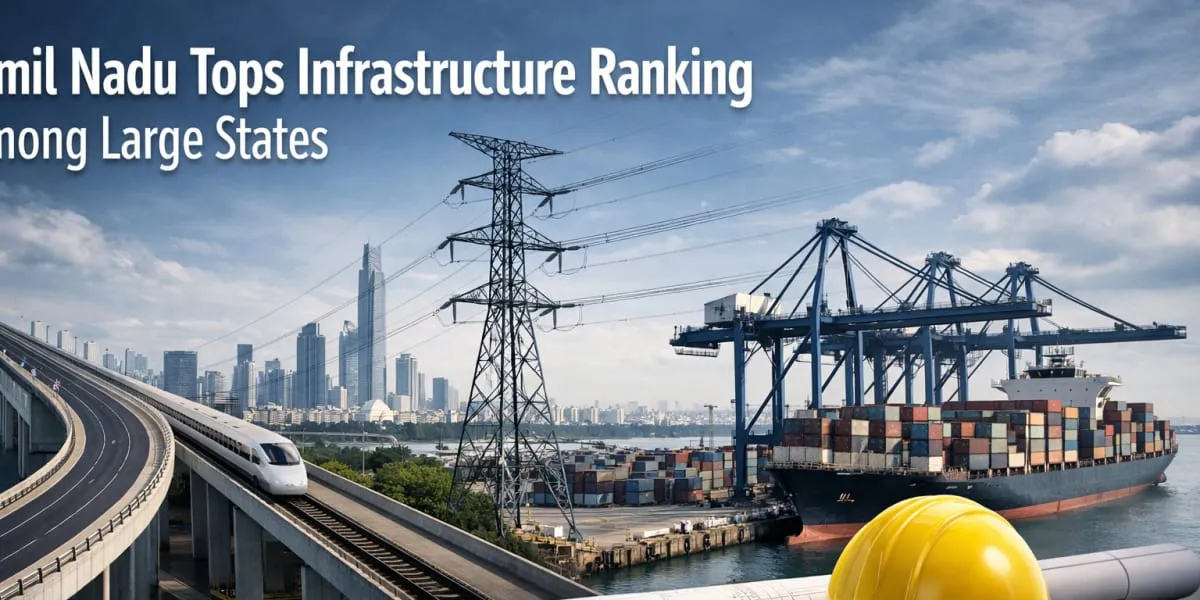
The Niti Aayog Investment Friendliness Index 2026 ranked Tamil Nadu first among large states on the infrastructure pillar and placed it third overall with a composite score of 53.3, behind Gujarat at 56.6 and Maharashtra at 53.7. The assessment highlighted the state’s technical talent, efficient ports and a reliable power network as competitive advantages.

The report said an extensive network of engineering colleges, industrial training institutes and polytechnics has created a strong industrial skills ecosystem that supports automobiles, electronics and advanced manufacturing. Ports ranked third nationally on turnaround time adjusted for capacity. Electricity outages were about four per cent lower than the average for large states and transmission and distribution losses were around three per cent below the peer group average.

Tamil Nadu’s export oriented industrial base was cited as a differentiator, with exports at 36 per cent of gross state domestic product (GSDP), above the large state average. The state had the second highest number of Atal Tinkering Labs, reflecting investment in innovation and technical education. Digital investor facilitation systems such as Biz Buddy and the Guidance Tamil Nadu Investor Facilitation Portal were noted for improving conversion of memoranda and resolving investor grievances within 30 days.

The report highlighted road and rail connectivity linking Chennai, Coimbatore and Hosur and networks serving the ports of Chennai and Kamarajar. Industrial parks by SIPCOT and SIDCO were described as well planned and attractive to multinational manufacturers. The state’s electric vehicle policy has been implemented on the ground, and Tamil Nadu was one of five states accounting for around 85 per cent of India’s foreign direct investment inflows. It scored well on environmental resilience with air quality about 22 per cent better than the large state average, but financial health remained the weakest pillar with interest payments of 3.4 per cent of GSDP and liabilities near 31 per cent, while logistics capacity at container freight stations and inland container depots was about one third below average relative to manufacturing output.

The Niti Aayog Investment Friendliness Index 2026 ranked Tamil Nadu first among large states on the infrastructure pillar and placed it third overall with a composite score of 53.3, behind Gujarat at 56.6 and Maharashtra at 53.7. The assessment highlighted the state’s technical talent, efficient ports and a reliable power network as competitive advantages. The report said an extensive network of engineering colleges, industrial training institutes and polytechnics has created a strong industrial skills ecosystem that supports automobiles, electronics and advanced manufacturing. Ports ranked third nationally on turnaround time adjusted for capacity. Electricity outages were about four per cent lower than the average for large states and transmission and distribution losses were around three per cent below the peer group average. Tamil Nadu’s export oriented industrial base was cited as a differentiator, with exports at 36 per cent of gross state domestic product (GSDP), above the large state average. The state had the second highest number of Atal Tinkering Labs, reflecting investment in innovation and technical education. Digital investor facilitation systems such as Biz Buddy and the Guidance Tamil Nadu Investor Facilitation Portal were noted for improving conversion of memoranda and resolving investor grievances within 30 days. The report highlighted road and rail connectivity linking Chennai, Coimbatore and Hosur and networks serving the ports of Chennai and Kamarajar. Industrial parks by SIPCOT and SIDCO were described as well planned and attractive to multinational manufacturers. The state’s electric vehicle policy has been implemented on the ground, and Tamil Nadu was one of five states accounting for around 85 per cent of India’s foreign direct investment inflows. It scored well on environmental resilience with air quality about 22 per cent better than the large state average, but financial health remained the weakest pillar with interest payments of 3.4 per cent of GSDP and liabilities near 31 per cent, while logistics capacity at container freight stations and inland container depots was about one third below average relative to manufacturing output.

Related Stories

Gold Stories

Next Story
Infrastructure Urban

KONE Opens India's First Digital Experience Centre in Pune

KONE, a global elevator and escalator manufacturer, has inaugurated its first Digital Experience Centre (DEC) in India, located in Pune. The facility aims to showcase how artificial intelligence (AI), connectivity and data-driven technologies can enhance customer experiences and improve building operations.The centre was inaugurated by Jussi Herlin, Executive Vice Chair, KONE Corporation; Philippe Delorme, President and CEO, KONE; and Nandan Nilekani, Co-founder and Chairman of the Board, Infosys.Designed as an interactive customer environment, the facility demonstrates digital solutions cover..

Next Story
Infrastructure Urban

CII GreenCo Launches Circularity Guidelines for Indian Industry

The Confederation of Indian Industry (CII) GreenCo Council has launched the CII GreenCo Circularity Guidelines – Pilot Version at the 17th CII GreenCo Waste & Resource Management Summit 2026 in Chennai. The initiative aims to strengthen resource efficiency, waste reduction and circular economy practices across Indian manufacturing and process industries.The guidelines introduce a structured framework with circularity indices covering raw materials, consumables, packaging and other resource inputs. These indicators will help industries assess existing practices, identify opportunities to ..

Next Story
Infrastructure Energy

Global Electronics Association Launches IPC-1783-CO2E Standard

The Global Electronics Association has introduced IPC-1783-CO2E, a new international standard aimed at improving consistency, transparency and comparability in product carbon footprint reporting across the electronics manufacturing industry.The standard, titled International Standard for Data Collection and Reporting of CO2 Equivalent (CO2e) Emissions for the Electronics Manufacturing Supply Chain, provides industry-specific guidance for collecting, estimating and reporting carbon emissions data.With increasing regulatory requirements and customer expectations, electronics manufacturers face c..

Advertisement

Subscribe to Our Newsletter

Get daily newsletters around different themes from Construction world.

STAY CONNECTED

Advertisement

SPECIAL OFFER
QR Code