+
Tamsa River Rejuvenation Becomes Model For Tributary Conservation
ECONOMY & POLICY

Tamsa River Rejuvenation Becomes Model For Tributary Conservation

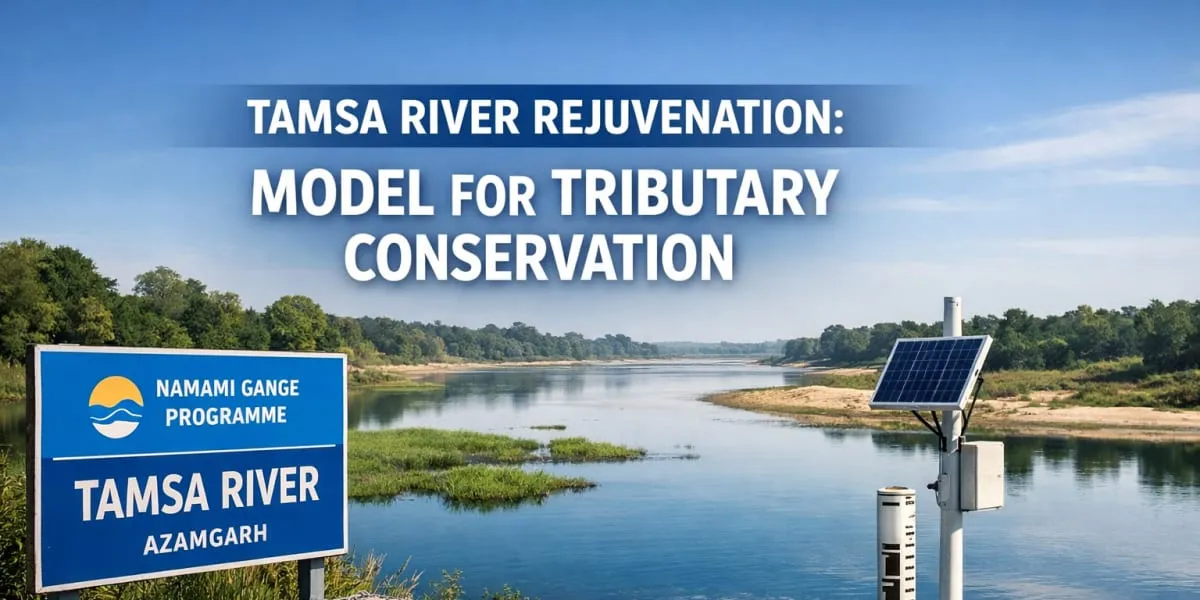
The Tamsa River has undergone a marked revival in Azamgarh district of eastern Uttar Pradesh following concerted administrative action and community participation under the Namami Gange Programme (NGP). The river, an ancient tributary of the Ganga, flows through Ambedkar Nagar, Ayodhya and Azamgarh districts and an approximate 89-kilometre stretch in Azamgarh passes through 111 Gram Panchayats (GPs). The District Ganga Committee (DGC) and local stakeholders coordinated planning and implementation to address siltation, waste accumulation and encroachments.

A detailed grassroots action plan prioritised desilting of shallow stretches, removal of garbage and debris from riverbanks and measurement and deoccupation of illegal encroachments. Plantation of fruit-bearing trees along available land parcels was included to support ecological restoration and provide economic value through local produce for the GPs. Officials ensured that sanitation workers and local volunteers were engaged to maintain the restored stretches.

Sustained Shramdaan and awareness campaigns mobilised school children, youth, women’s self-help groups, voluntary organisations and residents to prevent dumping and promote segregation of wet and dry waste. Dustbins were installed at key locations and regular cleanliness drives focused on removal of plastic, polythene and other solid waste from ghats and banks. Convergence with the Mahatma Gandhi National Rural Employment Guarantee Act (MGNREGA) facilitated labour support and underlined the participatory model of restoration.

Officials reported improvements in water quality, revival of biodiversity and enhancement of soil fertility and irrigation potential in adjacent agricultural areas as direct outcomes of the work. The initiative has also improved the cleanliness and organisation of religious and cultural activities on riverbanks, enhancing the experience for devotees. Authorities indicated that the Tamsa renewal provides a replicable model for conservation of tributaries and smaller rivers across the Ganga basin and will continue in mission mode under the NGP.

The Tamsa River has undergone a marked revival in Azamgarh district of eastern Uttar Pradesh following concerted administrative action and community participation under the Namami Gange Programme (NGP). The river, an ancient tributary of the Ganga, flows through Ambedkar Nagar, Ayodhya and Azamgarh districts and an approximate 89-kilometre stretch in Azamgarh passes through 111 Gram Panchayats (GPs). The District Ganga Committee (DGC) and local stakeholders coordinated planning and implementation to address siltation, waste accumulation and encroachments. A detailed grassroots action plan prioritised desilting of shallow stretches, removal of garbage and debris from riverbanks and measurement and deoccupation of illegal encroachments. Plantation of fruit-bearing trees along available land parcels was included to support ecological restoration and provide economic value through local produce for the GPs. Officials ensured that sanitation workers and local volunteers were engaged to maintain the restored stretches. Sustained Shramdaan and awareness campaigns mobilised school children, youth, women’s self-help groups, voluntary organisations and residents to prevent dumping and promote segregation of wet and dry waste. Dustbins were installed at key locations and regular cleanliness drives focused on removal of plastic, polythene and other solid waste from ghats and banks. Convergence with the Mahatma Gandhi National Rural Employment Guarantee Act (MGNREGA) facilitated labour support and underlined the participatory model of restoration. Officials reported improvements in water quality, revival of biodiversity and enhancement of soil fertility and irrigation potential in adjacent agricultural areas as direct outcomes of the work. The initiative has also improved the cleanliness and organisation of religious and cultural activities on riverbanks, enhancing the experience for devotees. Authorities indicated that the Tamsa renewal provides a replicable model for conservation of tributaries and smaller rivers across the Ganga basin and will continue in mission mode under the NGP.

Next Story
Equipment

Kabelschlepp India Installs Robotic VMC in Bengaluru

Kabelschlepp India, part of the Tsubaki Group, has installed a state-of-the-art Vertical Machining Center (VMC) integrated with robotic automation at its Bengaluru facility. The inauguration was held in the presence of Henning Preis, President & CEO, Kabelschlepp Group, Jörg Schulz, Vice President – Production, and Srinivas P. Kamisetty, Managing Director, Kabelschlepp India.The high-precision CNC VMC is designed for advanced milling, drilling, tapping and multi-axis machining. Equipped with a vertical spindle orientation, automatic tool changer and intelligent CNC control system, it en..

Next Story
Infrastructure Transport

Highway Delivery Reset!

Project delays and inefficiencies continue to bedevil the progress of India’s National Highways network. A multi-pronged reform agenda is needed to inject greater transparency and accountability at every stage – from planning and procurement to execution, maintenance and oversight. This article offers key recommendations and reform strategies that government stakeholders – from the Ministry of Road Transport & Highways (MoRTH) and the National Highways Authority of India (NHAI) to state agencies and oversight bodies – should pursue to put highway development on a better track.Decen..

Next Story
Infrastructure Transport

MSIDC Executes ₹37,000 Crore Road Programme

With Rs 37,000 crore worth of road projects under execution across Maharashtra, Maharashtra State Infrastructure Development Corporation (MSIDC) is driving one of the state’s largest infrastructure programmes. Dr Brijesh Dixit, Managing Director, discusses the institutional reforms, execution frameworks, financing strategies and technology adoption enabling timely, high-quality delivery, in conversation with PRATAP PADODE, Editor-in-Chief, CW.With over Rs 37,000 crore worth of road projects underway across districts – many under tight timelines – what institutional and executio..

Advertisement

Subscribe to Our Newsletter

Get daily newsletters around different themes from Construction world.

STAY CONNECTED

Advertisement

Advertisement

Advertisement

Open In App