+
Telangana Begins Phase One of Musi River Rejuvenation
ECONOMY & POLICY

Telangana Begins Phase One of Musi River Rejuvenation

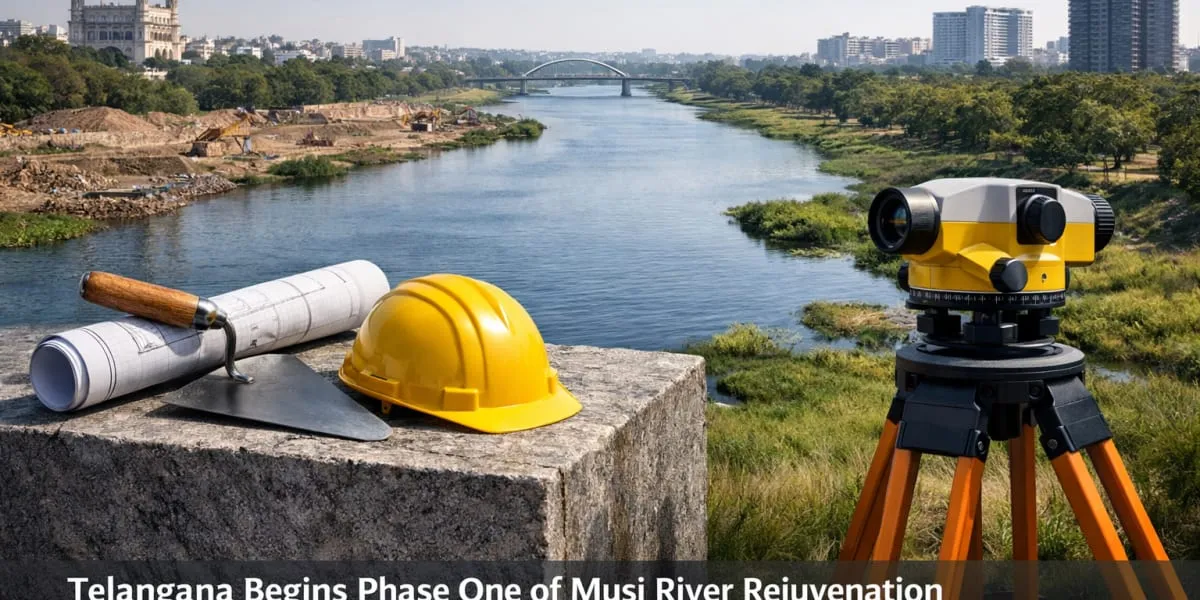
Telangana will begin the first phase of the Musi River rejuvenation project in the first week of April, officials confirmed. Phase one will cover Osman Sagar to Bapu Ghat, an 11 km stretch, and Himayat Sagar to Bapu Ghat, a nine km stretch, and will develop about 200 acres near Bapu Ghat into Gandhi Sarovar as an experiential centre. Preparatory work delayed a February start and the government plans to invite the Union Defence Minister to lay the foundation stone.

The Musi Riverfront Development Corporation Limited has completed the detailed project report and hydrological studies, and the Asian Development Bank has given in-principle approval for phased funding. Phase one works will include trunk sewer lines, stormwater drains, water-retention structures, weirs and barrages at selected sites. Gandhi Sarovar will include a handloom promotion centre, exhibition spaces, a meditation village, public recreation areas and visitor ghats, with tertiary-treated water reused for landscaping and industry.

Gandhi Sarovar will require about 300 acres, of which 98 acres belong to the defence ministry, approximately 40 acres are private patta land and the remainder is government land; authorities have identified about 1,400 structures on private parcels. The MRDCL managing director EV Narasimha Reddy said the corporation carried out a 100-year hydrological study that recorded a maximum flood discharge of 0.162 mn cusecs. A 50-metre buffer zone has been established on the basis of the study.

The 55 km Musi stretch is divided into five zones for rejuvenation, with phase one covering Zone one around Bapu Ghat. To prevent untreated sewage entering the river, 62 sewage treatment plants are planned along the stretch and two point five tmcft of Godavari water will be diverted to maintain river levels. Phase one will also include river cleaning, slope stabilisation and construction of a four-lane road on one bank and a two-lane road on the other, marking a long-term effort to restore the river and create a public space that blends environmental restoration with cultural heritage.

Telangana will begin the first phase of the Musi River rejuvenation project in the first week of April, officials confirmed. Phase one will cover Osman Sagar to Bapu Ghat, an 11 km stretch, and Himayat Sagar to Bapu Ghat, a nine km stretch, and will develop about 200 acres near Bapu Ghat into Gandhi Sarovar as an experiential centre. Preparatory work delayed a February start and the government plans to invite the Union Defence Minister to lay the foundation stone. The Musi Riverfront Development Corporation Limited has completed the detailed project report and hydrological studies, and the Asian Development Bank has given in-principle approval for phased funding. Phase one works will include trunk sewer lines, stormwater drains, water-retention structures, weirs and barrages at selected sites. Gandhi Sarovar will include a handloom promotion centre, exhibition spaces, a meditation village, public recreation areas and visitor ghats, with tertiary-treated water reused for landscaping and industry. Gandhi Sarovar will require about 300 acres, of which 98 acres belong to the defence ministry, approximately 40 acres are private patta land and the remainder is government land; authorities have identified about 1,400 structures on private parcels. The MRDCL managing director EV Narasimha Reddy said the corporation carried out a 100-year hydrological study that recorded a maximum flood discharge of 0.162 mn cusecs. A 50-metre buffer zone has been established on the basis of the study. The 55 km Musi stretch is divided into five zones for rejuvenation, with phase one covering Zone one around Bapu Ghat. To prevent untreated sewage entering the river, 62 sewage treatment plants are planned along the stretch and two point five tmcft of Godavari water will be diverted to maintain river levels. Phase one will also include river cleaning, slope stabilisation and construction of a four-lane road on one bank and a two-lane road on the other, marking a long-term effort to restore the river and create a public space that blends environmental restoration with cultural heritage.

Next Story
Infrastructure Urban

Implementation Status of Jal Jeevan Mission

Since August 2019 the Government has implemented Jal Jeevan Mission to provide assured potable water through household tap connections in rural India. At the start of the mission only 32.3 million (mn) rural households, representing 16.7 per cent, were reported to have tap water connections. States and union territories have reported that 125.8 mn additional rural households have since been provided with tap connections. As a result, of about 193.6 mn rural households roughly 158.2 mn, or 81.71 per cent, are reported to have tap water supply at home.\n\nThe State, district and village level st..

Next Story
Infrastructure Urban

Jal Jeevan Mission Reaches Eighty One Per Cent Rural Coverage

The Government reported substantial progress under the Jal Jeevan Mission, launched in August 2019 to provide tap water to every rural household. At launch only 32.3 million (mn) rural households had tap connections and states and Union territories reported provision of 125.8 mn additional households by March 2026. Consequently, out of about 193.6 mn rural households around 158.2 mn, or 81.71 per cent, are reported to have tap water at home. The Finance Minister announced extension of the mission until 2028 in the 2025-26 budget speech. The Swachh Bharat Mission Grameen, launched in October 20..

Next Story
Infrastructure Urban

Empowering Local Governance for Sustainable Rural Water Supply

The Ministry of Jal Shakti has aligned the Jal Jeevan Mission (JJM) with the 73rd Amendment to strengthen village level planning and community ownership of water supply. Gram Panchayats, village water and sanitation committees and Pani Samitis are to plan, implement, manage and maintain piped water systems, with gram sabha processes formalising handover and oversight. Implementation support agencies including non government organisations, community based organisations and self help groups have been empanelled to train local committees and promote women participation. Under JJM, the department ..

Advertisement

Subscribe to Our Newsletter

Get daily newsletters around different themes from Construction world.

STAY CONNECTED

Advertisement

Advertisement

Advertisement