Titagarh Rail Systems Approved To Operate As Wagon Leasing Company
ECONOMY & POLICY

Titagarh Rail Systems Approved To Operate As Wagon Leasing Company

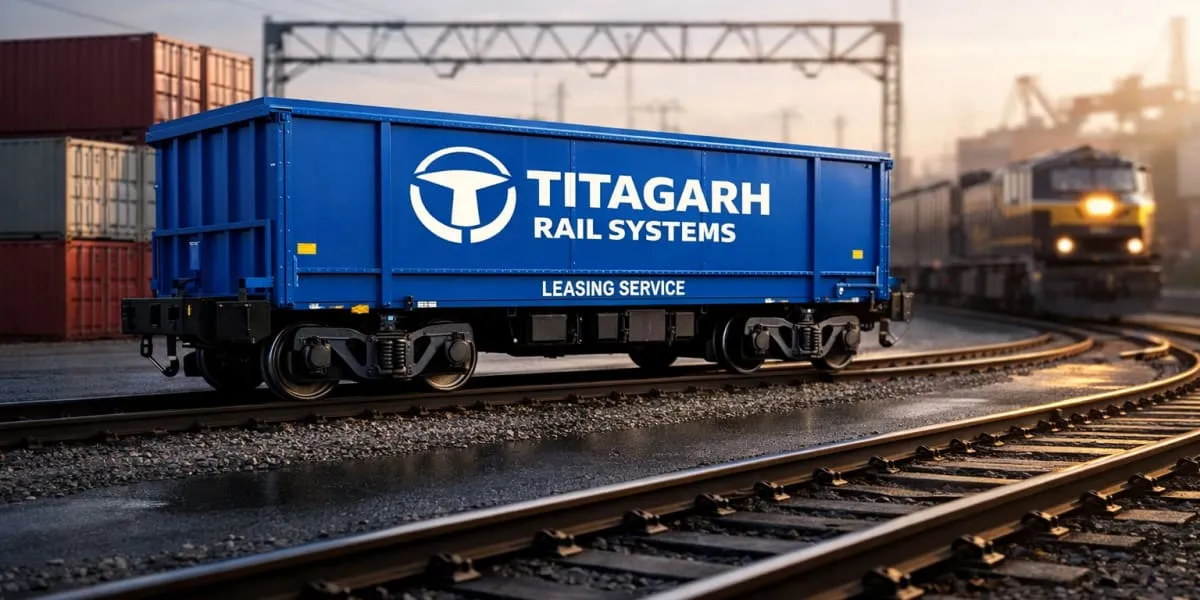
Titagarh Rail Systems has received formal approval from the national rail operator to operate as a wagon leasing company. The clearance allows the Kolkata-headquartered rolling stock manufacturer to expand its business model into leased freight wagons, supplying capacity to industrial and logistics customers. The development follows a regulatory process under which private entities obtain authorisation to offer wagon leasing services on the national network.

The move is expected to diversify Titagarh Rail Systems' revenue stream beyond manufacturing and maintenance services and to create recurring income from asset leasing. The company will be positioned to offer tailored leasing solutions that can reduce capital expenditure for shippers and enable faster deployment of wagon capacity. This may strengthen its aftermarket service offerings and long term client relationships.

For the freight sector, increased private leasing could improve fleet availability and operational flexibility by allowing demand driven deployment of wagons. Greater participation by private lessors may support a shift towards market oriented freight solutions and complement public sector capacity. This could be especially relevant for commodities and industrial supply chains that require predictable and dedicated wagon availability.

Commercial operations will require adherence to safety and maintenance norms set by the rail operator as well as compliance with technical standards for wagons and couplings. Titagarh Rail Systems will need to integrate its logistics, maintenance and regulatory functions to ensure uptime and reliability. Coordination with network operators and freight customers will be essential to manage scheduling and asset utilisation.

The approval may also prompt competitors and new entrants to evaluate wagon leasing as a viable business line, altering competitive dynamics in the rolling stock and logistics market. For investors and industry observers, the development signals a potential maturation of private participation in rail freight services. The company and its stakeholders will now focus on scaling leased assets and converting the regulatory nod into commercial traction.

Titagarh Rail Systems has received formal approval from the national rail operator to operate as a wagon leasing company. The clearance allows the Kolkata-headquartered rolling stock manufacturer to expand its business model into leased freight wagons, supplying capacity to industrial and logistics customers. The development follows a regulatory process under which private entities obtain authorisation to offer wagon leasing services on the national network. The move is expected to diversify Titagarh Rail Systems' revenue stream beyond manufacturing and maintenance services and to create recurring income from asset leasing. The company will be positioned to offer tailored leasing solutions that can reduce capital expenditure for shippers and enable faster deployment of wagon capacity. This may strengthen its aftermarket service offerings and long term client relationships. For the freight sector, increased private leasing could improve fleet availability and operational flexibility by allowing demand driven deployment of wagons. Greater participation by private lessors may support a shift towards market oriented freight solutions and complement public sector capacity. This could be especially relevant for commodities and industrial supply chains that require predictable and dedicated wagon availability. Commercial operations will require adherence to safety and maintenance norms set by the rail operator as well as compliance with technical standards for wagons and couplings. Titagarh Rail Systems will need to integrate its logistics, maintenance and regulatory functions to ensure uptime and reliability. Coordination with network operators and freight customers will be essential to manage scheduling and asset utilisation. The approval may also prompt competitors and new entrants to evaluate wagon leasing as a viable business line, altering competitive dynamics in the rolling stock and logistics market. For investors and industry observers, the development signals a potential maturation of private participation in rail freight services. The company and its stakeholders will now focus on scaling leased assets and converting the regulatory nod into commercial traction.

Related Stories

Gold Stories

Next Story
Infrastructure Urban

KONE Opens India's First Digital Experience Centre in Pune

KONE, a global elevator and escalator manufacturer, has inaugurated its first Digital Experience Centre (DEC) in India, located in Pune. The facility aims to showcase how artificial intelligence (AI), connectivity and data-driven technologies can enhance customer experiences and improve building operations.The centre was inaugurated by Jussi Herlin, Executive Vice Chair, KONE Corporation; Philippe Delorme, President and CEO, KONE; and Nandan Nilekani, Co-founder and Chairman of the Board, Infosys.Designed as an interactive customer environment, the facility demonstrates digital solutions cover..

Next Story
Infrastructure Urban

CII GreenCo Launches Circularity Guidelines for Indian Industry

The Confederation of Indian Industry (CII) GreenCo Council has launched the CII GreenCo Circularity Guidelines – Pilot Version at the 17th CII GreenCo Waste & Resource Management Summit 2026 in Chennai. The initiative aims to strengthen resource efficiency, waste reduction and circular economy practices across Indian manufacturing and process industries.The guidelines introduce a structured framework with circularity indices covering raw materials, consumables, packaging and other resource inputs. These indicators will help industries assess existing practices, identify opportunities to ..

Next Story
Infrastructure Energy

Global Electronics Association Launches IPC-1783-CO2E Standard

The Global Electronics Association has introduced IPC-1783-CO2E, a new international standard aimed at improving consistency, transparency and comparability in product carbon footprint reporting across the electronics manufacturing industry.The standard, titled International Standard for Data Collection and Reporting of CO2 Equivalent (CO2e) Emissions for the Electronics Manufacturing Supply Chain, provides industry-specific guidance for collecting, estimating and reporting carbon emissions data.With increasing regulatory requirements and customer expectations, electronics manufacturers face c..

Advertisement

Subscribe to Our Newsletter

Get daily newsletters around different themes from Construction world.

STAY CONNECTED

Advertisement

SPECIAL OFFER
QR Code