


+
TRAI Assesses Mobile Network Quality in Mumbai
ECONOMY & POLICY

TRAI Assesses Mobile Network Quality in Mumbai

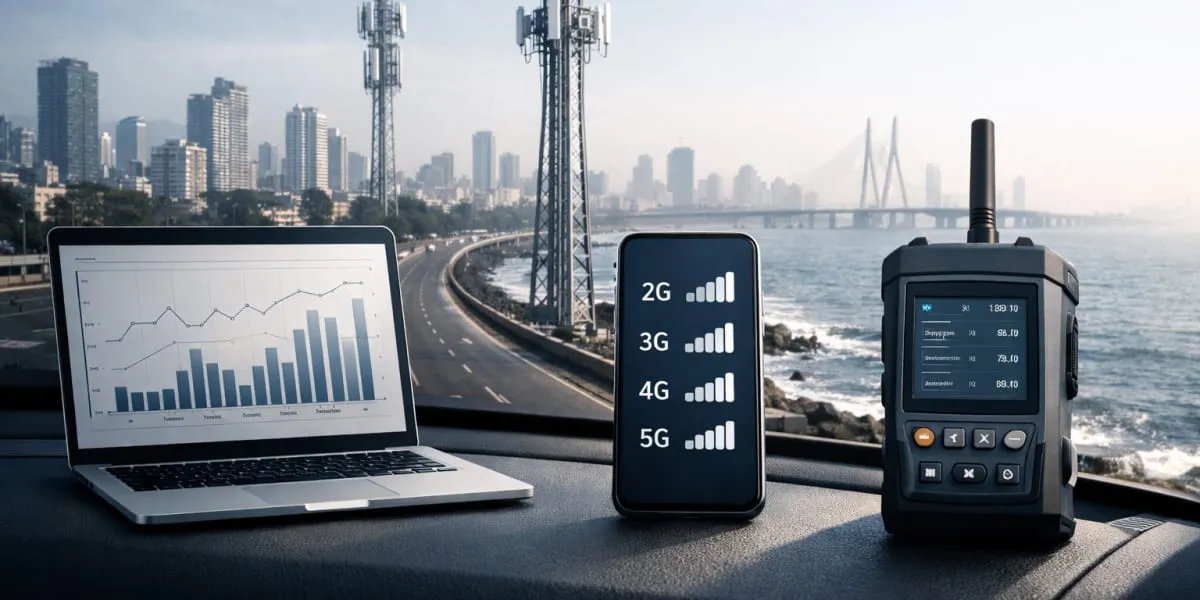
The Telecom Regulatory Authority of India (TRAI) released findings from its Independent Drive Test for the Mumbai Licensed Service Area (LSA) covering real?world mobile network performance during January 2026. The TRAI regional office in Bengaluru supervised tests across 214.8 km of routes, including 201.7 km of city driving, seven hotspots, a 3.7 km walk test and a 9.4 km coastal drive. Technologies evaluated comprised second generation, third generation, fourth generation and fifth generation cellular networks to reflect user experience across handset capabilities.

Key parameters assessed for voice included Call Setup Success Rate (CSSR), Drop Call Rate (DCR), Call Setup Time, Call Silence Rate and Mean Opinion Score (MOS) for speech quality, together with coverage. Data service parameters included download and upload throughput, latency, jitter, packet drop rate and video streaming delay. These measures were gathered across urban zones, institutional hotspots, public transport hubs and high?speed corridors to capture varied network behaviour.

The findings were intimated to all Telecom Service Providers (TSPs) for further action. In automatic selection mode across generations, Airtel, MTNL, RJIL and VIL recorded CSSR of 100 per cent, 20.77 per cent, 100 per cent and 100 per cent respectively. The corresponding DCR figures were 0.00 per cent, 45.34 per cent, 0.63 per cent and 0.00 per cent. Poor signal strength on the city route during voice testing was observed in 0.32 per cent, 71.31 per cent, 0.22 per cent and 0.33 per cent respectively.

During data testing the proportion of poor signal strength on the city route was 2.00 per cent, 71.43 per cent, 1.84 per cent and 1.26 per cent for the four operators, and on the coastal route it was 2.00 per cent, 96.71 per cent, 2.34 per cent and 0.80 per cent respectively. Walk tests focused on Airoli Railway Station, Kopar Khairane Railway Station and Rabale Railway Station and the coastal drive covered Atal Setu to Belapur Jetty. The tests used TRAI calibrated equipment and standardised protocols in real?time environments and the detailed report was made available on the TRAI website for stakeholders.

The Telecom Regulatory Authority of India (TRAI) released findings from its Independent Drive Test for the Mumbai Licensed Service Area (LSA) covering real?world mobile network performance during January 2026. The TRAI regional office in Bengaluru supervised tests across 214.8 km of routes, including 201.7 km of city driving, seven hotspots, a 3.7 km walk test and a 9.4 km coastal drive. Technologies evaluated comprised second generation, third generation, fourth generation and fifth generation cellular networks to reflect user experience across handset capabilities. Key parameters assessed for voice included Call Setup Success Rate (CSSR), Drop Call Rate (DCR), Call Setup Time, Call Silence Rate and Mean Opinion Score (MOS) for speech quality, together with coverage. Data service parameters included download and upload throughput, latency, jitter, packet drop rate and video streaming delay. These measures were gathered across urban zones, institutional hotspots, public transport hubs and high?speed corridors to capture varied network behaviour. The findings were intimated to all Telecom Service Providers (TSPs) for further action. In automatic selection mode across generations, Airtel, MTNL, RJIL and VIL recorded CSSR of 100 per cent, 20.77 per cent, 100 per cent and 100 per cent respectively. The corresponding DCR figures were 0.00 per cent, 45.34 per cent, 0.63 per cent and 0.00 per cent. Poor signal strength on the city route during voice testing was observed in 0.32 per cent, 71.31 per cent, 0.22 per cent and 0.33 per cent respectively. During data testing the proportion of poor signal strength on the city route was 2.00 per cent, 71.43 per cent, 1.84 per cent and 1.26 per cent for the four operators, and on the coastal route it was 2.00 per cent, 96.71 per cent, 2.34 per cent and 0.80 per cent respectively. Walk tests focused on Airoli Railway Station, Kopar Khairane Railway Station and Rabale Railway Station and the coastal drive covered Atal Setu to Belapur Jetty. The tests used TRAI calibrated equipment and standardised protocols in real?time environments and the detailed report was made available on the TRAI website for stakeholders.

Next Story
Infrastructure Urban

Implementation Status of Jal Jeevan Mission

Since August 2019 the Government has implemented Jal Jeevan Mission to provide assured potable water through household tap connections in rural India. At the start of the mission only 32.3 million (mn) rural households, representing 16.7 per cent, were reported to have tap water connections. States and union territories have reported that 125.8 mn additional rural households have since been provided with tap connections. As a result, of about 193.6 mn rural households roughly 158.2 mn, or 81.71 per cent, are reported to have tap water supply at home.\n\nThe State, district and village level st..

Next Story
Infrastructure Urban

Jal Jeevan Mission Reaches Eighty One Per Cent Rural Coverage

The Government reported substantial progress under the Jal Jeevan Mission, launched in August 2019 to provide tap water to every rural household. At launch only 32.3 million (mn) rural households had tap connections and states and Union territories reported provision of 125.8 mn additional households by March 2026. Consequently, out of about 193.6 mn rural households around 158.2 mn, or 81.71 per cent, are reported to have tap water at home. The Finance Minister announced extension of the mission until 2028 in the 2025-26 budget speech. The Swachh Bharat Mission Grameen, launched in October 20..

Next Story
Infrastructure Urban

Empowering Local Governance for Sustainable Rural Water Supply

The Ministry of Jal Shakti has aligned the Jal Jeevan Mission (JJM) with the 73rd Amendment to strengthen village level planning and community ownership of water supply. Gram Panchayats, village water and sanitation committees and Pani Samitis are to plan, implement, manage and maintain piped water systems, with gram sabha processes formalising handover and oversight. Implementation support agencies including non government organisations, community based organisations and self help groups have been empanelled to train local committees and promote women participation. Under JJM, the department ..

Advertisement

Subscribe to Our Newsletter

Get daily newsletters around different themes from Construction world.

STAY CONNECTED

Advertisement

Advertisement

Advertisement