+
Hyderabad Airport Handles 31 Million (mn), Eyes Transit Hub Push
AVIATION & AIRPORTS

Hyderabad Airport Handles 31 Million (mn), Eyes Transit Hub Push

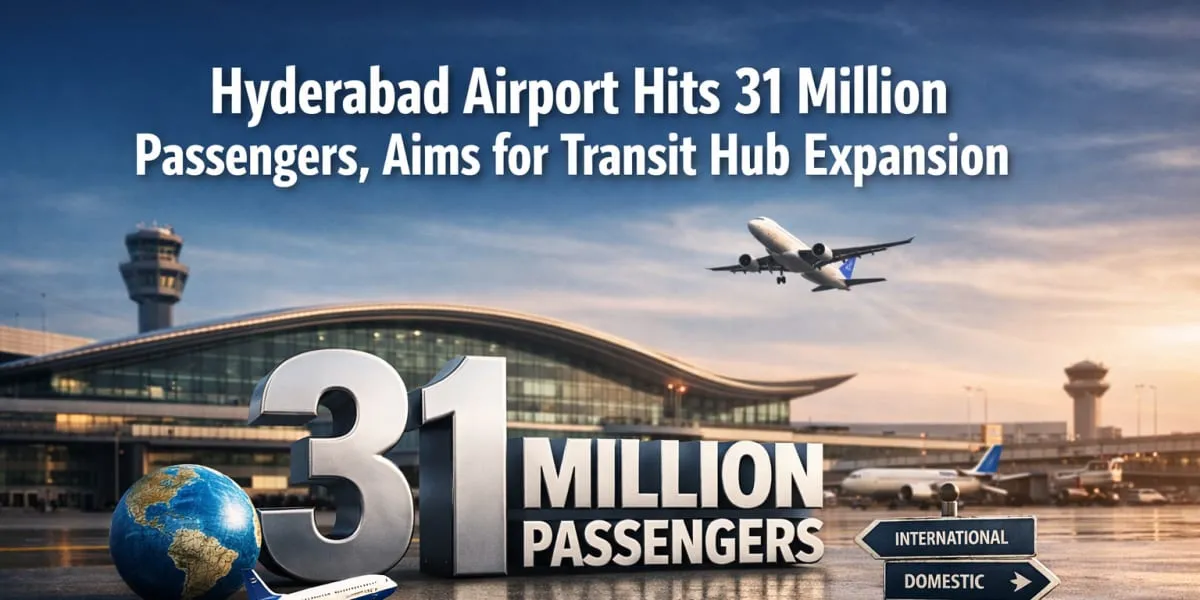
Hyderabad airport (HIA) handled 31 million (mn) passengers in 2025, marking a notable rise in traffic and reinforcing ambitions to develop into a regional transit hub. The airport management attributed the increase to expanded flight frequencies and higher connectivity across domestic and international routes. The figures were presented alongside plans to enhance transit services and streamline passenger flows.

Officials said that network expansion by carriers and improved slot utilisation contributed to the traffic growth, while ancillary services and ground handling improvements supported operational efficiency. Investment in terminal facilities and transport links was described as central to accommodating higher volumes. Airport authorities also noted a focus on seamless transfers to attract transit passengers.

To advance the transit hub push, the airport intends to prioritise dedicated transfer facilities, reduced connection times and partnerships with airlines to facilitate through bookings. Measures under consideration include optimising gate allocation, increasing transit lounges and enhancing baggage transfer systems. Emphasis was placed on creating a competitive proposition for carriers to route passengers via Hyderabad.

Stakeholders expect that growth in transit traffic would bolster the regional aviation ecosystem and support tourism and business travel. The airport's strategy is designed to balance passenger experience with operational resilience as volumes rise. Authorities highlighted the need for coordinated planning with state and central agencies to upgrade surface connectivity and utilities.

While specific investment figures were not disclosed, airport executives signalled that phased infrastructure upgrades would align with traffic forecasts and airline commitments. The airport will monitor passenger trends and adjust capacity plans to avoid congestion and maintain service standards. Continued collaboration with carriers and policymakers was identified as key to realising the transit hub objective.

Hyderabad airport (HIA) handled 31 million (mn) passengers in 2025, marking a notable rise in traffic and reinforcing ambitions to develop into a regional transit hub. The airport management attributed the increase to expanded flight frequencies and higher connectivity across domestic and international routes. The figures were presented alongside plans to enhance transit services and streamline passenger flows. Officials said that network expansion by carriers and improved slot utilisation contributed to the traffic growth, while ancillary services and ground handling improvements supported operational efficiency. Investment in terminal facilities and transport links was described as central to accommodating higher volumes. Airport authorities also noted a focus on seamless transfers to attract transit passengers. To advance the transit hub push, the airport intends to prioritise dedicated transfer facilities, reduced connection times and partnerships with airlines to facilitate through bookings. Measures under consideration include optimising gate allocation, increasing transit lounges and enhancing baggage transfer systems. Emphasis was placed on creating a competitive proposition for carriers to route passengers via Hyderabad. Stakeholders expect that growth in transit traffic would bolster the regional aviation ecosystem and support tourism and business travel. The airport's strategy is designed to balance passenger experience with operational resilience as volumes rise. Authorities highlighted the need for coordinated planning with state and central agencies to upgrade surface connectivity and utilities. While specific investment figures were not disclosed, airport executives signalled that phased infrastructure upgrades would align with traffic forecasts and airline commitments. The airport will monitor passenger trends and adjust capacity plans to avoid congestion and maintain service standards. Continued collaboration with carriers and policymakers was identified as key to realising the transit hub objective.

Next Story
Infrastructure Urban

IICA Constitutes High Level Advisory Group On Ease Of Doing Business

The Indian Institute of Corporate Affairs (IICA), functioning under the aegis of the Ministry of Corporate Affairs (MCA), has constituted a high level Advisory Group (AG) on ease of doing business under the chairmanship of Gyaneshwar Kumar Singh, Director General and Chief Executive Officer of IICA. The initiative follows the Ministry order dated 31 December 2025 and aligns with the Government of India vision of Viksit Bharat 2047 to foster a robust, transparent and competitive business ecosystem. The Advisory Group has been tasked to provide strategic guidance on simplifying corporate complia..

Next Story
Infrastructure Urban

IICA Renews MoU With NALSAR University Of Law

The Indian Institute of Corporate Affairs (IICA) has renewed a memorandum of understanding with NALSAR University of Law, Hyderabad (NALSAR) for five years to deepen academic collaboration and capacity building. The renewal was formalised in New Delhi with the agreement signed by Shri Gyaneshwar Kumar Singh, Director General and Chief Executive Officer of IICA, and Prof. Srikrishna Deva Rao, Vice-Chancellor of NALSAR University of Law. The ceremony included senior officials and faculty from both institutions. The collaboration will support faculty and student exchanges, joint research and publ..

Next Story
Technology

India To Champion Edge Artificial Intelligence Solutions

The Research Symposium on Artificial Intelligence (AI) and Its Impact convened on 18 February 2026 as part of the India AI Impact Summit 2026, bringing together leading researchers, policymakers, technologists and industry leaders. The event was designed to bridge frontier research and real\n\nworld application by examining how AI can drive scientific breakthroughs while remaining aligned with public interest, safety and inclusive growth. The programme included plenary keynotes, research dialogues on frontier questions, Global South panels and poster presentations by international researchers...

Advertisement

Subscribe to Our Newsletter

Get daily newsletters around different themes from Construction world.

STAY CONNECTED

Advertisement

Advertisement

Advertisement

Open In App