+
ICRA Sees Indian Aviation Losses Narrowing To Rs 110-120 Billion
AVIATION & AIRPORTS

ICRA Sees Indian Aviation Losses Narrowing To Rs 110-120 Billion

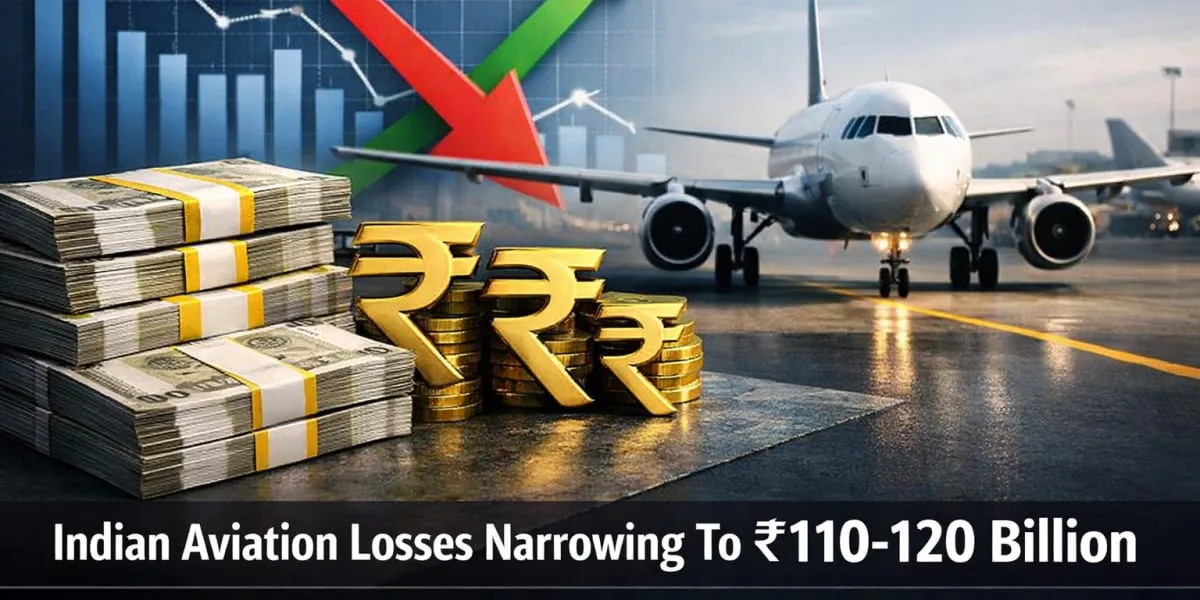
The ratings agency ICRA projected that the net loss of the Indian aviation industry will narrow to Rs 110-120 billion (bn) in 2026-27 as recovery in passenger demand continues. The agency attributed the improvement to sustained domestic traffic growth, higher flight operations and gradual recovery in yields amid capacity rationalisation. It indicated that financial stress will remain but will be materially lower than in prior years, and improved ancillary income streams supported cash flows.

ICRA noted that airlines have continued to benefit from robust leisure travel and the resumption of corporate movements, supporting load factors and revenue per seat. The agency observed that cost pressures from fuel and maintenance remain a challenge but could be moderated by operational efficiencies and network optimisation. It expected that ancillary revenue and calibrated capacity additions would help strengthen airline balance sheets, operating discipline and yield management were highlighted as near-term priorities and careful network planning ahead.

Analysts at the ratings firm emphasised that policy support and improved liquidity in the financial system were important to sustain the recovery and reduce default risk in the sector. They suggested that disciplined capacity growth and focus on unit economics would be crucial for translating traffic gains into profitability. The assessment reflected a cautious optimism that industry losses would shrink while profitability would return for some carriers. The firm said slower demand shocks would test resilience but noted sectoral adaptability.

ICRA recommended continued monitoring of global crude oil trends, interest rate movements and possible demand shocks that could alter the recovery path. The agency urged stakeholders to maintain prudence in fleet expansion and maintain cash buffers to absorb unforeseen shocks. Overall, the projection signalled a notable improvement for the Indian aviation industry in the coming financial year. Market participants were advised to prioritise liquidity management and contingency planning.

The ratings agency ICRA projected that the net loss of the Indian aviation industry will narrow to Rs 110-120 billion (bn) in 2026-27 as recovery in passenger demand continues. The agency attributed the improvement to sustained domestic traffic growth, higher flight operations and gradual recovery in yields amid capacity rationalisation. It indicated that financial stress will remain but will be materially lower than in prior years, and improved ancillary income streams supported cash flows. ICRA noted that airlines have continued to benefit from robust leisure travel and the resumption of corporate movements, supporting load factors and revenue per seat. The agency observed that cost pressures from fuel and maintenance remain a challenge but could be moderated by operational efficiencies and network optimisation. It expected that ancillary revenue and calibrated capacity additions would help strengthen airline balance sheets, operating discipline and yield management were highlighted as near-term priorities and careful network planning ahead. Analysts at the ratings firm emphasised that policy support and improved liquidity in the financial system were important to sustain the recovery and reduce default risk in the sector. They suggested that disciplined capacity growth and focus on unit economics would be crucial for translating traffic gains into profitability. The assessment reflected a cautious optimism that industry losses would shrink while profitability would return for some carriers. The firm said slower demand shocks would test resilience but noted sectoral adaptability. ICRA recommended continued monitoring of global crude oil trends, interest rate movements and possible demand shocks that could alter the recovery path. The agency urged stakeholders to maintain prudence in fleet expansion and maintain cash buffers to absorb unforeseen shocks. Overall, the projection signalled a notable improvement for the Indian aviation industry in the coming financial year. Market participants were advised to prioritise liquidity management and contingency planning.

Next Story
Infrastructure Urban

We’ve cut 50,000 tonnes of carbon emmissions since 2019

MatchLog is challenging a decades-old logistics norm and empty container miles by directly matching import flows with export demand. Indeed, the platform is unlocking measurable cost savings, cutting emissions and driving structural change in landside operations. Dhruv Taneja, Founder and Global CEO, outlines the quantified impact, adoption  journey and the evolving future of container reuse in an exclusive interview with Construction World. MatchLog has partnered with carriers such as Maersk, ONE and HMM in India. Could you share quantified outcomes from one specific corri..

Next Story
Infrastructure Transport

Airports: Capacity is Key

A lotus-inspired terminal design in Navi Mumbai International Airport. A terminal in a garden in Bengaluru’s Kempegowda International Airport. A peacock-inspired canopy in Chhatrapati Shivaji Maharaj International Airport. A nature-inspired terminal in Guwahati’s Lokpriya Gopinath Bordoloi International Airport.Truly, “India’s airports are no longer constrained by architectural ambition,” avers Ravikanth Mididhodi, Chief Technical Officer, J&F, a German-based engineering firm with over 25 years of global legacy in delivering advanced engineering and BIM services for air..

Next Story
Real Estate

In 2025, Amaravati attracted ₹ 28,075 crore in investments

In an exclusive interview with Construction World, Kanna Babu, IAS, Commissioner, Andhra Pradesh Capital Region Development Authority (APCRDA), reveals how Amaravati is entering a decisive new phase of capital city development. With 36 MoUs worth ₹ 45,589 crore, a ₹ 58,000 crore tender pipeline, and rising institutional investments, he explains the strategic execution, infrastructure rollout, and governance framework driving Amaravati’s emergence as a structured, investment-ready, and future-focused capital.APCRDA has recently secured major financial tie-ups, including loans from NA..

Advertisement

Subscribe to Our Newsletter

Get daily newsletters around different themes from Construction world.

STAY CONNECTED

Advertisement

Advertisement

Advertisement

Open In App