Rs 9.52 Billion Elevated Corridor Launched in Bhubaneswar
AVIATION & AIRPORTS

Rs 9.52 Billion Elevated Corridor Launched in Bhubaneswar

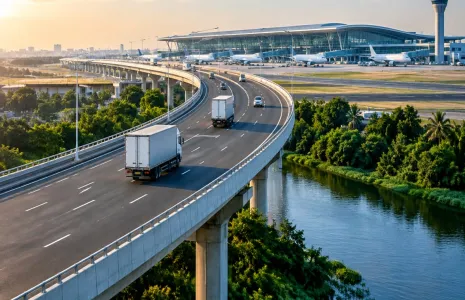
In a major boost to road and traffic infrastructure in the state capital, Mohan Charan Majhi on Monday laid the foundation stone for an elevated corridor project worth Rs 9.52 billion, connecting Jayadev Vihar with Nandankanan in Bhubaneswar.

The 9.5 km-long elevated corridor will link Kalinga Stadium with Raghunathpur and has gained importance after the state government decided to put the proposed metro project for this stretch on hold due to revisions to the detailed project report. The new road corridor is expected to serve as a critical alternative to improve traffic flow along one of the city’s busiest arterial routes.

Majhi said the elevated corridor would be a significant infrastructure upgrade for Bhubaneswar and support its evolution into a futuristic, metropolitan city. He added that the project would ensure seamless traffic movement and improve connectivity to key locations.

The corridor will be integrated with multiple flyovers to enhance access to major junctions such as Kalinga Hospital Square and Damana Square. Planned roundabouts at major intersections are expected to further smoothen vehicular movement. The chief minister also said similar road network projects are being planned for other parts of the city.

Works minister Prithiviraj Harichandan said emphasis would be placed on timely completion of the project. Officials confirmed that the project will be executed by Odisha Bridge and Construction Corporation Limited, with an initial construction timeline of two years.

According to project details, the corridor aligns with Bhubaneswar’s Comprehensive Development Plan 2030. It will start near Gate No. 4 of Kalinga Stadium and terminate at the Raghunathpur bridge. Once completed, the existing six-lane road will be upgraded to an eight-lane configuration to increase capacity and ease congestion.

The project also includes 5.5-metre-wide service roads on both sides, with a combined length of around 17.5 km, and 7.5-metre-wide slip roads extending about 9 km. Four-lane flyovers are planned at Kalinga Hospital Square, Damana Square, KIIT Square and Kalarahanga, along with grade-separated junctions.

In addition, a four-lane, 190-metre cable-stayed bridge is proposed at the Jayadev Vihar junction on National Highway 16, designed to serve as an architectural landmark. Grade roundabouts are planned at nine locations, including Jayadev Vihar, XIMB Square, Care Hospital Junction, Infocity Square, Sishu Vihar Junction, KIIT Square and Kalarahanga Junction.

In a major boost to road and traffic infrastructure in the state capital, Mohan Charan Majhi on Monday laid the foundation stone for an elevated corridor project worth Rs 9.52 billion, connecting Jayadev Vihar with Nandankanan in Bhubaneswar. The 9.5 km-long elevated corridor will link Kalinga Stadium with Raghunathpur and has gained importance after the state government decided to put the proposed metro project for this stretch on hold due to revisions to the detailed project report. The new road corridor is expected to serve as a critical alternative to improve traffic flow along one of the city’s busiest arterial routes. Majhi said the elevated corridor would be a significant infrastructure upgrade for Bhubaneswar and support its evolution into a futuristic, metropolitan city. He added that the project would ensure seamless traffic movement and improve connectivity to key locations. The corridor will be integrated with multiple flyovers to enhance access to major junctions such as Kalinga Hospital Square and Damana Square. Planned roundabouts at major intersections are expected to further smoothen vehicular movement. The chief minister also said similar road network projects are being planned for other parts of the city. Works minister Prithiviraj Harichandan said emphasis would be placed on timely completion of the project. Officials confirmed that the project will be executed by Odisha Bridge and Construction Corporation Limited, with an initial construction timeline of two years. According to project details, the corridor aligns with Bhubaneswar’s Comprehensive Development Plan 2030. It will start near Gate No. 4 of Kalinga Stadium and terminate at the Raghunathpur bridge. Once completed, the existing six-lane road will be upgraded to an eight-lane configuration to increase capacity and ease congestion. The project also includes 5.5-metre-wide service roads on both sides, with a combined length of around 17.5 km, and 7.5-metre-wide slip roads extending about 9 km. Four-lane flyovers are planned at Kalinga Hospital Square, Damana Square, KIIT Square and Kalarahanga, along with grade-separated junctions. In addition, a four-lane, 190-metre cable-stayed bridge is proposed at the Jayadev Vihar junction on National Highway 16, designed to serve as an architectural landmark. Grade roundabouts are planned at nine locations, including Jayadev Vihar, XIMB Square, Care Hospital Junction, Infocity Square, Sishu Vihar Junction, KIIT Square and Kalarahanga Junction.

Next Story
Infrastructure Urban

Implementation Status of Jal Jeevan Mission

Since August 2019 the Government has implemented Jal Jeevan Mission to provide assured potable water through household tap connections in rural India. At the start of the mission only 32.3 million (mn) rural households, representing 16.7 per cent, were reported to have tap water connections. States and union territories have reported that 125.8 mn additional rural households have since been provided with tap connections. As a result, of about 193.6 mn rural households roughly 158.2 mn, or 81.71 per cent, are reported to have tap water supply at home.\n\nThe State, district and village level st..

Next Story
Infrastructure Urban

Jal Jeevan Mission Reaches Eighty One Per Cent Rural Coverage

The Government reported substantial progress under the Jal Jeevan Mission, launched in August 2019 to provide tap water to every rural household. At launch only 32.3 million (mn) rural households had tap connections and states and Union territories reported provision of 125.8 mn additional households by March 2026. Consequently, out of about 193.6 mn rural households around 158.2 mn, or 81.71 per cent, are reported to have tap water at home. The Finance Minister announced extension of the mission until 2028 in the 2025-26 budget speech. The Swachh Bharat Mission Grameen, launched in October 20..

Next Story
Infrastructure Urban

Empowering Local Governance for Sustainable Rural Water Supply

The Ministry of Jal Shakti has aligned the Jal Jeevan Mission (JJM) with the 73rd Amendment to strengthen village level planning and community ownership of water supply. Gram Panchayats, village water and sanitation committees and Pani Samitis are to plan, implement, manage and maintain piped water systems, with gram sabha processes formalising handover and oversight. Implementation support agencies including non government organisations, community based organisations and self help groups have been empanelled to train local committees and promote women participation. Under JJM, the department ..

Advertisement

Subscribe to Our Newsletter

Get daily newsletters around different themes from Construction world.

STAY CONNECTED

Advertisement

Advertisement

Advertisement