+
UP govt okays ph 2 land acquisition for Noida airport
AVIATION & AIRPORTS

UP govt okays ph 2 land acquisition for Noida airport

The Uttar Pradesh government has approved a proposal for the acquisition of another 1,365 hectares of land in Jewar for the second phase of the upcoming Noida International Airport, also known as Jewar Airport.

Earlier, in a proposal to the state government, the Noida district administration had said it would need to acquire 1,365 hectares for the expansion of the airport, of which 1,185 hectares is private land.

The Noida administration had prepared a Rs 2,890 crore budget to acquire land from seven villages for the second phase of the Noida International Airport. The cabinet has approved the proposal for the land acquisition, besides resettlement and rehabilitation of the people who will be affected by the expansion of the greenfield project.

The seven villages where land would be acquired are Mundhera, Nangla Shahpur, Berampur, Karauli Bangar, Kureb, Dayanatpur and Ranhera.

The Noida administration has also decided to offer incentives to the families who need to be rehabilitated because of the project. Special camps will be set up at the Jewar tehsil, where officials will approve the building plans and layouts of the houses of the displaced families.

According to officials, work is currently underway for the first phase of development of the Noida International Airport Limited (NIAL) in the Jewar area of Gautam Buddh Nagar district in western Uttar Pradesh.

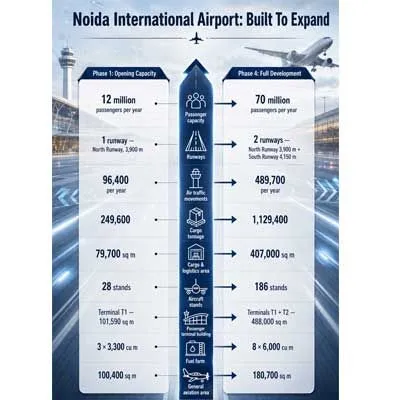
The greenfield airport is being developed in four phases and billed to be the biggest when completed with five or six runways spread in an area of 5,000 hectares, officials told media sources.

The first phase of the project is coming up on over 1,300 hectare land, and commercial operations from the airport are expected to begin by December 2023 or January 2024, they said.

Swiss-developer Zurich International Airport AG is developing the Jewar airport at an estimated cost of Rs 29,560 crore.

As we have reported earlier, late last month, UP government had sanctioned Rs 4,000 crore for land acquisition for the second phase of the airport. Subsequently, last week, Noida Authority had prepared a budget for Rs 2,890 crore for the land acquisition.

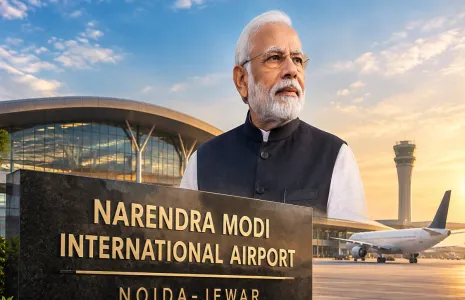
Image Source


The Uttar Pradesh government has approved a proposal for the acquisition of another 1,365 hectares of land in Jewar for the second phase of the upcoming Noida International Airport, also known as Jewar Airport. Earlier, in a proposal to the state government, the Noida district administration had said it would need to acquire 1,365 hectares for the expansion of the airport, of which 1,185 hectares is private land. The Noida administration had prepared a Rs 2,890 crore budget to acquire land from seven villages for the second phase of the Noida International Airport. The cabinet has approved the proposal for the land acquisition, besides resettlement and rehabilitation of the people who will be affected by the expansion of the greenfield project. The seven villages where land would be acquired are Mundhera, Nangla Shahpur, Berampur, Karauli Bangar, Kureb, Dayanatpur and Ranhera. The Noida administration has also decided to offer incentives to the families who need to be rehabilitated because of the project. Special camps will be set up at the Jewar tehsil, where officials will approve the building plans and layouts of the houses of the displaced families. According to officials, work is currently underway for the first phase of development of the Noida International Airport Limited (NIAL) in the Jewar area of Gautam Buddh Nagar district in western Uttar Pradesh. The greenfield airport is being developed in four phases and billed to be the biggest when completed with five or six runways spread in an area of 5,000 hectares, officials told media sources. The first phase of the project is coming up on over 1,300 hectare land, and commercial operations from the airport are expected to begin by December 2023 or January 2024, they said. Swiss-developer Zurich International Airport AG is developing the Jewar airport at an estimated cost of Rs 29,560 crore. As we have reported earlier, late last month, UP government had sanctioned Rs 4,000 crore for land acquisition for the second phase of the airport. Subsequently, last week, Noida Authority had prepared a budget for Rs 2,890 crore for the land acquisition. Image Source

Next Story
Real Estate

Hindware Introduces Starc Smart Wall Mount Toilet

Hindware has introduced the Starc Smart Wall-Mount Toilet under its Hindware Italian Collection, designed to combine automation, hygiene and contemporary bathroom aesthetics. The model features automatic flushing, sensor-based seat opening and closing, and remote-controlled functions. It also includes an oscillating water spray and warm air dryer for cleaning, along with a self-cleaning nozzle designed to maintain hygiene. Additional features include adjustable heated seating, customisable water temperature and pressure settings, a foot-touch flush system and an LCD control interface. The wa..

Next Story
Equipment

Company showcases North America-certified machinery and secures new deals

Zoomlion Heavy Industry Science & Technology Co., recently showcased a wide portfolio of North America-certified and customised construction equipment at CONEXPO-CON/AGG 2026 in Las Vegas. The display included engineering hoisting machinery, concrete equipment, earthmoving machinery, mining equipment and construction hoisting solutions tailored to regional operational requirements.All equipment presented at the exhibition complies with North American certification standards, with several models specifically developed to meet local regulatory requirements and site conditions. One of the hig..

Next Story
Technology

Sinoboom Launches Dual-ETM Smart Technology

Sinoboom recently introduced its Dual-ETM Smart Technology at CONEXPO-CON/AGG 2026, designed to enhance battery endurance and operational efficiency in electric boom lifts.The new technology integrates advanced components that enable real-time optimisation of power usage during equipment operation. By calculating the precise power requirement instantly, the system delivers only the energy needed for each movement, reducing the inefficiencies associated with conventional maximum-demand power systems.The solution incorporates multiple sensors—including pressure, weight, length and level sensor..

Advertisement

Subscribe to Our Newsletter

Get daily newsletters around different themes from Construction world.

STAY CONNECTED

Advertisement

Advertisement

Advertisement