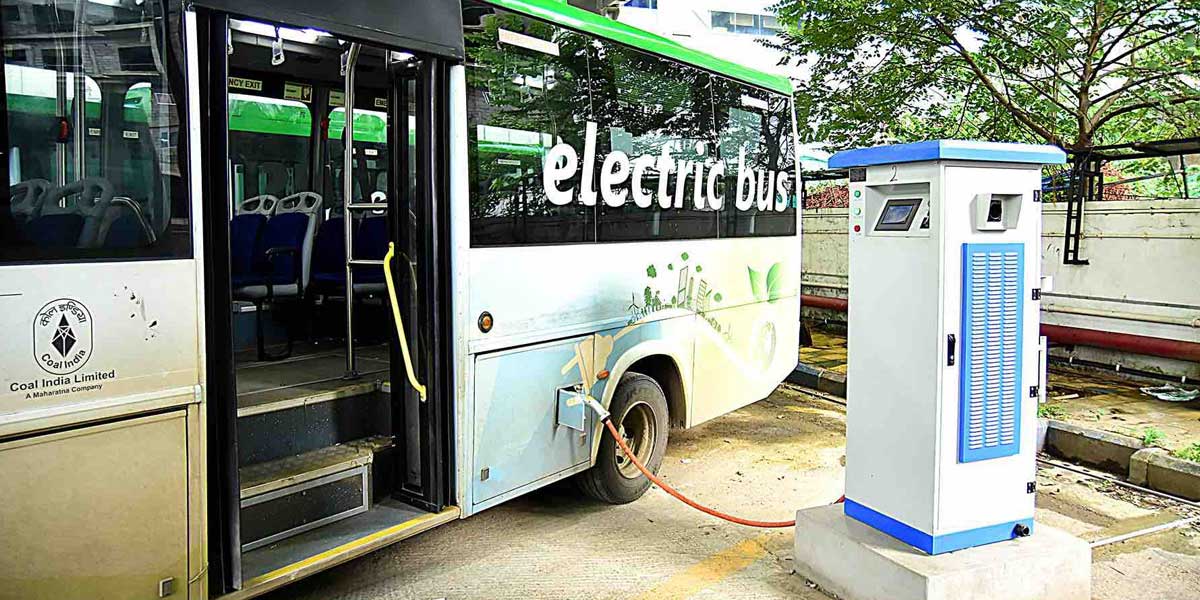
EESL arm, WRI join hands to promote e-buses across India
ROADS & HIGHWAYS

EESL arm, WRI join hands to promote e-buses across India

As the move towards more sustainable mobility gathers momentum, Convergence Energy Services Ltd (CESL), a subsidiary of Energy Efficiency Services Ltd (EESL), together with the World Resources Institute India (WRI), has been contemplating ways to speed up the deployment of 50,000 electric buses in the country to have them in place by 2030.

The Grand Challenge tender comprises demand for electric buses across five major Indian cities – Kolkata, Delhi, Bangalore, Hyderabad and Surat. And the prices realised set a benchmark for public transport, the price point for which may encourage even the smaller cities to adopt electric vehicles.

The rationale behind the move is not just about being environment friendly, Mahua Acharya, MD & CEO, CESL. He insisted on the practicality of the ‘mobility-as-a-service’ business model. Indicating the lowest-ever prices being up to 27% cheaper than diesel-based buses, she explained, “State transport undertakings benefit more from bigger tender buckets as that allows for lower price discovery for procurement and operation of electric buses in India.”

The State Transport segment has been reeling under severe fund shortages and Acharya said the need of the hour is to get in massive capital to bring about a transition to electric buses. She was speaking at the curtain raiser for INSIGHT 2022 on Twitter Spaces along with WRI India CEO O P Agarwal and World Bank Land Transport Specialist Gerald Ollivier about how green financing might spark a sustainable public transportation system in India.

Acharya pointed out that public mobility financing schemes need a different approach. There is a need to bring different financing schemes on board – corporate financing, and structured financing, that can cater to the demand and provide well-suited services, she added.

See also:
Framework for drone procurement underway
Govt to provide incentive under PLI scheme


As the move towards more sustainable mobility gathers momentum, Convergence Energy Services Ltd (CESL), a subsidiary of Energy Efficiency Services Ltd (EESL), together with the World Resources Institute India (WRI), has been contemplating ways to speed up the deployment of 50,000 electric buses in the country to have them in place by 2030. The Grand Challenge tender comprises demand for electric buses across five major Indian cities – Kolkata, Delhi, Bangalore, Hyderabad and Surat. And the prices realised set a benchmark for public transport, the price point for which may encourage even the smaller cities to adopt electric vehicles. The rationale behind the move is not just about being environment friendly, Mahua Acharya, MD & CEO, CESL. He insisted on the practicality of the ‘mobility-as-a-service’ business model. Indicating the lowest-ever prices being up to 27% cheaper than diesel-based buses, she explained, “State transport undertakings benefit more from bigger tender buckets as that allows for lower price discovery for procurement and operation of electric buses in India.” The State Transport segment has been reeling under severe fund shortages and Acharya said the need of the hour is to get in massive capital to bring about a transition to electric buses. She was speaking at the curtain raiser for INSIGHT 2022 on Twitter Spaces along with WRI India CEO O P Agarwal and World Bank Land Transport Specialist Gerald Ollivier about how green financing might spark a sustainable public transportation system in India. Acharya pointed out that public mobility financing schemes need a different approach. There is a need to bring different financing schemes on board – corporate financing, and structured financing, that can cater to the demand and provide well-suited services, she added. See also: Framework for drone procurement underwayGovt to provide incentive under PLI scheme

Related Stories

Gold Stories

Next Story
Resources

Schindler named among Forbes’ World’s Best Employers 2026

Schindler has been named among Forbes’ World’s Best Employers 2026, a global ranking recognising companies for their workplace environments.Compiled by Forbes in partnership with Statista, the ranking is based on independent employee feedback, including whether employees would recommend their organisation to friends and family.The company said the recognition reflected its focus on creating a workplace where employees can develop their expertise and build careers. ..
Next Story
Infrastructure Urban

India needs an export-execution mindset: Vishesh Jain

Interview with Vishesh Jain, Founder & CEO, EximpleWhat gaps in India’s global trade ecosystem led you to build Eximple, and what problem did you see businesses struggling with most?Eximple came out of a problem that all three founders had seen from different choke points in the trade ecosystem. India has millions of MSMEs and manufacturers, and many of them can make products that are genuinely competitive on quality. Yet only a small fraction is able to build meaningful international businesses. In our experience, the gap is usually not manufacturing capability; it is the ability to exe..

Next Story
Building Material

Nuvoco reports 13.5% revenue growth in Q2 FY27

Nuvoco Vistas Corp. Ltd. reported consolidated revenue of Rs 27.9 billion for Q2 FY27, up 13.5% year on year. Cement sales volume rose 9% to 4.7 million tonnes (MMT), while EBITDA increased 11% to Rs 4.11 billion.The company said it began its cement operations in 2014 with a 2.3 MMT per annum (MMTPA) operation at Nimbol. It now aims to reach 35 MMTPA of cement capacity by FY28, nearly 15 times its initial capacity. Its portfolio spans cement, ready-mix concrete and modern building materials.On sustainability and cost efficiency, Nuvoco partnered with CleanMax for a 46.4 MW wind-solar hybrid re..

Advertisement

Subscribe to Our Newsletter

Get daily newsletters around different themes from Construction world.

STAY CONNECTED

Advertisement

SPECIAL OFFER
QR Code