Gadkari Announces 30 GHz Band for Vehicle-to-Vehicle Safety Tech
ROADS & HIGHWAYS

Gadkari Announces 30 GHz Band for Vehicle-to-Vehicle Safety Tech

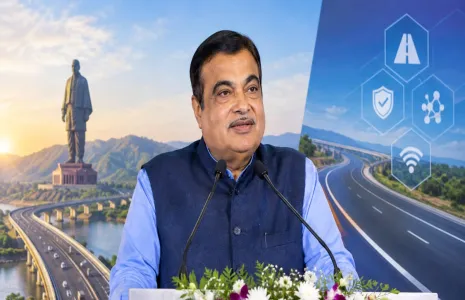
The Consultative Committee of the Ministry of Road Transport & Highways (MoRTH), chaired by Nitin Gadkari, recently reviewed measures to reduce road accidents and fatalities, emphasising a coordinated, multi-pronged road safety strategy. Ministers of State Harsh Malhotra and Ajay Tamta were also present at the meeting.

The discussions focused on strengthening interventions across the four pillars of road safety—engineering, enforcement, education and emergency care. The Chairman of National Highways Authority of India briefed members on ongoing initiatives to improve safety on national highways, followed by a presentation from the Additional Secretary (Transport) highlighting progress, challenges and the need for new interventions. The Secretary, Road Transport & Highways, also outlined the development of AI-enabled road safety technologies in collaboration with IIT Kanpur.

Committee members expressed concern over the persistently high number of road accidents and fatalities and called for a comprehensive approach combining better engineering, public awareness and stronger enforcement. Key issues raised included rectification of black spots, widening of select highway stretches, availability of trauma care facilities, enhancement of compensation for accident victims, road maintenance, and improved coordination with state governments. Suggestions were also made to identify landslide-prone locations on the lines of black spots, improve road markings and signage, include road safety in school curricula, establish a Centre for Road Safety, and ensure at least one trauma centre in each district.

Responding to the deliberations, the Union Minister informed the Committee that the Department of Telecommunications has allocated the 30 GHz radio frequency band for the development of vehicle-to-vehicle communication systems. He said this technology would play a critical role in reducing road accidents and fatalities by enabling real-time communication between vehicles.

The Minister added that road safety considerations are being integrated into Detailed Project Reports and directed regional officers and project directors of MoRTH and NHAI to participate regularly in district-level road safety committee meetings. He also stated that AI-based road safety applications would be shared with states and union territories for wider adoption.

During the meeting, the Minister showcased the Road Safety Anthem, now translated into 22 regional languages, and urged members of parliament to promote its use in schools and public forums. Reiterating the Government’s commitment to saving lives, he called upon all stakeholders to continue dedicated efforts towards building safer road infrastructure across the country.

The Consultative Committee of the Ministry of Road Transport & Highways (MoRTH), chaired by Nitin Gadkari, recently reviewed measures to reduce road accidents and fatalities, emphasising a coordinated, multi-pronged road safety strategy. Ministers of State Harsh Malhotra and Ajay Tamta were also present at the meeting. The discussions focused on strengthening interventions across the four pillars of road safety—engineering, enforcement, education and emergency care. The Chairman of National Highways Authority of India briefed members on ongoing initiatives to improve safety on national highways, followed by a presentation from the Additional Secretary (Transport) highlighting progress, challenges and the need for new interventions. The Secretary, Road Transport & Highways, also outlined the development of AI-enabled road safety technologies in collaboration with IIT Kanpur. Committee members expressed concern over the persistently high number of road accidents and fatalities and called for a comprehensive approach combining better engineering, public awareness and stronger enforcement. Key issues raised included rectification of black spots, widening of select highway stretches, availability of trauma care facilities, enhancement of compensation for accident victims, road maintenance, and improved coordination with state governments. Suggestions were also made to identify landslide-prone locations on the lines of black spots, improve road markings and signage, include road safety in school curricula, establish a Centre for Road Safety, and ensure at least one trauma centre in each district. Responding to the deliberations, the Union Minister informed the Committee that the Department of Telecommunications has allocated the 30 GHz radio frequency band for the development of vehicle-to-vehicle communication systems. He said this technology would play a critical role in reducing road accidents and fatalities by enabling real-time communication between vehicles. The Minister added that road safety considerations are being integrated into Detailed Project Reports and directed regional officers and project directors of MoRTH and NHAI to participate regularly in district-level road safety committee meetings. He also stated that AI-based road safety applications would be shared with states and union territories for wider adoption. During the meeting, the Minister showcased the Road Safety Anthem, now translated into 22 regional languages, and urged members of parliament to promote its use in schools and public forums. Reiterating the Government’s commitment to saving lives, he called upon all stakeholders to continue dedicated efforts towards building safer road infrastructure across the country.

Next Story
Equipment

Going Higher

The year 2026 got off to a sorry start for the elevator industry with a 31-year-old security guard crushed to death when a lift collapsed on him in a Mulund East (Mumbai) housing society, and two boys, aged 11, grievously injured by falling into a lift duct when the third floor lift door in their Goregaon (Mumbai) building gave way. Faulty door-lock wiring and poor maintenance by the vendor are most probably behind these tragic accidents.No month goes by without a fatal elevator accident in some city across India. CW asks why?Regulatory gaps For starters, “regulations should be lif..

Next Story
Infrastructure Transport

Amrit Kaal or Asphault Illusion

Massive spending, inflated metrics, systemic delays and deep-rooted corruption now threaten the credibility of India’s highway expansion, observes  LT GEN RAJEEV CHAUDHRY (Retd), former DG Border Roads.India is spending more on national highways than ever before. With Rs 2.72 lakh crore earmarked for FY 2025–26 and ambitious targets under the Amrit Kaal vision, the narrative is one of speed, scale and transformation. Yet, beneath the headline numbers lies an uncomfortable reality: highways that crack under monsoons, projects that spiral into delays and arbitration, and a system where ..

Next Story
Infrastructure Transport

Executing 37,000 Crore Road Projects With Speed And Accountability

With Rs.37,000 crore worth of road projects under execution across Maharashtra, Maharashtra State Infrastructure Development Corporation (MSIDC) is driving one of the state’s largest infrastructure programmes. Dr Brijesh Dixit, Managing Director, discusses the institutional reforms, execution frameworks, financing strategies and technology adoption enabling timely, high-quality delivery, in conversation with PRATAP PADODE, Editor-in-Chief, CW.With over Rs.37,000 crore worth of road projects underway across districts – many under tight timelines – what institutional and executio..

Advertisement

Subscribe to Our Newsletter

Get daily newsletters around different themes from Construction world.

STAY CONNECTED

Advertisement

Advertisement

Advertisement

Advertisement

Open In App