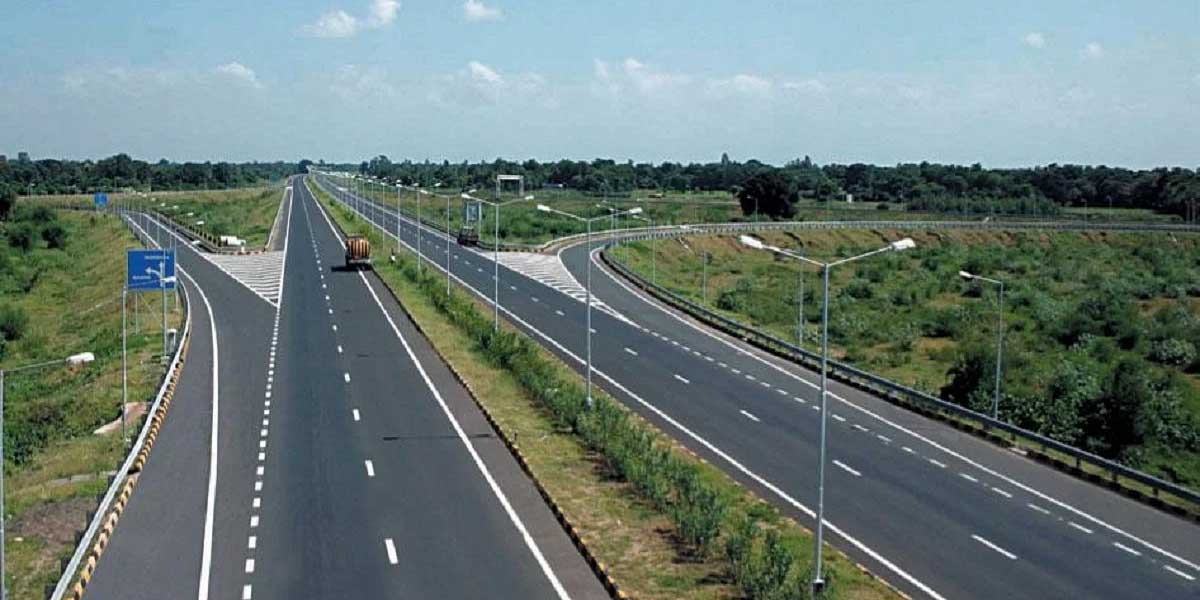
Government plans to build 45 km of roads each day in FY24
ROADS & HIGHWAYS

Government plans to build 45 km of roads each day in FY24

Despite the possibility of a worldwide economic slowdown, India is expected to speed up highway construction this fiscal year, building the longest road ever in a single year.

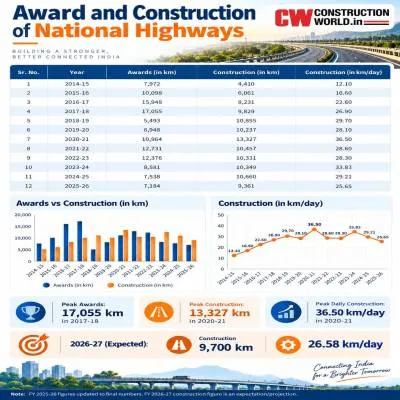
Internally, the MoRTH (minister of roads, transport, and highways) has set a target of building at least 45 km of highways each day this year. This ambitious goal was set in response to the failure to complete the planned amount of road building over the previous two fiscal years, despite having completed a record 13,298 km (36.4 km/day) during the pandemic-hit year of 2020–2021. The pace then reduced to around 29 km in FY22, and it is anticipated that it would stay that way in FY23.

According to data available through February, road construction will pick up speed in the current fiscal year as awards of roads have significantly improved recently. Many projects that were close to completion will also soon be operational, particularly in the Union territories of Jammu & Kashmir and Ladakh. If unfavourable weather conditions do not hinder construction this year, record numbers of roadways will open in FY24.

The official target may be slightly lower than the government's stated goal of 45 km per day of construction, more in line with the 12,200 km actually completed last year, as delays in clearances, land acquisition, and rising input costs could impede some unprofitable road projects with unattractive traffic projections for investors.

However, officials claimed that 45 Km was a realistic goal and that additional work may have really been completed in FY24.

Highway work has been ordered to go more quickly, and any obstacles have been asked to be removed. The ministry is also anticipated to organise a number of high-level inter-ministerial conferences with state government representatives to address project-related difficulties and start work right away.

In order to complete the backlogged road projects, the national government increased MoRTH's financial allocation by 36% to Rs 2.7 lakh crore.

See also:
42 km/day of NH construction, highest in FY23
Budget 2023: A 25% increase in funding for road construction


Despite the possibility of a worldwide economic slowdown, India is expected to speed up highway construction this fiscal year, building the longest road ever in a single year. Internally, the MoRTH (minister of roads, transport, and highways) has set a target of building at least 45 km of highways each day this year. This ambitious goal was set in response to the failure to complete the planned amount of road building over the previous two fiscal years, despite having completed a record 13,298 km (36.4 km/day) during the pandemic-hit year of 2020–2021. The pace then reduced to around 29 km in FY22, and it is anticipated that it would stay that way in FY23. According to data available through February, road construction will pick up speed in the current fiscal year as awards of roads have significantly improved recently. Many projects that were close to completion will also soon be operational, particularly in the Union territories of Jammu & Kashmir and Ladakh. If unfavourable weather conditions do not hinder construction this year, record numbers of roadways will open in FY24. The official target may be slightly lower than the government's stated goal of 45 km per day of construction, more in line with the 12,200 km actually completed last year, as delays in clearances, land acquisition, and rising input costs could impede some unprofitable road projects with unattractive traffic projections for investors. However, officials claimed that 45 Km was a realistic goal and that additional work may have really been completed in FY24. Highway work has been ordered to go more quickly, and any obstacles have been asked to be removed. The ministry is also anticipated to organise a number of high-level inter-ministerial conferences with state government representatives to address project-related difficulties and start work right away. In order to complete the backlogged road projects, the national government increased MoRTH's financial allocation by 36% to Rs 2.7 lakh crore. See also: 42 km/day of NH construction, highest in FY23 Budget 2023: A 25% increase in funding for road construction

Next Story
Real Estate

RBI Rate Cut Boosts Confidence Across Housing Market

Industry Context and Market DynamicsThe real estate industry has welcomed the RBI’s rate cut as a timely boost to affordability and demand. With home prices having risen steadily across major markets, even a marginal reduction in interest rates meaningfully strengthens purchasing power, especially for first-time and mid-income buyers.Ashish Jerath, President – Sales & Marketing, Smartworld Developers, observes:“The RBI’s 25-basis-point cut, bringing the repo rate down to 5.25%, is a timely boost for the real estate sector. Lower interest rates reduce borrowing costs, enabling homeb..

Next Story
Infrastructure Transport

BMC Resumes Rs 170 Billion Road Works, Targets 80 per cent By Jan 2026

Following the withdrawal of the southwest monsoon in October, the Brihanmumbai Municipal Corporation (BMC) has restarted work on 645 roads—covering 297.49 kilometres—under its large-scale concretisation programme. Data shows that more than 60 per cent of the resumed works are located in the western suburbs. Officials said the civic body aims to complete concretisation on 80 per cent of the roads where fresh work has begun by January 2026. Launched in 2022, the Rs 170 billion project seeks to concretise 700 kilometres of roads across Mumbai. All civil works were halted during the monsoon ..

Next Story
Infrastructure Urban

India Pushes Digital Shift In Urban Land Mapping

The Department of Land Resources (DoLR) under the Ministry of Rural Development has convened a National Symposium on NAKSHA – the National Geospatial Knowledge-based Land Survey of Urban Habitations – to advance India’s transition to modern, technology-driven land mapping. Speaking at the inaugural session, Secretary Manoj Joshi underscored the urgent need to move revenue departments away from outdated, tape-based methods and rough hand-drawn sketches. He stressed that adopting latitude–longitude-based digital mapping and GIS-linked registration systems is essential for economic stabi..

Advertisement

Subscribe to Our Newsletter

Get daily newsletters around different themes from Construction world.

STAY CONNECTED

Advertisement

Advertisement

Advertisement

Advertisement

Open In App