MoRTH aims highway construction milestone amidst Bharatmala Progress
ROADS & HIGHWAYS

MoRTH aims highway construction milestone amidst Bharatmala Progress

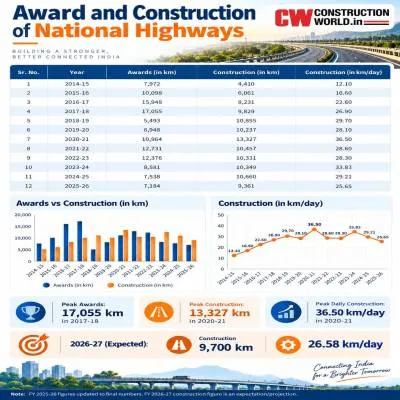
During the initial seven months of the current fiscal year, official data reveals that the rate of national highway construction in the country reached 20.78 kilometres per day. The Ministry of Road Transport and Highways (MoRTH) has devised plans to sustain this development pace, aiming to construct 12,500 kilometres of highways in the fiscal year 2023-24.

According to MoRTH's monthly summary for the Cabinet in October 2023, the project award figure for this period is 2,595 kilometres, a decrease from the 5,007 kilometres awarded in the previous year. However, the ministry has successfully built 4,474 kilometres of national highways up to October in 2023-24, surpassing the 4,060 kilometres constructed up to October in 2022-23.

In the 2019-20 financial year, the ministry achieved the construction of 10,237 kilometres of national highways, followed by 13,327 kilometres in 2020-21 and 10,457 kilometres in 2021-22.

To meet the annual award target, MoRTH emphasises the need for prompt decision-making on the approval of the revised Bharatmala Phase-1 or an alternate program. The ministry warns that a shortfall in awards this year will impact the progress of construction in the fiscal year 2024-25.

The Bharatmala Pariyojana, India's largest highway infrastructure program, aims to develop 34,800 kilometres of national highway corridors with an investment of Rs 5.35 trillion. Phase 1 of the program focuses on the development of approximately 24,800 kilometres of national highway networks, including economic corridors, inter-corridor and feeder roads, efficiency improvements for national corridors, border and international connectivity roads, coastal and port connectivity roads, expressways, and 10,000 kilometres of roads under the balance National Highway Development Project (NHDP).

During the initial seven months of the current fiscal year, official data reveals that the rate of national highway construction in the country reached 20.78 kilometres per day. The Ministry of Road Transport and Highways (MoRTH) has devised plans to sustain this development pace, aiming to construct 12,500 kilometres of highways in the fiscal year 2023-24. According to MoRTH's monthly summary for the Cabinet in October 2023, the project award figure for this period is 2,595 kilometres, a decrease from the 5,007 kilometres awarded in the previous year. However, the ministry has successfully built 4,474 kilometres of national highways up to October in 2023-24, surpassing the 4,060 kilometres constructed up to October in 2022-23. In the 2019-20 financial year, the ministry achieved the construction of 10,237 kilometres of national highways, followed by 13,327 kilometres in 2020-21 and 10,457 kilometres in 2021-22. To meet the annual award target, MoRTH emphasises the need for prompt decision-making on the approval of the revised Bharatmala Phase-1 or an alternate program. The ministry warns that a shortfall in awards this year will impact the progress of construction in the fiscal year 2024-25. The Bharatmala Pariyojana, India's largest highway infrastructure program, aims to develop 34,800 kilometres of national highway corridors with an investment of Rs 5.35 trillion. Phase 1 of the program focuses on the development of approximately 24,800 kilometres of national highway networks, including economic corridors, inter-corridor and feeder roads, efficiency improvements for national corridors, border and international connectivity roads, coastal and port connectivity roads, expressways, and 10,000 kilometres of roads under the balance National Highway Development Project (NHDP).

Next Story
Infrastructure Urban

India Expands Semiconductor Training To 500 Institutions

Under the Chips to Startups programme of the India Semiconductor Mission, the Union minister responsible for Railways, Information and Broadcasting, and Electronics and IT reported notable progress in talent development. He indicated that over the past four years substantial steps have been taken towards a 10-year target of training 85,000 engineers in semiconductor design. World-class EDA tools have been deployed in 315 academic institutions across the country to provide students with practical exposure to chip design. These EDA tools are supported by leading global firms and are accessible t..

Next Story
Infrastructure Urban

Delhi Institutions Support India Semiconductor Mission

The Government of India has prioritised talent development through training, upskilling and workforce development under the Chips to Startups initiative of the India Semiconductor Mission, with officials noting progress in four years towards a 10-year target of training 85,000 engineers in semiconductor design. Electronic design automation tools provided by Synopsys, Cadence, Siemens, Renesas, Ansys and AMD have been deployed in 315 academic institutions, enabling students to gain practical chip design experience. Chips have been fabricated and tested at the Semiconductor Laboratory, Mohali, a..

Next Story
Infrastructure Urban

NHA Announces Winners Of NHCX Hackathon At IIT Hyderabad

The National Health Authority (NHA) has concluded the NHCX Hackathon under the Ayushman Bharat Digital Mission (ABDM) to stimulate innovation around the National Health Claims Exchange (NHCX). The winning teams presented their solutions at the NHCX Innovation Meet held at IIT Hyderabad during a two-day event in March 2026 that also served as the hackathon grand finale. The hackathon itself ran from 22 to 28 February 2026 and aimed to accelerate paperless, transparent claims processing across India. The event was organised with a range of ecosystem partners, including the Insurance Regulatory a..

Advertisement

Subscribe to Our Newsletter

Get daily newsletters around different themes from Construction world.

STAY CONNECTED

Advertisement

Advertisement

Advertisement