




NHAI Launches Bee Corridor Along NH-16 In Odisha
ROADS & HIGHWAYS

NHAI Launches Bee Corridor Along NH-16 In Odisha

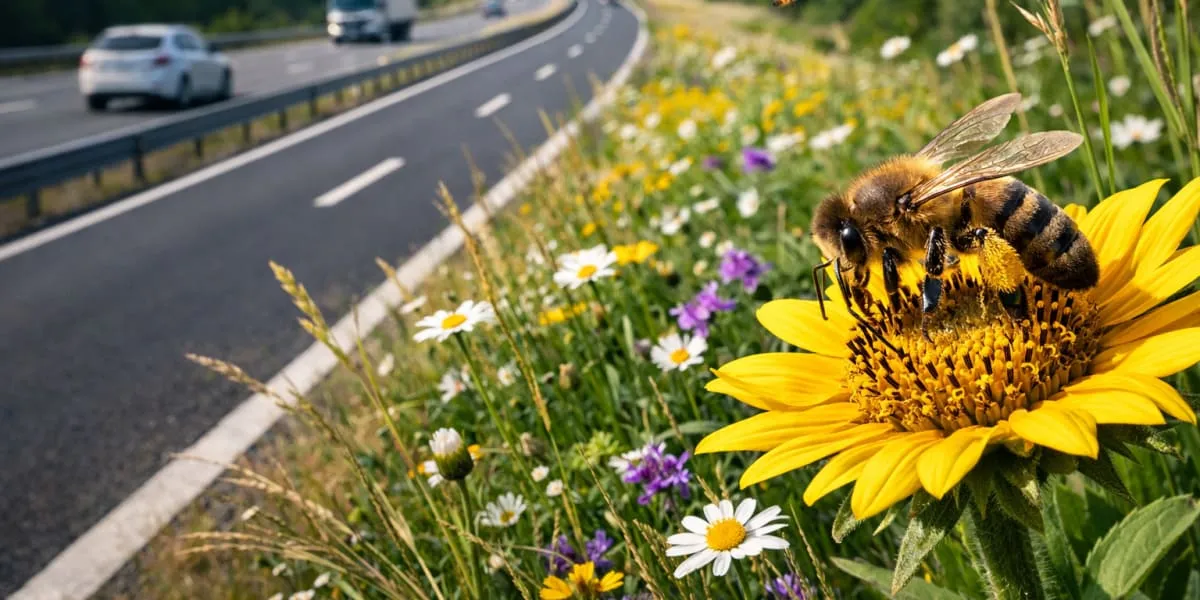
The National Highways Authority of India (NHAI) has launched a Bee Corridor along the Puintola–Ichchapuram stretch of National Highway-16 (NH-16) in Odisha as part of an effort to integrate biodiversity conservation with highway infrastructure. The initiative aims to create a pollinator-friendly ecosystem to support honeybee populations and other pollinating insects that contribute to ecological balance and agricultural productivity. The project reflects NHAI's drive to incorporate environmental sustainability into road development.

It was inaugurated by the NHAI regional officer for Odisha, Pradeep Kumar Lal, in the presence of Bhubaneswar Project Implementation Unit (PIU) project director Suraj Kumar Singh, and is being implemented in partnership with the concessionaire Puintola Ichchapuram TOT Private Limited. NHAI officials said the Bee Corridor has been designed to restore and strengthen habitats for honeybees and other pollinating insects. The scheme is described as contributing to roadside greenery while supporting agricultural productivity.

As part of the first phase, 345 saplings have been planted along the Tangi–Ichchapuram section of NH-16, chosen from nectar and pollen rich species such as Jamun, Neem, Drumstick (Moringa) and Gulmohar to provide a reliable food source for pollinators. Officials indicated plantation activities have begun in Sambalpur and Dhenkanal and that NHAI plans to plant nearly 20,000 flowering trees along highway stretches in Sambalpur, Berhampur and Dhenkanal. The planting is intended to enhance roadside green cover and create habitat corridors linking fragmented natural areas.

The next phase will include a diverse mix of native and flowering species, including Neem, Karanj, Arjun, Kadamba, Jamun, Tamarind and Kanchan, selected to ensure staggered flowering throughout the year. Such sequencing is expected to provide a continuous source of nectar and pollen and to sustain honeybee populations and other beneficial insects. Once fully established the Bee Corridor is expected to improve roadside biodiversity, increase green cover and contribute to healthier ecosystems. NHAI officials suggested the scheme could serve as a model for pollinator friendly highway development in other parts of the country.

"Join industry leaders at RAHSTA Expo, India's premier platform for roads, highways and traffic infrastructure. Register now to explore innovations, network with experts and shape the future of mobility."

The National Highways Authority of India (NHAI) has launched a Bee Corridor along the Puintola–Ichchapuram stretch of National Highway-16 (NH-16) in Odisha as part of an effort to integrate biodiversity conservation with highway infrastructure. The initiative aims to create a pollinator-friendly ecosystem to support honeybee populations and other pollinating insects that contribute to ecological balance and agricultural productivity. The project reflects NHAI's drive to incorporate environmental sustainability into road development. It was inaugurated by the NHAI regional officer for Odisha, Pradeep Kumar Lal, in the presence of Bhubaneswar Project Implementation Unit (PIU) project director Suraj Kumar Singh, and is being implemented in partnership with the concessionaire Puintola Ichchapuram TOT Private Limited. NHAI officials said the Bee Corridor has been designed to restore and strengthen habitats for honeybees and other pollinating insects. The scheme is described as contributing to roadside greenery while supporting agricultural productivity. As part of the first phase, 345 saplings have been planted along the Tangi–Ichchapuram section of NH-16, chosen from nectar and pollen rich species such as Jamun, Neem, Drumstick (Moringa) and Gulmohar to provide a reliable food source for pollinators. Officials indicated plantation activities have begun in Sambalpur and Dhenkanal and that NHAI plans to plant nearly 20,000 flowering trees along highway stretches in Sambalpur, Berhampur and Dhenkanal. The planting is intended to enhance roadside green cover and create habitat corridors linking fragmented natural areas. The next phase will include a diverse mix of native and flowering species, including Neem, Karanj, Arjun, Kadamba, Jamun, Tamarind and Kanchan, selected to ensure staggered flowering throughout the year. Such sequencing is expected to provide a continuous source of nectar and pollen and to sustain honeybee populations and other beneficial insects. Once fully established the Bee Corridor is expected to improve roadside biodiversity, increase green cover and contribute to healthier ecosystems. NHAI officials suggested the scheme could serve as a model for pollinator friendly highway development in other parts of the country.

Next Story
Infrastructure Energy

Hexa Climate Signs 100 MW Wind Solar PPA With CESC

Hexa Climate has signed a power purchase agreement with CESC Limited for the supply of 100 megawatt (MW) of Interstate Transmission System (ISTS) connected wind-solar hybrid power, at a tariff of Rs three point seven five per kWh fixed for 25 years. The contracted capacity is 100 MW while the installation will include 50 MW of solar and 100 MW of wind to enable hybrid generation from a site in Mandsaur, Madhya Pradesh. The tariff has been adopted by the West Bengal Electricity Regulatory Commission, providing regulatory assent for the long term arrangement. The agreement was secured through CE..

Next Story
Infrastructure Energy

JUWI Tops One GW Under Construction As Solar Portfolio Exceeds 900 MW

Renewable energy developer JUWI has reached a milestone of one gigawatt (GW) of renewable capacity under simultaneous construction across its global portfolio, reflecting expansion in solar and wind sectors. The firm said it is installing around 1.3 million (mn) solar modules across 12 photovoltaic (PV) projects and is constructing 46 wind turbines with a combined capacity of about 270 megawatt (MW). Overall, nearly one GW of additional capacity is expected to be commissioned in the coming months. Module installation has begun at the Trifylli solar park in northern Greece, part of the 156 MW C..

Next Story
Infrastructure Energy

MNRE Clarifies ALMM List-II Rules For Government Rooftop Solar

The Ministry of New and Renewable Energy issued a memorandum dated 6 July 2026 clarifying implementation of the Approved List of Models and Manufacturers (ALMM) List-II requirements for solar photovoltaic (PV) cells in rooftop solar projects on government buildings. The clarification restated that ALMM List-I covers solar PV modules while ALMM List-II applies to solar PV cells and that the framework seeks to promote the use of domestically manufactured equipment. The mandatory application of List-II had been scheduled from 1 June 2026, but industry representations prompted the ministry to spec..

Advertisement

Subscribe to Our Newsletter

Get daily newsletters around different themes from Construction world.

STAY CONNECTED

Advertisement

Advertisement

Advertisement