NHAI Uses In-House AI To Flag Highway Project Issues
ROADS & HIGHWAYS

NHAI Uses In-House AI To Flag Highway Project Issues

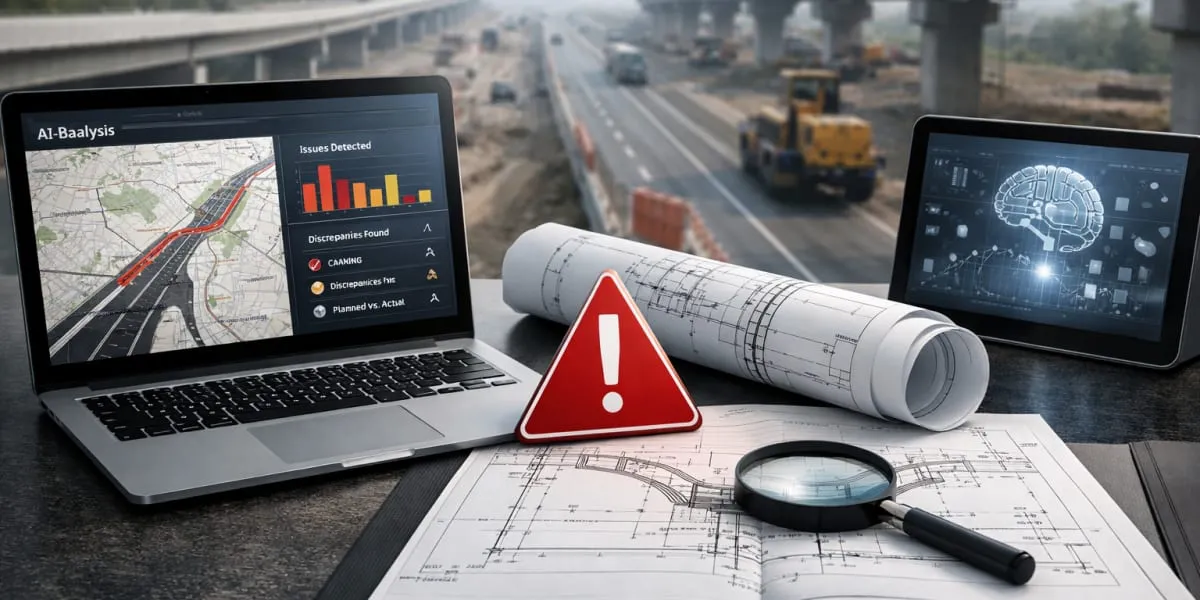
The National Highways Authority of India (NHAI) has deployed an in-house artificial intelligence (AI) system to detect discrepancies in detailed project reports (DPRs), verify site conditions and flag issues before they cause delays or cost overruns. The Technical Schedule Analyzer compares DPR data with technical standards, policy provisions and a repository of field data to identify inconsistencies in planning.

NHAI said the Analyzer currently examines Schedule B and Schedule C sections to check quantities and specifications against Indian Roads Congress codes, Ministry of Road Transport and Highways norms and NHAI standards. The authority indicated the tool aims to reduce planning omissions that can produce large cost variations, noting that in a Rs 20 billion (Rs 20 bn) project variations of about Rs 2 bn to Rs 3 bn may arise.

Officials said the system will draw data from drone surveys, network survey vehicle records, geospatial information, monthly progress reports and site photographs to verify whether plans match ground conditions. It is part of an AI ecosystem built by the authority's AI Cell and complements Margsarthi, the in-house AI assistant trained on circulars, Acts, codes and approved technical documents.

Margsarthi, launched in April, has handled more than 50,000 queries from around 1,100 users across the organisation, with each response linked to source documents so officers can verify recommendations. Access is already available to officers nationwide and is planned to be extended to authority and independent engineers associated with projects.

Officials said the applications are intended to assist rather than replace decision-making and that accountability for project decisions will remain with officers. The authority described a multidisciplinary effort involving civil and AI engineers and design specialists to digitise manuals and standards into a structured repository. Work under development includes automated defect analysis, maintenance planning and AI-assisted drawing reviews.

The National Highways Authority of India (NHAI) has deployed an in-house artificial intelligence (AI) system to detect discrepancies in detailed project reports (DPRs), verify site conditions and flag issues before they cause delays or cost overruns. The Technical Schedule Analyzer compares DPR data with technical standards, policy provisions and a repository of field data to identify inconsistencies in planning. NHAI said the Analyzer currently examines Schedule B and Schedule C sections to check quantities and specifications against Indian Roads Congress codes, Ministry of Road Transport and Highways norms and NHAI standards. The authority indicated the tool aims to reduce planning omissions that can produce large cost variations, noting that in a Rs 20 billion (Rs 20 bn) project variations of about Rs 2 bn to Rs 3 bn may arise. Officials said the system will draw data from drone surveys, network survey vehicle records, geospatial information, monthly progress reports and site photographs to verify whether plans match ground conditions. It is part of an AI ecosystem built by the authority's AI Cell and complements Margsarthi, the in-house AI assistant trained on circulars, Acts, codes and approved technical documents. Margsarthi, launched in April, has handled more than 50,000 queries from around 1,100 users across the organisation, with each response linked to source documents so officers can verify recommendations. Access is already available to officers nationwide and is planned to be extended to authority and independent engineers associated with projects. Officials said the applications are intended to assist rather than replace decision-making and that accountability for project decisions will remain with officers. The authority described a multidisciplinary effort involving civil and AI engineers and design specialists to digitise manuals and standards into a structured repository. Work under development includes automated defect analysis, maintenance planning and AI-assisted drawing reviews.

Next Story
Infrastructure Transport

Surya Roshni delivers customised lighting for NCRTC RRTS stations

Surya Roshni has supplied customised indoor lighting solutions for 18 elevated stations on the National Capital Region Transport Corporation's (NCRTC) Rapid Rail Transit System (RRTS), strengthening its presence in India's infrastructure lighting segment.The project involved the design and deployment of lighting systems for platforms, concourses, foot overbridges (FOBs) and back-of-house (BOH) areas. According to the company, the luminaires were developed specifically to meet NCRTC's design, operational and performance requirements rather than using standard products.Surya introduced two custo..

Next Story
Real Estate

Hilton debuts Tapestry Collection brand in Vietnam

Hilton has opened NHAAN Resort & Spa Hoi An, Tapestry Collection by Hilton, marking the debut of the Tapestry Collection brand in Vietnam and expanding its lifestyle hospitality portfolio in Southeast Asia.Located along the Co Co River in Cam Thanh village, the 174-key resort provides access to Hoi An Ancient Town, Cua Dai Beach and the Cam Thanh Nipa Forest. The property has been designed by Vietnamese architect Vo Trong Nghia, incorporating biophilic architecture, locally sourced materials and riverfront landscapes.The resort offers a mix of guest rooms and suites, including family-frien..

Next Story
Building Material

Electrent expands lithium energy storage system portfolio

Electrent Energy has expanded its lithium-based energy storage portfolio with the launch of the ESS 850 and ESS 1050, targeting compact and maintenance-free power backup solutions for Indian homes.The new systems integrate a Home UPS and a LiFePO4 lithium battery into a single unit, extending the company's product range following the launch of its ESS 1350 and ESS 2500 models.Designed for apartments and smaller homes, the ESS 850 provides up to 1 hour 15 minutes of backup, while the ESS 1050 offers up to 1 hour 45 minutes on a typical 400 W household load. The systems can power essential appli..

Advertisement

Subscribe to Our Newsletter

Get daily newsletters around different themes from Construction world.

STAY CONNECTED

Advertisement

Advertisement

Advertisement