Panvel-Borivli-Vasai Corridor Gets Green Signal to Boost Connectivity
ROADS & HIGHWAYS

Panvel-Borivli-Vasai Corridor Gets Green Signal to Boost Connectivity

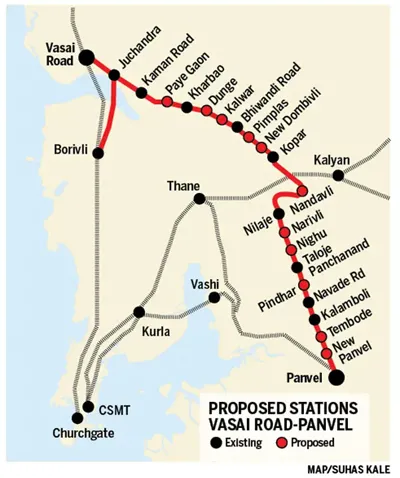
After years of anticipation and repeated delays, the long-awaited Panvel-Borivli-Vasai local train corridor — a transformative Central Railway-Western Railway (CR-WR) connector — is set to materialise. The new 69.23-kilometre independent suburban corridor, part of the Mumbai Urban Transport Project (MUTP) III-B, promises to revolutionise commuting for thousands of Panvel residents who currently must change trains at Kurla or Wadala on the Harbour Line to continue their journey.

The project, with a revised completion cost of Rs 12.71 billion, will feature a dedicated suburban corridor with connections at both ends — Borivli and Virar — at Vasai. Officials from the Mumbai Railway Vikas Corporation (MRVC) confirmed that the initiative will enhance east-west connectivity by integrating Panvel with Mumbai’s western suburbs and beyond. “It will be a two-pronged line linking both the Borivli and Vasai ends. The proposal has already been approved by the Maharashtra government’s Cabinet Committee on Infrastructure,” a senior official noted.

The existing Panvel-Diva-Vasai line will remain unchanged, while this corridor will function independently, similar to the Panvel-Karjat model, allowing seamless travel without the need for transfers. The broader MUTP III-B initiative, which also includes the third line between Badlapur and Karjat (32.46 km at a cost of Rs 1.33 billion) and the fourth line between Asangaon and Kasara (34.97 km at Rs 872 million), carries a total budget of Rs 14.91 billion.

“Changing trains at Kurla during peak hours is a nightmare. This corridor will save us time and energy,” said commuter Mr Ravindra Patil. Designed to bypass congested junctions, the corridor will provide a direct link that could cut travel times significantly. “Though completion will take some time, the approval marks a new era for Mumbai’s suburban rail network. It is a major step towards easing the pressure on existing lines and improving accessibility to northern parts of the Mumbai Metropolitan Region (MMR),” added a senior official.

Voices from Commuters and Experts

Mr Rajiv Singal, member of the Western Railway Mumbai’s Divisional Railway Users’ Consultative Committee, stated, “This will boost the entire region, especially Bhiwandi — the Manchester of India. I have been advocating this for the last two decades.”

Mr Shailesh Goyal, former member of the National Railway Users Consultative Committee, remarked, “The new Vasai-Panvel suburban corridor will offer great convenience to passengers from western suburbs travelling to Goa and Pune from Panvel. It will also be extremely beneficial for powerloom industry workers in Bhiwandi.”


After years of anticipation and repeated delays, the long-awaited Panvel-Borivli-Vasai local train corridor — a transformative Central Railway-Western Railway (CR-WR) connector — is set to materialise. The new 69.23-kilometre independent suburban corridor, part of the Mumbai Urban Transport Project (MUTP) III-B, promises to revolutionise commuting for thousands of Panvel residents who currently must change trains at Kurla or Wadala on the Harbour Line to continue their journey.The project, with a revised completion cost of Rs 12.71 billion, will feature a dedicated suburban corridor with connections at both ends — Borivli and Virar — at Vasai. Officials from the Mumbai Railway Vikas Corporation (MRVC) confirmed that the initiative will enhance east-west connectivity by integrating Panvel with Mumbai’s western suburbs and beyond. “It will be a two-pronged line linking both the Borivli and Vasai ends. The proposal has already been approved by the Maharashtra government’s Cabinet Committee on Infrastructure,” a senior official noted.The existing Panvel-Diva-Vasai line will remain unchanged, while this corridor will function independently, similar to the Panvel-Karjat model, allowing seamless travel without the need for transfers. The broader MUTP III-B initiative, which also includes the third line between Badlapur and Karjat (32.46 km at a cost of Rs 1.33 billion) and the fourth line between Asangaon and Kasara (34.97 km at Rs 872 million), carries a total budget of Rs 14.91 billion.“Changing trains at Kurla during peak hours is a nightmare. This corridor will save us time and energy,” said commuter Mr Ravindra Patil. Designed to bypass congested junctions, the corridor will provide a direct link that could cut travel times significantly. “Though completion will take some time, the approval marks a new era for Mumbai’s suburban rail network. It is a major step towards easing the pressure on existing lines and improving accessibility to northern parts of the Mumbai Metropolitan Region (MMR),” added a senior official.Voices from Commuters and ExpertsMr Rajiv Singal, member of the Western Railway Mumbai’s Divisional Railway Users’ Consultative Committee, stated, “This will boost the entire region, especially Bhiwandi — the Manchester of India. I have been advocating this for the last two decades.”Mr Shailesh Goyal, former member of the National Railway Users Consultative Committee, remarked, “The new Vasai-Panvel suburban corridor will offer great convenience to passengers from western suburbs travelling to Goa and Pune from Panvel. It will also be extremely beneficial for powerloom industry workers in Bhiwandi.”

Next Story
Infrastructure Energy

Vedanta Aluminium Uses 1.57 bn Units of Green Energy in FY25

Vedanta Aluminium, India’s largest aluminium producer, recently reported consumption of 1.57 billion units of renewable energy in FY25, marking a significant milestone in its 2030 decarbonisation roadmap. The company also achieved an 8.96 per cent reduction in greenhouse gas (GHG) emissions intensity compared to FY21, reinforcing its leadership in India’s low-carbon manufacturing transition. During FY25, Vedanta Aluminium expanded its renewable energy portfolio through long-term power purchase agreements, strengthening its strategy to source nearly 1,500 MW of renewable power over the lon..

Next Story
Real Estate

Oberoi Group to Develop Luxury Resort at Makaibari Tea Estate

EIH Limited, the flagship company of The Oberoi Group, has announced the signing of a management agreement to develop an Oberoi luxury resort at the iconic Makaibari Tea Estate in Darjeeling. The project marks a key milestone in the Group’s long-term strategy of creating distinctive hospitality experiences in rare and environmentally significant locations. Established in 1859, Makaibari is one of the world’s oldest tea estates and is globally recognised for its Himalayan landscape, primary forests and exceptional biodiversity. Spread across 1,236 acres, the estate houses one of the world..

Next Story
Real Estate

GHV Infra Secures Rs 1.09 Bn EPC Order in Jamshedpur

GHV Infra Projects Ltd, a fast-growing EPC company in India’s infrastructure and construction sector, has recently secured a Rs 1.09 billion work order in Jamshedpur, Jharkhand. Awarded by a reputed group entity, the contract covers end-to-end civil construction, mechanical, electrical and plumbing (MEP) systems, along with high-quality finishing works for a large building development. The project will be executed over a 30-month period, with defined benchmarks for quality, safety and timely delivery. The order strengthens GHV Infra’s footprint in Jamshedpur, a key industrial hub known fo..

Advertisement

Subscribe to Our Newsletter

Get daily newsletters around different themes from Construction world.

STAY CONNECTED

Advertisement

Advertisement

Advertisement

Advertisement

Open In App