Rail Minister To Launch Mumbai Ahmedabad Bullet Train Tunnel Work
ROADS & HIGHWAYS

Rail Minister To Launch Mumbai Ahmedabad Bullet Train Tunnel Work

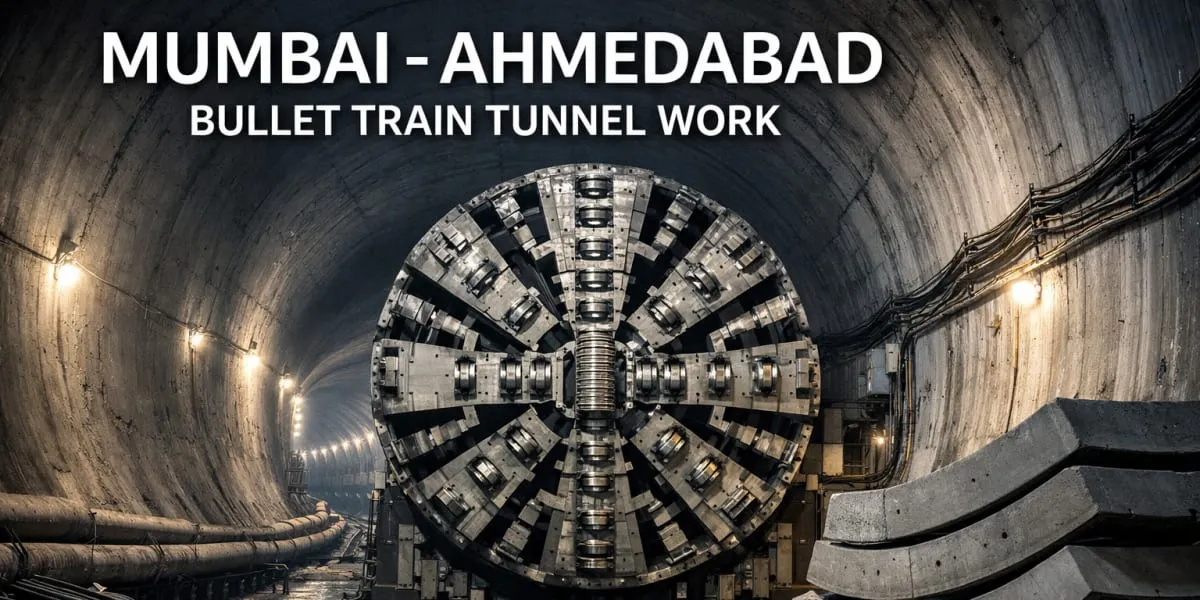
Railway Minister Ashwini Vaishnaw will inaugurate the underground tunnel-boring operation from Vikhroli to the Bandra Kurla Complex station on Sunday, marking the first use in India of a Tunnel Boring Machine (TBM) for the Mumbai-Ahmedabad High-Speed Rail Corridor. The machines, two customised German-made TBMs imported from China in March 2026, are owned by Afcons Infrastructure Limited (Afcons), which is constructing a 20.37 km tunnel including a seven km undersea stretch. The tunnel will be built at a depth of about 65 metres below ground level.

An official of the National High Speed Rail Corporation Limited (NHSRCL) said the Railway Minister would push a button to commence the operation of a TBM stationed 56.6 metres below ground at Vikhroli. The first TBM will begin tunnelling from Vikhroli towards the BKC station, covering a distance of approximately five point eight km. A second TBM is being assembled at Sawli and is expected to be ready within a week; it will excavate the nine point seven km stretch from Sawli to Vikhroli, including the seven km undersea section.

A senior railway expert said each TBM is expected to excavate about 300 metres of tunnel every month, and that once both machines become operational around 600 metres of tunnelling will be completed monthly. The 20.37 km package stretches from BKC to Shilphata, of which 15.4 km between BKC and Sawli will be excavated using TBMs while the remaining four point eight km from Sawli to Shilphata has already been completed using the drill-and-blast method. The tunnel will be a single-tube structure designed to accommodate twin tracks for bi-directional traffic.

Two shafts at Vikhroli and Sawli, at depths of about 56 metres and 39 metres respectively, will facilitate construction, and 39 equipment rooms at 37 locations will be built adjoining the tunnel alignment. The TBMs are among the largest and most expensive deployed in India, each with a cutter head diameter of 13.6 metres. By comparison, TBMs used for urban metro projects typically have cutter head diameters of five to six metres.

"Join industry leaders at RAHSTA Expo, India's premier platform for roads, highways and traffic infrastructure. Register now to explore innovations, network with experts and shape the future of mobility."

Railway Minister Ashwini Vaishnaw will inaugurate the underground tunnel-boring operation from Vikhroli to the Bandra Kurla Complex station on Sunday, marking the first use in India of a Tunnel Boring Machine (TBM) for the Mumbai-Ahmedabad High-Speed Rail Corridor. The machines, two customised German-made TBMs imported from China in March 2026, are owned by Afcons Infrastructure Limited (Afcons), which is constructing a 20.37 km tunnel including a seven km undersea stretch. The tunnel will be built at a depth of about 65 metres below ground level. An official of the National High Speed Rail Corporation Limited (NHSRCL) said the Railway Minister would push a button to commence the operation of a TBM stationed 56.6 metres below ground at Vikhroli. The first TBM will begin tunnelling from Vikhroli towards the BKC station, covering a distance of approximately five point eight km. A second TBM is being assembled at Sawli and is expected to be ready within a week; it will excavate the nine point seven km stretch from Sawli to Vikhroli, including the seven km undersea section. A senior railway expert said each TBM is expected to excavate about 300 metres of tunnel every month, and that once both machines become operational around 600 metres of tunnelling will be completed monthly. The 20.37 km package stretches from BKC to Shilphata, of which 15.4 km between BKC and Sawli will be excavated using TBMs while the remaining four point eight km from Sawli to Shilphata has already been completed using the drill-and-blast method. The tunnel will be a single-tube structure designed to accommodate twin tracks for bi-directional traffic. Two shafts at Vikhroli and Sawli, at depths of about 56 metres and 39 metres respectively, will facilitate construction, and 39 equipment rooms at 37 locations will be built adjoining the tunnel alignment. The TBMs are among the largest and most expensive deployed in India, each with a cutter head diameter of 13.6 metres. By comparison, TBMs used for urban metro projects typically have cutter head diameters of five to six metres.

Next Story
Infrastructure Transport

Ningbo showcases smart manufacturing at Colombo trade dialogue

Ningbo, one of China's historic port cities, showcased its smart manufacturing capabilities and global trade strategy during the Encounter & Insight: Dialogue Between Ningbo, China and Colombo, Sri Lanka, held in Colombo on July 4. The event brought together representatives from the two port cities to discuss integrated port-city development, trade connectivity and cultural exchange.The dialogue highlighted Ningbo's transition from a traditional manufacturing hub to a centre for advanced industrial production, supported by digital transformation and technology-driven exports. According to ..

Next Story
Products

Aerolam partners Leminar to expand insulation business in UAE

Aerolam Group has entered into an exclusive distribution agreement with Leminar Global to strengthen the availability of its insulation products across the UAE, marking a key step in the company's expansion across the Gulf Cooperation Council (GCC) region.Under the agreement, Leminar Global, an HVAC and plumbing solutions provider and part of the Al Shirawi Group, will serve as the authorised distributor of Aerolam's insulation portfolio in the UAE. The partnership is aimed at meeting growing demand for energy-efficient building materials as construction activity accelerates across the country..

Next Story
Products

GRAFF showcases water-focused bathroom and kitchen collections

GRAFF has introduced a range of bathroom and kitchen collections centred on water, design and sustainability, highlighting products that combine user comfort with water-efficient technologies.For bathrooms, the company has showcased its Riva, Ametis and Aqua-Sense shower collections, featuring rain showers, adjustable water streams, intuitive controls and chromatic lighting designed to enhance the bathing experience. The collections are intended to create a spa-like environment while incorporating technologies that optimise water consumption.In the kitchen segment, GRAFF has highlighted its Fu..

Advertisement

Subscribe to Our Newsletter

Get daily newsletters around different themes from Construction world.

STAY CONNECTED

Advertisement

Advertisement

Advertisement