Saibaba Colony Flyover Work Resumes After 8-Month Delay
ROADS & HIGHWAYS

Saibaba Colony Flyover Work Resumes After 8-Month Delay

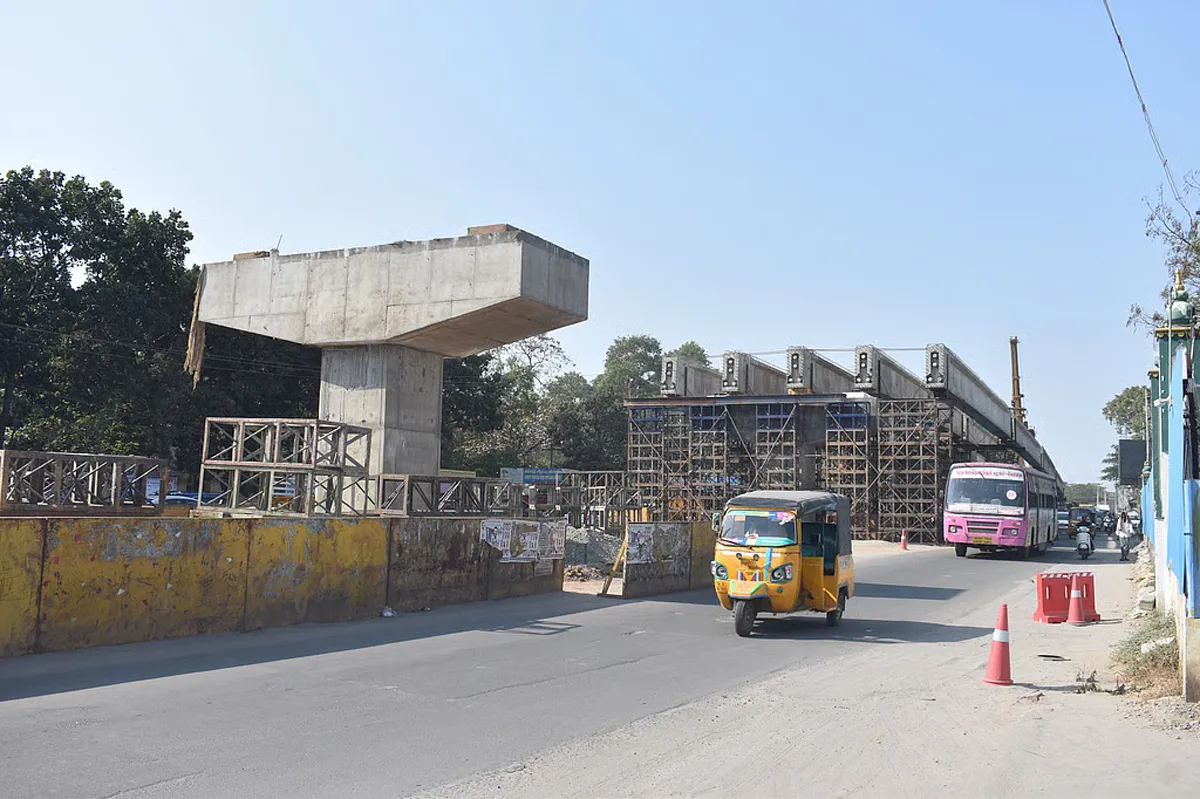
After months of prolonged delays, the National Highways (NH) wing of the State Highways Department has finally commenced foundation work for the last remaining pillar of the long-stalled Saibaba Colony flyover project in Coimbatore.
The 975-metre-long flyover, which connects Alagesan Road to the MTP Road Bus Terminus near Eru Company, is being developed at a cost of Rs 520 million. However, construction came to a standstill in December last year when workers accidentally damaged an underground drainage (UGD) pipeline.
For nearly eight months, the site remained waterlogged with stagnant sewage, as neither the Tamil Nadu Water Supply and Drainage (TWAD) Board nor the Coimbatore City Municipal Corporation (CCMC) took steps to repair the line or drain the wastewater, despite repeated appeals by the Highways Department.
During the impasse, engineers managed to install girders on 22 pillars, with only the final pillar left incomplete. To resolve the issue, the Highways Department eventually intervened, pumping out the sewage and laying an alternative drainage pipeline, finally enabling foundation work to proceed.
A senior NH official confirmed on Monday:
“After eight months of delay, the foundation for the last pillar has commenced. Work is progressing rapidly, and we expect to complete it in the coming days. Once this is done, the remaining components of the flyover will follow.”
With construction back on track, the project is now expected to reach completion by January 2026, offering long-awaited traffic relief in the Saibaba Colony region. 

After months of prolonged delays, the National Highways (NH) wing of the State Highways Department has finally commenced foundation work for the last remaining pillar of the long-stalled Saibaba Colony flyover project in Coimbatore.The 975-metre-long flyover, which connects Alagesan Road to the MTP Road Bus Terminus near Eru Company, is being developed at a cost of Rs 520 million. However, construction came to a standstill in December last year when workers accidentally damaged an underground drainage (UGD) pipeline.For nearly eight months, the site remained waterlogged with stagnant sewage, as neither the Tamil Nadu Water Supply and Drainage (TWAD) Board nor the Coimbatore City Municipal Corporation (CCMC) took steps to repair the line or drain the wastewater, despite repeated appeals by the Highways Department.During the impasse, engineers managed to install girders on 22 pillars, with only the final pillar left incomplete. To resolve the issue, the Highways Department eventually intervened, pumping out the sewage and laying an alternative drainage pipeline, finally enabling foundation work to proceed.A senior NH official confirmed on Monday:“After eight months of delay, the foundation for the last pillar has commenced. Work is progressing rapidly, and we expect to complete it in the coming days. Once this is done, the remaining components of the flyover will follow.”With construction back on track, the project is now expected to reach completion by January 2026, offering long-awaited traffic relief in the Saibaba Colony region. 

Next Story
Infrastructure Transport

India Becomes First to Produce Bio-Bitumen for Roads

India has become the first country in the world to commercially produce bio-bitumen for use in road construction, according to Road, Transport and Highways Minister Nitin Gadkari. Bitumen, a black and viscous hydrocarbon derived from crude oil, is a key binding material in road building, and the bio-based alternative is expected to significantly improve the sector’s environmental footprint.Addressing the CSIR Technology Transfer Ceremony in New Delhi, Mr Gadkari congratulated Council of Scientific and Industrial Research on achieving the milestone, noting that the initiative would help curb ..

Next Story
Infrastructure Urban

HILT Policy Seen Boosting Telangana Revenue Sharply

The Hyderabad Industrial Land Transformation (HILT) Policy is expected to generate around Rs 1.08 billion in revenue for the Telangana state exchequer, according to Deputy Chief Minister Bhatti Vikramarka Mallu. Speaking in the Telangana Legislative Assembly, he said the policy would be implemented within a six-month timeframe in a transparent manner, with uniform rules applicable to all stakeholders. Mr Vikramarka noted that without the HILT Policy, the state would have earned only about Rs 1.2 million per acre. Under the new framework, however, revenue is projected to rise sharply to Rs 70 ..

Next Story
Infrastructure Urban

India Post, MoRD Tie Up to Boost Rural Inclusion

The Department of Posts and the Ministry of Rural Development have signed a Memorandum of Understanding to accelerate rural transformation and expand financial, digital and logistics services for Self-Help Groups (SHGs) and rural households across India. The agreement was signed in the presence of Union Minister of Communications and Development of North Eastern Region Jyotiraditya M. Scindia and Union Minister of Rural Development and Agriculture and Farmers’ Welfare Shivraj Singh Chouhan. The collaboration aligns with the government’s “Dak Sewa, Jan Sewa” vision and seeks to repositi..

Advertisement

Subscribe to Our Newsletter

Get daily newsletters around different themes from Construction world.

STAY CONNECTED

Advertisement

Advertisement

Advertisement

Advertisement

Open In App