Banashankari Skywalk Project Finally Set to Improve Commuter Access
RAILWAYS & METRO RAIL

Banashankari Skywalk Project Finally Set to Improve Commuter Access

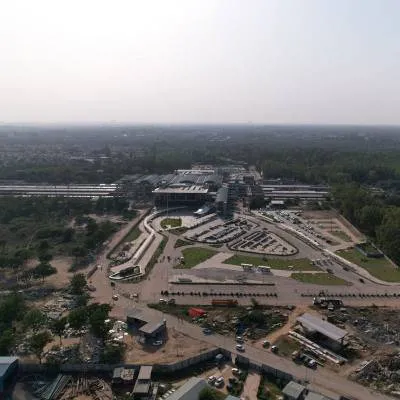
The Bangalore Metro Rail Corporation (BMRCL) has initiated the long-delayed Banashankari skywalk project, aiming to enhance pedestrian safety and last-mile connectivity at the busy South Bengaluru junction. A tender has been floated for the project, with an estimated cost between Rs 500 million and Rs 550 million.

The skywalk will link Banashankari Metro Station, the TTMC bus terminal, and the Banashankari Temple, easing congestion at one of South Bengaluru’s most crowded intersections. A contractor will be selected through the tendering process, with construction to be completed within 15 months, including the relocation of electric lines and translocation of trees.

The Banashankari Metro Station, operational since June 2017 on the Green Line, faces heavy footfall, particularly on temple days. The 700-m distance between the metro and bus terminal has long posed challenges for commuters.

The new skywalk will feature a circular design with multiple loops, greenery, resting areas, and designated spaces for street vendors, aiming to improve the pedestrian experience.

The project gained momentum after visits by Bengaluru South Member of Parliament Tejasvi Surya and former Revenue Minister R Ashoka in 2019. Revived jointly by BMRCL and BBMP in 2022, it now moves closer to realisation.

Source: Bangalore Mirror


The Bangalore Metro Rail Corporation (BMRCL) has initiated the long-delayed Banashankari skywalk project, aiming to enhance pedestrian safety and last-mile connectivity at the busy South Bengaluru junction. A tender has been floated for the project, with an estimated cost between Rs 500 million and Rs 550 million.The skywalk will link Banashankari Metro Station, the TTMC bus terminal, and the Banashankari Temple, easing congestion at one of South Bengaluru’s most crowded intersections. A contractor will be selected through the tendering process, with construction to be completed within 15 months, including the relocation of electric lines and translocation of trees.The Banashankari Metro Station, operational since June 2017 on the Green Line, faces heavy footfall, particularly on temple days. The 700-m distance between the metro and bus terminal has long posed challenges for commuters.The new skywalk will feature a circular design with multiple loops, greenery, resting areas, and designated spaces for street vendors, aiming to improve the pedestrian experience.The project gained momentum after visits by Bengaluru South Member of Parliament Tejasvi Surya and former Revenue Minister R Ashoka in 2019. Revived jointly by BMRCL and BBMP in 2022, it now moves closer to realisation.Source: Bangalore Mirror

Related Stories

Gold Stories

Next Story
Infrastructure Urban

KONE Opens India's First Digital Experience Centre in Pune

KONE, a global elevator and escalator manufacturer, has inaugurated its first Digital Experience Centre (DEC) in India, located in Pune. The facility aims to showcase how artificial intelligence (AI), connectivity and data-driven technologies can enhance customer experiences and improve building operations.The centre was inaugurated by Jussi Herlin, Executive Vice Chair, KONE Corporation; Philippe Delorme, President and CEO, KONE; and Nandan Nilekani, Co-founder and Chairman of the Board, Infosys.Designed as an interactive customer environment, the facility demonstrates digital solutions cover..

Next Story
Infrastructure Urban

CII GreenCo Launches Circularity Guidelines for Indian Industry

The Confederation of Indian Industry (CII) GreenCo Council has launched the CII GreenCo Circularity Guidelines – Pilot Version at the 17th CII GreenCo Waste & Resource Management Summit 2026 in Chennai. The initiative aims to strengthen resource efficiency, waste reduction and circular economy practices across Indian manufacturing and process industries.The guidelines introduce a structured framework with circularity indices covering raw materials, consumables, packaging and other resource inputs. These indicators will help industries assess existing practices, identify opportunities to ..

Next Story
Infrastructure Energy

Global Electronics Association Launches IPC-1783-CO2E Standard

The Global Electronics Association has introduced IPC-1783-CO2E, a new international standard aimed at improving consistency, transparency and comparability in product carbon footprint reporting across the electronics manufacturing industry.The standard, titled International Standard for Data Collection and Reporting of CO2 Equivalent (CO2e) Emissions for the Electronics Manufacturing Supply Chain, provides industry-specific guidance for collecting, estimating and reporting carbon emissions data.With increasing regulatory requirements and customer expectations, electronics manufacturers face c..

Advertisement

Subscribe to Our Newsletter

Get daily newsletters around different themes from Construction world.

STAY CONNECTED

Advertisement

SPECIAL OFFER
QR Code