
+
China's first suspended monorail opens
RAILWAYS & METRO RAIL

China's first suspended monorail opens

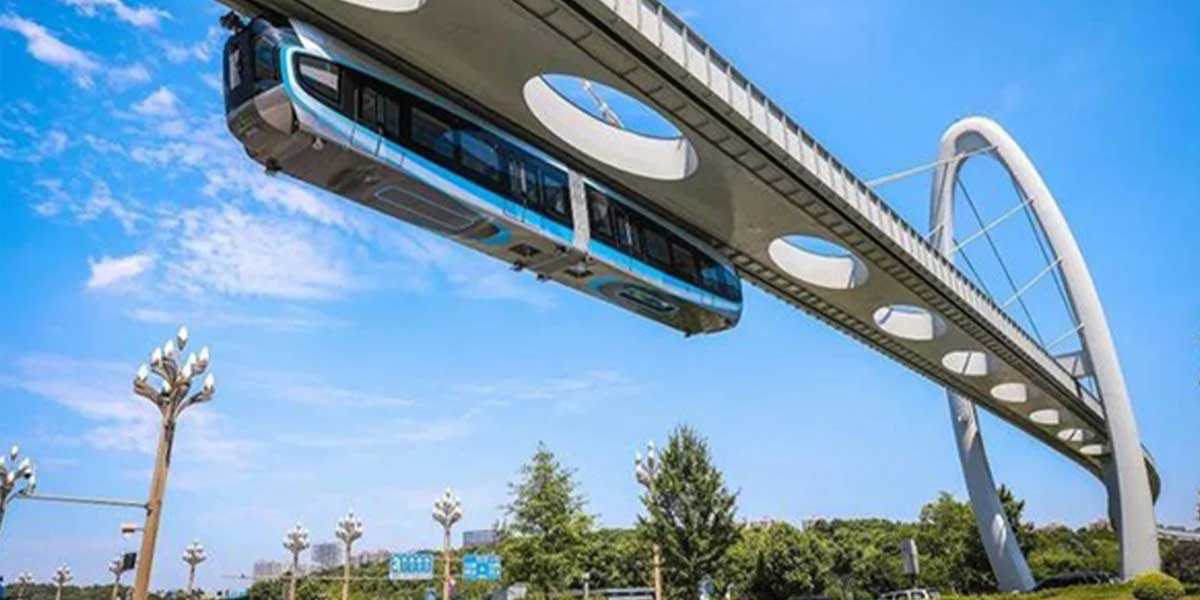
China's First Suspended Monorail Offers Eco-Friendly Transport and Futuristic Views China has taken a significant step in its commitment to eco-friendly public transportation with the inauguration of its first suspended monorail system. The recently opened Wuhan Guanggu Aerial Rail Tourist Line, situated in the city's East Lake high-tech zone, aims to connect the Nine Peaks National Forest Park and the Longquanshan Ming Chuwang Tomb Archaeological Site Park. Spanning 10.5 kilometres and featuring six stations, this cutting-edge transport mode operates at speeds of up to 60 kilometres per hour, accommodating as many as 220 passengers per train. The fully automated monorail boasts spacious windows, providing riders with breathtaking panoramic views of the surrounding area.

Although the project came with a substantial price tag of 2.5 billion Yuan (approximately US$341 million), its eco-friendly and space-efficient design offers numerous advantages, including reduced noise and vibration, improved safety, and efficient land utilisation. While the project commenced in 2019 and was completed in 2023, it signifies a promising move towards sustainable and futuristic transportation solutions.

China's First Suspended Monorail Offers Eco-Friendly Transport and Futuristic Views China has taken a significant step in its commitment to eco-friendly public transportation with the inauguration of its first suspended monorail system. The recently opened Wuhan Guanggu Aerial Rail Tourist Line, situated in the city's East Lake high-tech zone, aims to connect the Nine Peaks National Forest Park and the Longquanshan Ming Chuwang Tomb Archaeological Site Park. Spanning 10.5 kilometres and featuring six stations, this cutting-edge transport mode operates at speeds of up to 60 kilometres per hour, accommodating as many as 220 passengers per train. The fully automated monorail boasts spacious windows, providing riders with breathtaking panoramic views of the surrounding area. Although the project came with a substantial price tag of 2.5 billion Yuan (approximately US$341 million), its eco-friendly and space-efficient design offers numerous advantages, including reduced noise and vibration, improved safety, and efficient land utilisation. While the project commenced in 2019 and was completed in 2023, it signifies a promising move towards sustainable and futuristic transportation solutions.

Next Story
Infrastructure Urban

India–Japan CEPA Joint Committee Meets in Tokyo

The seventh Joint Committee Meeting under the India–Japan Comprehensive Economic Partnership Agreement (CEPA) was held on two March 2026 in Tokyo and was co-chaired by the Secretary of the Department of Commerce, Shri Rajesh Agrawal, and the Senior Deputy Minister of the Ministry of Foreign Affairs of Japan. Delegates from both sides reviewed implementation issues under the CEPA and deliberated on measures to further strengthen bilateral economic engagement. The meeting was positioned as part of ongoing efforts to translate high-level commitments into concrete trade and investment outcomes. ..

Next Story
Infrastructure Urban

India Sets Vision For Affordable Intelligent Connectivity At MWC 2026

Union Minister Jyotiraditya M. Scindia led India’s engagements at Mobile World Congress 2026 (MWC 2026) in Barcelona, outlining a vision for affordable, inclusive and future ready digital connectivity. He delivered addresses at the GSMA Ministerial Programme and the MWC Main Stage and emphasised that affordability must be central to digital inclusion, noting that three point one billion (bn) people remain excluded from meaningful digital participation. He called for a coordinated response by government, industry and finance to enable device affordability and sustainable ecosystems. On the MW..

Next Story
Infrastructure Transport

Indian Railways Cuts Charges To Boost Bulk Cement Tank Transport

Indian Railways (IR) has announced a reduction in charges for transporting bulk cement in tank containers to encourage modal shift from bagged consignments to specialised tank logistics. The move is presented as part of a broader push to improve efficiency in freight operations and to reduce handling time and costs for cement producers and buyers. Officials indicated the adjustment aims to optimise wagon utilisation and lower unit transport costs across domestic and interstate routes nationwide. Railway officials noted that tank container consignments reduce transshipment and the need for repe..

Advertisement

Subscribe to Our Newsletter

Get daily newsletters around different themes from Construction world.

STAY CONNECTED

Advertisement

Advertisement

Advertisement