+
Delhi Metro To Paint 200 Pillars With Public Art
RAILWAYS & METRO RAIL

Delhi Metro To Paint 200 Pillars With Public Art

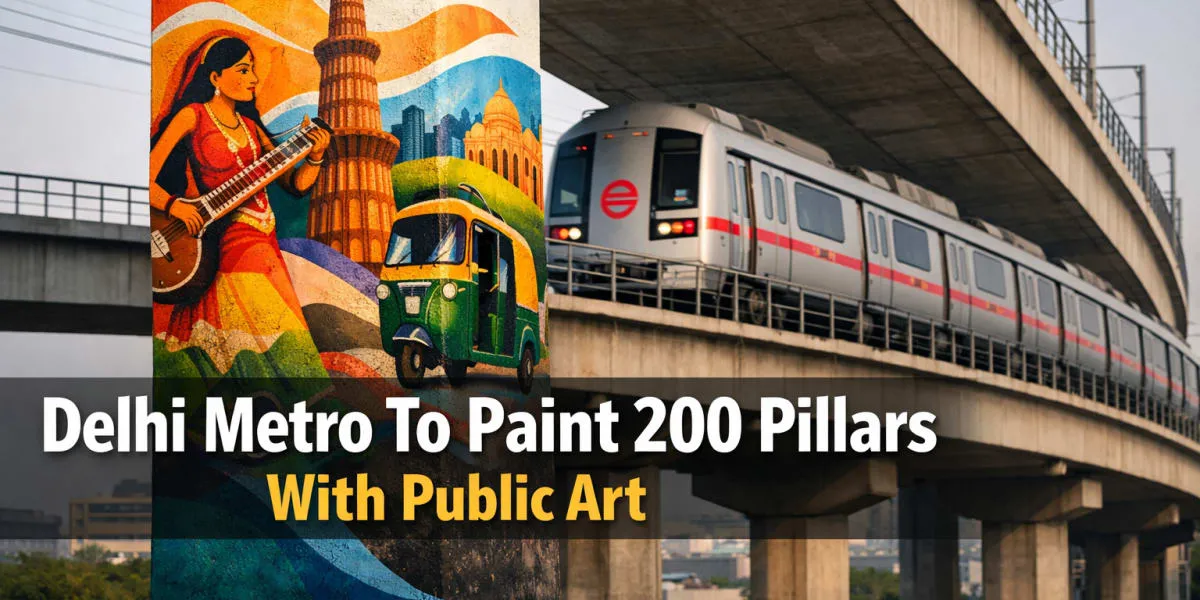
Delhi Metro will convert 200 pillars across the city into large scale public art as part of an urban beautification initiative, authorities said. The project will transform structural supports along metro corridors into canvases that reflect local culture and urban life. Officials described the move as an effort to enhance visual amenity and to make daily travel more engaging for commuters.

Organisers plan to invite artists from diverse backgrounds to interpret neighbourhood themes and to involve community groups in design decisions. Murals will vary in scale and style to suit site conditions and to maintain structural safety. The approach aims to showcase emerging talent while ensuring artworks endure urban exposure.

Officials expect the painted pillars to discourage vandalism and to foster a sense of ownership among residents and commuters. The enhanced streetscape is intended to improve wayfinding and to make public spaces feel safer and more welcoming. Maintenance and conservation plans will be integral to the project to preserve colour and form over time.

Funding is to be drawn from existing urban improvement budgets and may include collaborations with local organisations and sponsors. Project managers will coordinate with transport authorities and civic agencies to minimise disruption during implementation. Success in the initial phase could prompt expansion to additional corridors and to other cities.

The scheme is expected to offer artists novel public exposure and to create new points of civic pride. Planners will measure public response and will adapt designs to reflect feedback and practical considerations. If well received, the initiative may serve as a model for integrating art into urban infrastructure more broadly. Officials will document the process to inform future cultural programming.

Delhi Metro will convert 200 pillars across the city into large scale public art as part of an urban beautification initiative, authorities said. The project will transform structural supports along metro corridors into canvases that reflect local culture and urban life. Officials described the move as an effort to enhance visual amenity and to make daily travel more engaging for commuters. Organisers plan to invite artists from diverse backgrounds to interpret neighbourhood themes and to involve community groups in design decisions. Murals will vary in scale and style to suit site conditions and to maintain structural safety. The approach aims to showcase emerging talent while ensuring artworks endure urban exposure. Officials expect the painted pillars to discourage vandalism and to foster a sense of ownership among residents and commuters. The enhanced streetscape is intended to improve wayfinding and to make public spaces feel safer and more welcoming. Maintenance and conservation plans will be integral to the project to preserve colour and form over time. Funding is to be drawn from existing urban improvement budgets and may include collaborations with local organisations and sponsors. Project managers will coordinate with transport authorities and civic agencies to minimise disruption during implementation. Success in the initial phase could prompt expansion to additional corridors and to other cities. The scheme is expected to offer artists novel public exposure and to create new points of civic pride. Planners will measure public response and will adapt designs to reflect feedback and practical considerations. If well received, the initiative may serve as a model for integrating art into urban infrastructure more broadly. Officials will document the process to inform future cultural programming.

Next Story
Infrastructure Urban

Implementation Status of Jal Jeevan Mission

Since August 2019 the Government has implemented Jal Jeevan Mission to provide assured potable water through household tap connections in rural India. At the start of the mission only 32.3 million (mn) rural households, representing 16.7 per cent, were reported to have tap water connections. States and union territories have reported that 125.8 mn additional rural households have since been provided with tap connections. As a result, of about 193.6 mn rural households roughly 158.2 mn, or 81.71 per cent, are reported to have tap water supply at home.\n\nThe State, district and village level st..

Next Story
Infrastructure Urban

Jal Jeevan Mission Reaches Eighty One Per Cent Rural Coverage

The Government reported substantial progress under the Jal Jeevan Mission, launched in August 2019 to provide tap water to every rural household. At launch only 32.3 million (mn) rural households had tap connections and states and Union territories reported provision of 125.8 mn additional households by March 2026. Consequently, out of about 193.6 mn rural households around 158.2 mn, or 81.71 per cent, are reported to have tap water at home. The Finance Minister announced extension of the mission until 2028 in the 2025-26 budget speech. The Swachh Bharat Mission Grameen, launched in October 20..

Next Story
Infrastructure Urban

Empowering Local Governance for Sustainable Rural Water Supply

The Ministry of Jal Shakti has aligned the Jal Jeevan Mission (JJM) with the 73rd Amendment to strengthen village level planning and community ownership of water supply. Gram Panchayats, village water and sanitation committees and Pani Samitis are to plan, implement, manage and maintain piped water systems, with gram sabha processes formalising handover and oversight. Implementation support agencies including non government organisations, community based organisations and self help groups have been empanelled to train local committees and promote women participation. Under JJM, the department ..

Advertisement

Subscribe to Our Newsletter

Get daily newsletters around different themes from Construction world.

STAY CONNECTED

Advertisement

Advertisement

Advertisement