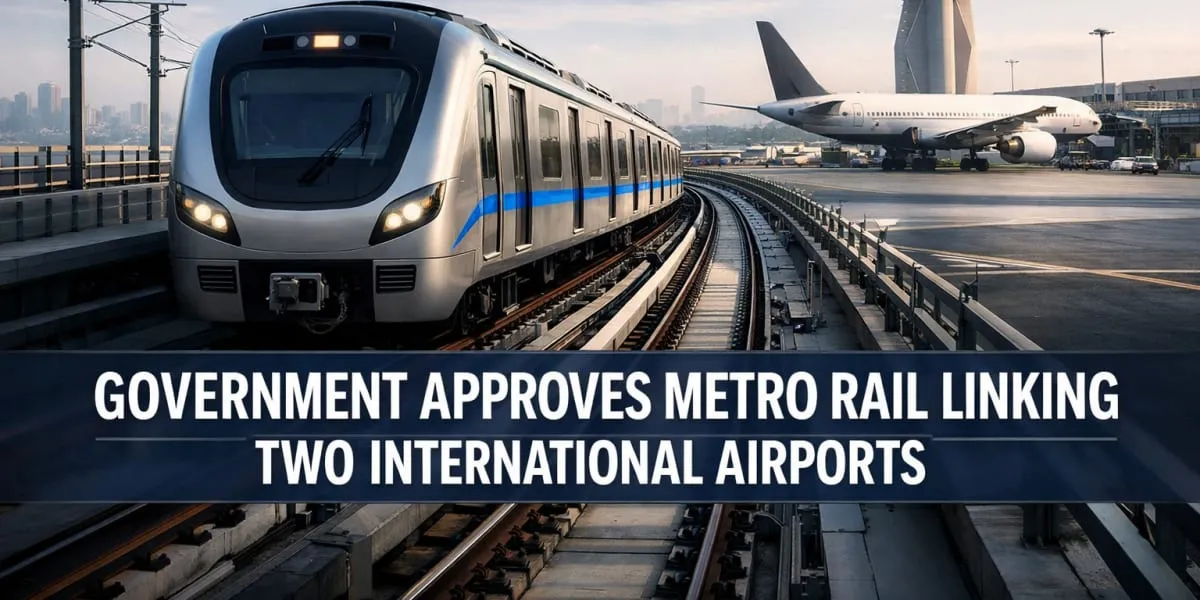
Government Approves Metro Rail Between Two International Airports
RAILWAYS & METRO RAIL

Government Approves Metro Rail Between Two International Airports

Government has approved construction of a metro rail line linking the two international airports in Mumbai and will fund forty per cent of the project cost. It will create dedicated rapid transit between the terminals and aim to integrate with existing suburban rail and metro networks. The approval follows feasibility work and intergovernmental consultations, and costs and timeline will be defined in the detailed study. Central funding is intended to attract investment and accelerate project delivery.

Officials said the corridor is expected to ease congestion on roads connecting the airports and offer a reliable alternative for airport-bound travellers and staff. The line is expected to support multimodal transfers, including park and ride and feeder bus services, and to improve access to commercial and cargo hubs. Planners intend to prioritise seamless ticketing and schedule coordination with other public transport operators to promote commuter convenience. User fares and subsidy frameworks will be assessed subsequently.

The project will be implemented by the state metro authority in coordination with central agencies and municipal corporations. Funding arrangements will combine central grants, state contributions and possible multilateral or private participation for specific components, while operation and maintenance models will be finalised later. A detailed project report will establish alignment, station locations and technical specifications before tenders are issued. Technical standards will follow national metro guidelines and best practice.

Challenges such as land acquisition, utility relocation and environmental clearances are expected to shape the timeline, with authorities indicating that statutory approvals must be secured prior to major works. Stakeholders will monitor costs and ridership projections as the scheme moves into execution. The central funding commitment is viewed as a decisive step that should help mobilise state resources and private interest while planning for long term urban mobility benefits. Authorities expect regular reviews during construction and initial operation.

Government has approved construction of a metro rail line linking the two international airports in Mumbai and will fund forty per cent of the project cost. It will create dedicated rapid transit between the terminals and aim to integrate with existing suburban rail and metro networks. The approval follows feasibility work and intergovernmental consultations, and costs and timeline will be defined in the detailed study. Central funding is intended to attract investment and accelerate project delivery. Officials said the corridor is expected to ease congestion on roads connecting the airports and offer a reliable alternative for airport-bound travellers and staff. The line is expected to support multimodal transfers, including park and ride and feeder bus services, and to improve access to commercial and cargo hubs. Planners intend to prioritise seamless ticketing and schedule coordination with other public transport operators to promote commuter convenience. User fares and subsidy frameworks will be assessed subsequently. The project will be implemented by the state metro authority in coordination with central agencies and municipal corporations. Funding arrangements will combine central grants, state contributions and possible multilateral or private participation for specific components, while operation and maintenance models will be finalised later. A detailed project report will establish alignment, station locations and technical specifications before tenders are issued. Technical standards will follow national metro guidelines and best practice. Challenges such as land acquisition, utility relocation and environmental clearances are expected to shape the timeline, with authorities indicating that statutory approvals must be secured prior to major works. Stakeholders will monitor costs and ridership projections as the scheme moves into execution. The central funding commitment is viewed as a decisive step that should help mobilise state resources and private interest while planning for long term urban mobility benefits. Authorities expect regular reviews during construction and initial operation.

Next Story
Infrastructure Urban

Güntner Showcases Cooling Tech at China Expo

Güntner showcased its latest refrigeration and air conditioning innovations at China Refrigeration 2026, highlighting digital intelligence and carbon-neutral solutions.The company presented its aicore™ Controls and IoT platform, designed to optimise energy consumption, enable remote monitoring and enhance lifecycle management of cooling systems. The solution integrates advanced controllers and cloud-based capabilities to improve operational efficiency and reduce energy use.Güntner also demonstrated advancements in heat pump technologies, including its role in projects such as the Ordos Zer..

Next Story
Real Estate

Superb Realty Ties Up with Praan for AI Air Tech

Superb Realty has partnered with Praan to deploy AI-powered autonomous air infrastructure across over one million sq ft of real estate in Mumbai, marking a significant move towards intelligent indoor environments.The rollout will begin at Superb Altura and expand across upcoming residential and mixed-use developments. The initiative aims to integrate real-time sensing, adaptive purification and AI-led optimisation to improve indoor air quality and occupant experience.Praan’s technology is designed to remove ultrafine particles significantly smaller than conventional systems and eliminate har..

Next Story
Technology

DAAKit Raises $138,000 in Pre-Seed Round

DAAKit has raised $138,000 in a pre-seed funding round led by Inflection Point Ventures to expand its hyperlocal fulfilment network and strengthen technology capabilities.The company plans to use the funds to launch 25 new dark stores across Tier I and Tier II cities, enhance its technology infrastructure, and expand its leadership and operations teams. Currently operational in Delhi, Gurugram, Mumbai, Bengaluru and Kolkata, DAAKit is also piloting expansion into Tier II markets through Lucknow.Built on an asset-light, technology-driven model, the platform enables brands to position inventory ..

Advertisement

Subscribe to Our Newsletter

Get daily newsletters around different themes from Construction world.

STAY CONNECTED

Advertisement

Advertisement

Advertisement