Indian Railways Approves Kosamba Flyover And Bhagalpur Bypass
RAILWAYS & METRO RAIL

Indian Railways Approves Kosamba Flyover And Bhagalpur Bypass

The Ministry of Railways has approved two rail infrastructure projects to strengthen connectivity and ease congestion on critical routes. The projects have a combined sanctioned cost of Rs 6475.8 mn and aim to ensure safe and uninterrupted movement of trains. The approvals cover works in Western Railway and Eastern Railway and reflect continued prioritisation of capacity augmentation and network decongestion.

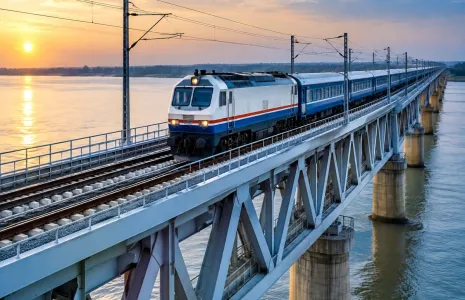
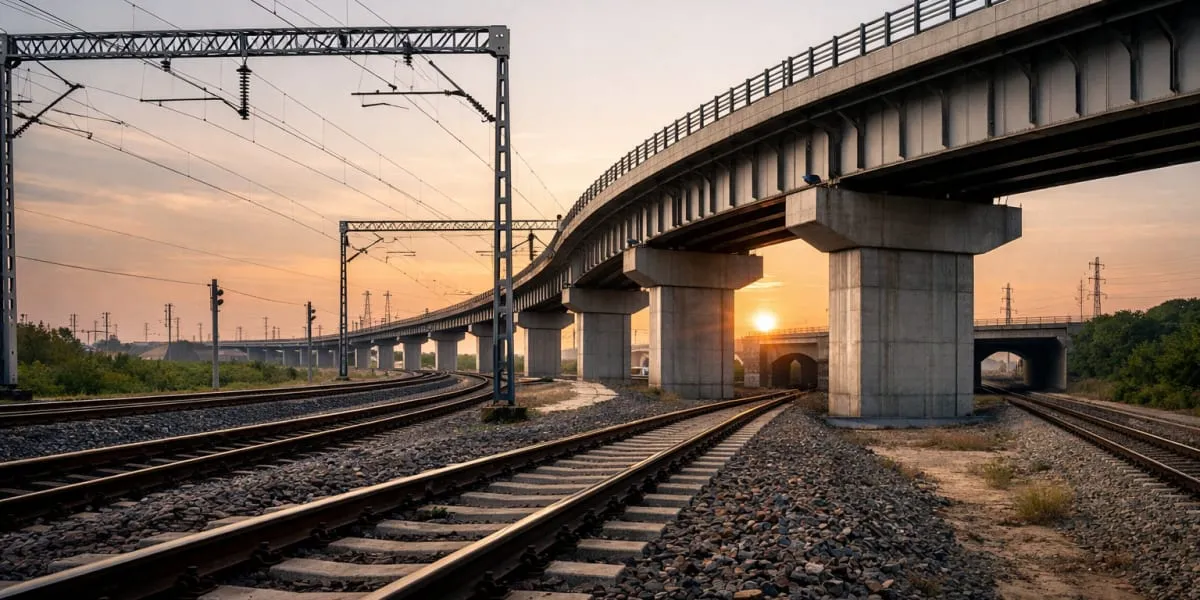
One project is the construction of a rail over rail flyover at Kosamba to integrate the Kosamba–Umrapada gauge conversion section. The flyover will span nine point two kilometre (km) and will remove surface crossings created by the Dedicated Freight Corridor alignment, enabling seamless linkage with the Mumbai–Vadodara main line. The sanctioned completion cost for this work is Rs 3443.8 mn and it will support the benefits of the gauge conversion by preventing operational interruptions.

The other project is the Bhagalpur bypass, a new link of 13.38 km that will connect Gonudham Halt on the Barahat–Bhagalpur section with Sabour on the Bhagalpur–Sahibganj section. The bypass has been sanctioned at Rs 3032.0 mn and is intended to ease severe congestion at Bhagalpur junction, where the Barahat–Bhagalpur section currently operates at more than 125 per cent capacity utilisation. The new alignment will eliminate engine reversals at Bhagalpur that result in detention and inefficiencies.

Together the projects are expected to enhance operational fluidity and punctuality, reduce congestion and improve safety for passenger and freight services. Implementation will enable more efficient train movements on the Mumbai–Vadodara corridor and in the Bhagalpur area without creating surface conflicts with freight corridors. The Ministry has signalled that such investments form part of a sustained effort to meet growing transportation demand and to improve overall network performance.

The Ministry of Railways has approved two rail infrastructure projects to strengthen connectivity and ease congestion on critical routes. The projects have a combined sanctioned cost of Rs 6475.8 mn and aim to ensure safe and uninterrupted movement of trains. The approvals cover works in Western Railway and Eastern Railway and reflect continued prioritisation of capacity augmentation and network decongestion. One project is the construction of a rail over rail flyover at Kosamba to integrate the Kosamba–Umrapada gauge conversion section. The flyover will span nine point two kilometre (km) and will remove surface crossings created by the Dedicated Freight Corridor alignment, enabling seamless linkage with the Mumbai–Vadodara main line. The sanctioned completion cost for this work is Rs 3443.8 mn and it will support the benefits of the gauge conversion by preventing operational interruptions. The other project is the Bhagalpur bypass, a new link of 13.38 km that will connect Gonudham Halt on the Barahat–Bhagalpur section with Sabour on the Bhagalpur–Sahibganj section. The bypass has been sanctioned at Rs 3032.0 mn and is intended to ease severe congestion at Bhagalpur junction, where the Barahat–Bhagalpur section currently operates at more than 125 per cent capacity utilisation. The new alignment will eliminate engine reversals at Bhagalpur that result in detention and inefficiencies. Together the projects are expected to enhance operational fluidity and punctuality, reduce congestion and improve safety for passenger and freight services. Implementation will enable more efficient train movements on the Mumbai–Vadodara corridor and in the Bhagalpur area without creating surface conflicts with freight corridors. The Ministry has signalled that such investments form part of a sustained effort to meet growing transportation demand and to improve overall network performance.

Next Story
Infrastructure Transport

The Critical Path

In Ircon International Ltd v. Afcons Infrastructure Ltd, OMP (Comm) 279/2019, the Delhi High Court examined how delay and extension of time (‘EOT’) are to be assessed in construction contracts, particularly in the context of the ‘critical path’ while dealing with challenge to an arbitral award under Section 34 of the Arbitration and Conciliation Act 1996 (‘the Act’). The High Court’s observations regarding the critical path are of significant import for construction and infrastructure projects and related arbitration. The parties entered into a contract for construction of T..

Next Story
Infrastructure Urban

Urgently Wanted: 2 Million Workers!

Construction, India’s second largest employer by industry, employs about 50 million workers but could additionally absorb another 40 million workers, according to estimates shared by the Construction Skill Development Council of India (CSDCI) in 2023. Within this, citing trade estimates, Rahul Bahl, Managing Director, Krishna Buildestates, says the shortage of trained, skilled workers is currently about 2 million, and is expected to rise to 5 million by 2030.Not only is the construction industry struggling to find workers but construction labour productivity in India significantly trails g..

Next Story
Real Estate

144 Years in the Making!

1. A century-spanning construction storyConstruction began in 1882, making the Sagrada Família one of the longest-running architectural projects in modern history. Today, the project is overseen by the Fundació Junta Constructora del Temple Expiatori de la Sagrada Família, with Chief Architect Jordi Faulí leading its final construction phases.2. The world’s tallest church towerhe Sagrada Família in Barcelona reached its final height of 172.5 m (566 ft) on February 20, 2026, with the installation of the cross atop the Tower of Jesus Christ, making it the tallest church in the world...To ..

Advertisement

Subscribe to Our Newsletter

Get daily newsletters around different themes from Construction world.

STAY CONNECTED

Advertisement

Advertisement

Advertisement