Indian Railways Investments Transforming Infrastructure
RAILWAYS & METRO RAIL

Indian Railways Investments Transforming Infrastructure

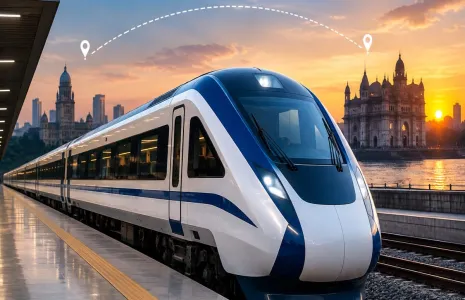
Indian Railways is undergoing a transformative journey, with projected investments of ?17.4 lakh crore from fiscal 2016 to 2025, reflecting a 12% compound annual growth rate (CAGR). This positions the railways as a crucial element in India’s ambition to achieve a high-income economy.

Infrastructure Development Highlights:

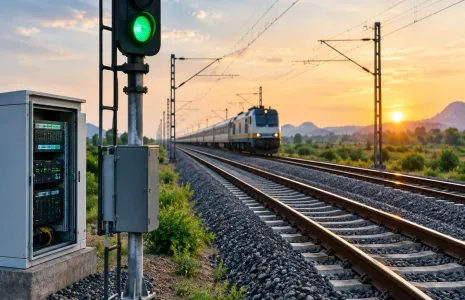
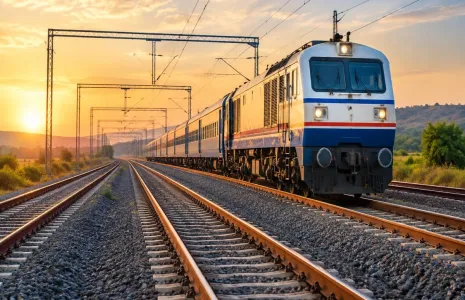
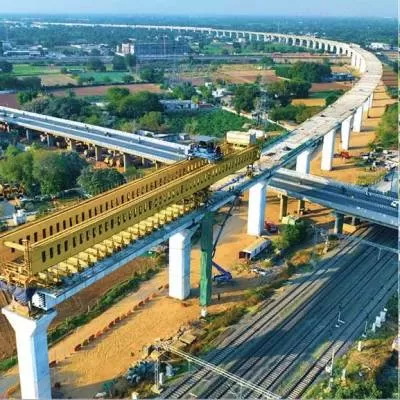
Electrification: As of fiscal 2024, over 94% of the broad-gauge network is electrified. High-Speed Rail: The Mumbai-Ahmedabad corridor is under construction at ?1.08 lakh crore, set to reduce travel time to just two hours at speeds up to 320 km/h. Dedicated Freight Corridor: Over 3,300 km is being developed to improve freight efficiency and relieve congestion on passenger lines. Track Doubling: Indian Railways has completed 15,861 km of track doubling since fiscal 2016, enhancing network capacity. Operational Advancements:

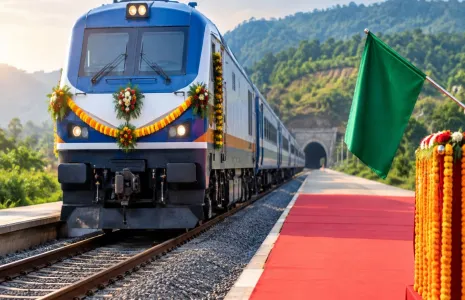
82 Vande Bharat and 8 Tejas Express trains are operational. 144 locomotives are equipped with Kavach, an indigenous automatic train protection system. Challenges and Revenue Diversification: Despite these advancements, the report notes the need for Indian Railways to diversify revenue sources, as budgetary allocations have increased only 2.8% this fiscal. Suggested strategies include:

Vicinity development around stations. Premium services for passengers. Data monetization to boost revenue. Future Plans: Indian Railways aims to:

Construct 100,000 km of new railway tracks in the next two decades. Expand Kavach to cover 44,000 km within five years. Produce 400 new Vande Bharat trains in three years. Station Modernization and Digital Innovations: The Amrit Bharat Station Scheme will redevelop 553 stations with a ?1 lakh crore budget. Enhancements will include improved waiting areas, digital ticketing, and green buildings. Free Wi-Fi has been installed at over 6,000 stations, alongside a next-generation e-ticketing system capable of processing 26,000 tickets per minute.

Indian Railways is undergoing a transformative journey, with projected investments of ?17.4 lakh crore from fiscal 2016 to 2025, reflecting a 12% compound annual growth rate (CAGR). This positions the railways as a crucial element in India’s ambition to achieve a high-income economy. Infrastructure Development Highlights: Electrification: As of fiscal 2024, over 94% of the broad-gauge network is electrified. High-Speed Rail: The Mumbai-Ahmedabad corridor is under construction at ?1.08 lakh crore, set to reduce travel time to just two hours at speeds up to 320 km/h. Dedicated Freight Corridor: Over 3,300 km is being developed to improve freight efficiency and relieve congestion on passenger lines. Track Doubling: Indian Railways has completed 15,861 km of track doubling since fiscal 2016, enhancing network capacity. Operational Advancements: 82 Vande Bharat and 8 Tejas Express trains are operational. 144 locomotives are equipped with Kavach, an indigenous automatic train protection system. Challenges and Revenue Diversification: Despite these advancements, the report notes the need for Indian Railways to diversify revenue sources, as budgetary allocations have increased only 2.8% this fiscal. Suggested strategies include: Vicinity development around stations. Premium services for passengers. Data monetization to boost revenue. Future Plans: Indian Railways aims to: Construct 100,000 km of new railway tracks in the next two decades. Expand Kavach to cover 44,000 km within five years. Produce 400 new Vande Bharat trains in three years. Station Modernization and Digital Innovations: The Amrit Bharat Station Scheme will redevelop 553 stations with a ?1 lakh crore budget. Enhancements will include improved waiting areas, digital ticketing, and green buildings. Free Wi-Fi has been installed at over 6,000 stations, alongside a next-generation e-ticketing system capable of processing 26,000 tickets per minute.

Related Stories

Gold Stories

Next Story
Resources

Schindler named among Forbes’ World’s Best Employers 2026

Schindler has been named among Forbes’ World’s Best Employers 2026, a global ranking recognising companies for their workplace environments.Compiled by Forbes in partnership with Statista, the ranking is based on independent employee feedback, including whether employees would recommend their organisation to friends and family.The company said the recognition reflected its focus on creating a workplace where employees can develop their expertise and build careers. ..

Next Story
Infrastructure Urban

India needs an export-execution mindset: Vishesh Jain

Interview with Vishesh Jain, Founder & CEO, EximpleWhat gaps in India’s global trade ecosystem led you to build Eximple, and what problem did you see businesses struggling with most?Eximple came out of a problem that all three founders had seen from different choke points in the trade ecosystem. India has millions of MSMEs and manufacturers, and many of them can make products that are genuinely competitive on quality. Yet only a small fraction is able to build meaningful international businesses. In our experience, the gap is usually not manufacturing capability; it is the ability to exe..

Next Story
Building Material

Nuvoco reports 13.5% revenue growth in Q2 FY27

Nuvoco Vistas Corp. Ltd. reported consolidated revenue of Rs 27.9 billion for Q2 FY27, up 13.5% year on year. Cement sales volume rose 9% to 4.7 million tonnes (MMT), while EBITDA increased 11% to Rs 4.11 billion.The company said it began its cement operations in 2014 with a 2.3 MMT per annum (MMTPA) operation at Nimbol. It now aims to reach 35 MMTPA of cement capacity by FY28, nearly 15 times its initial capacity. Its portfolio spans cement, ready-mix concrete and modern building materials.On sustainability and cost efficiency, Nuvoco partnered with CleanMax for a 46.4 MW wind-solar hybrid re..

Advertisement

Subscribe to Our Newsletter

Get daily newsletters around different themes from Construction world.

STAY CONNECTED

Advertisement

SPECIAL OFFER
QR Code