+
Kerala High-Speed Rail Route Revealed by E Sreedharan
RAILWAYS & METRO RAIL

Kerala High-Speed Rail Route Revealed by E Sreedharan

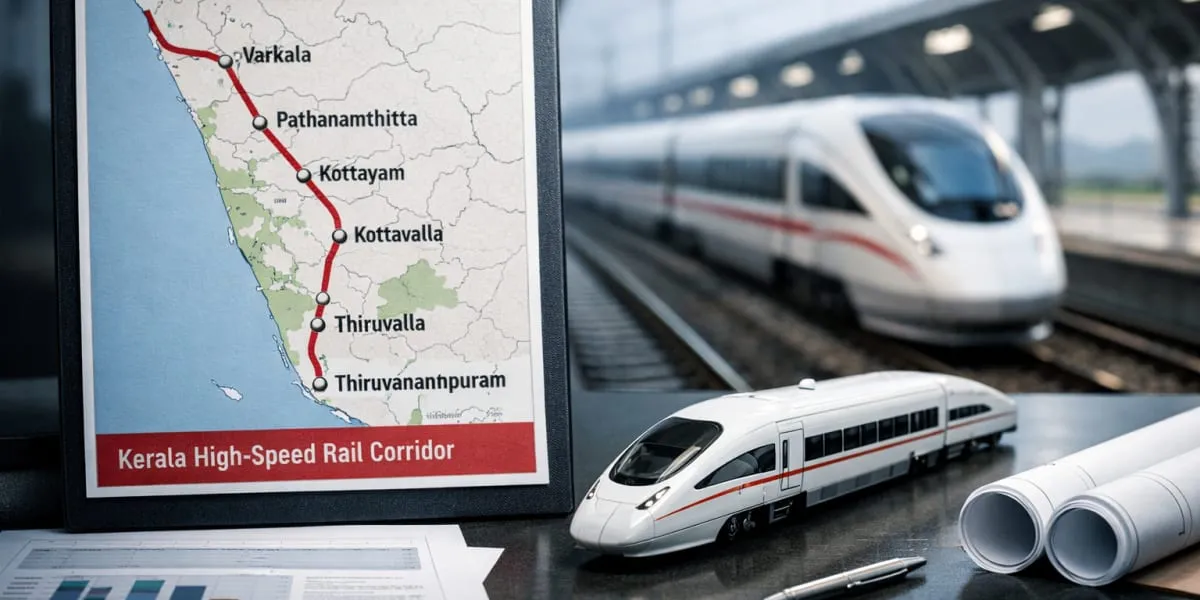
E Sreedharan unveiled key details of the proposed Kerala high-speed rail corridor, presenting a revised alignment, station list, expected fares and journey times. The updated alignment now includes Pathanamthitta district and will feature 20 stations along the 465 km corridor. A dedicated team has been constituted to steer implementation.

The line will originate at Thiruvananthapuram Central and pass through coastal and central towns including Varkala, Kollam, Kottarakkara, Thiruvalla, Kottayam and Ernakulam before reaching Nedumbassery, Thrissur, Malappuram and Kannur. Stations are planned at intervals of 20 to 30 km to enhance regional connectivity and the corridor will link the three major airports at Thiruvananthapuram, Nedumbassery and Kannur. The configuration is intended to strengthen multimodal transport integration across the state.

The project has been designed for a maximum speed of 200 kmph with a commercial operating speed set at 140 kmph and operational top speeds expected to reach 180 kmph in selected stretches. Once operational, the Thiruvananthapuram to Kannur journey is projected to take three hours and 20 minutes, delivering a substantial reduction in travel time compared with existing services. Service frequency and precise timetables will be developed during detailed planning.

The estimated construction cost for the first phase has been revised down to Rs565 billion (bn). Passenger demand is projected at 0.5 mn daily on average, reflecting anticipated modal shift and corridor demand. Proposed ticket fares range from Rs440 for Thiruvananthapuram to Ernakulam up to Rs780 for the full Thiruvananthapuram to Kannur trip and are presented as more affordable than current Vande Bharat services operating in the state. Fare structures and concessions will be finalised during financial modelling.

As part of sustainability measures, solar farms will be established at stations to supply power for operations and the cost of solar generation has been included in the project estimate. The project team will proceed to detailed surveys, alignment finalisation and stakeholder consultations ahead of funding and construction phases.

E Sreedharan unveiled key details of the proposed Kerala high-speed rail corridor, presenting a revised alignment, station list, expected fares and journey times. The updated alignment now includes Pathanamthitta district and will feature 20 stations along the 465 km corridor. A dedicated team has been constituted to steer implementation. The line will originate at Thiruvananthapuram Central and pass through coastal and central towns including Varkala, Kollam, Kottarakkara, Thiruvalla, Kottayam and Ernakulam before reaching Nedumbassery, Thrissur, Malappuram and Kannur. Stations are planned at intervals of 20 to 30 km to enhance regional connectivity and the corridor will link the three major airports at Thiruvananthapuram, Nedumbassery and Kannur. The configuration is intended to strengthen multimodal transport integration across the state. The project has been designed for a maximum speed of 200 kmph with a commercial operating speed set at 140 kmph and operational top speeds expected to reach 180 kmph in selected stretches. Once operational, the Thiruvananthapuram to Kannur journey is projected to take three hours and 20 minutes, delivering a substantial reduction in travel time compared with existing services. Service frequency and precise timetables will be developed during detailed planning. The estimated construction cost for the first phase has been revised down to Rs565 billion (bn). Passenger demand is projected at 0.5 mn daily on average, reflecting anticipated modal shift and corridor demand. Proposed ticket fares range from Rs440 for Thiruvananthapuram to Ernakulam up to Rs780 for the full Thiruvananthapuram to Kannur trip and are presented as more affordable than current Vande Bharat services operating in the state. Fare structures and concessions will be finalised during financial modelling. As part of sustainability measures, solar farms will be established at stations to supply power for operations and the cost of solar generation has been included in the project estimate. The project team will proceed to detailed surveys, alignment finalisation and stakeholder consultations ahead of funding and construction phases.

Next Story
Infrastructure Urban

India Issues Joint Space Cyber Security Guidelines

The Indian Computer Emergency Response Team (CERT-In), under the Ministry of Electronics and Information Technology, and the Space Industry Association of India (SIA-India) released a comprehensive framework and guidelines for space cyber security at the DefSat Conference and Expo 2026 in New Delhi from 24 to 26 February 2026. The release noted that space cyber security, including satellite communication systems, is vital to connectivity in remote and strategic regions and underpins national security, disaster response, navigation, broadcasting and a wide range of economic activities. The advi..

Next Story
Infrastructure Urban

MeitY And DSCI Honour Winners Of Cyber Security Grand Challenge 2.0

The Ministry of Electronics and Information Technology (MeitY) and the Data Security Council of India (DSCI) felicitated winners of the Cyber Security Grand Challenge 2.0, a programme to strengthen national cyber security capability and build expertise in critical technology areas. The event, presided over by S. Krishnan, Secretary at MeitY, marked the end of a staged innovation competition launched in January 2025 on the MyGov platform. The combined prize pool was Rs 68.5 mn for the competition overall. The grand winners comprised three start?ups. Cambrian Skillsda Technologies and Consultanc..

Next Story
Infrastructure Urban

UIDAI Teams With Google To Map Authorised Aadhaar Centres

The Unique Identification Authority of India (UIDAI) has partnered with Google to enable display of authorised Aadhaar centres on Google Maps, a measure intended to improve access and convenience for residents nationwide. The initiative will publish verified centre locations and associated service types to make navigation straightforward and reduce uncertainty. The announcement emphasises that the integration will direct users to centres that have been authenticated by the authority. The service will indicate the nature of services offered at each centre, including adult enrolment, child enrol..

Advertisement

Subscribe to Our Newsletter

Get daily newsletters around different themes from Construction world.

STAY CONNECTED

Advertisement

Advertisement

Advertisement

Open In App