+
Kochi Metro Introduces Braille Enabled Facilities
RAILWAYS & METRO RAIL

Kochi Metro Introduces Braille Enabled Facilities

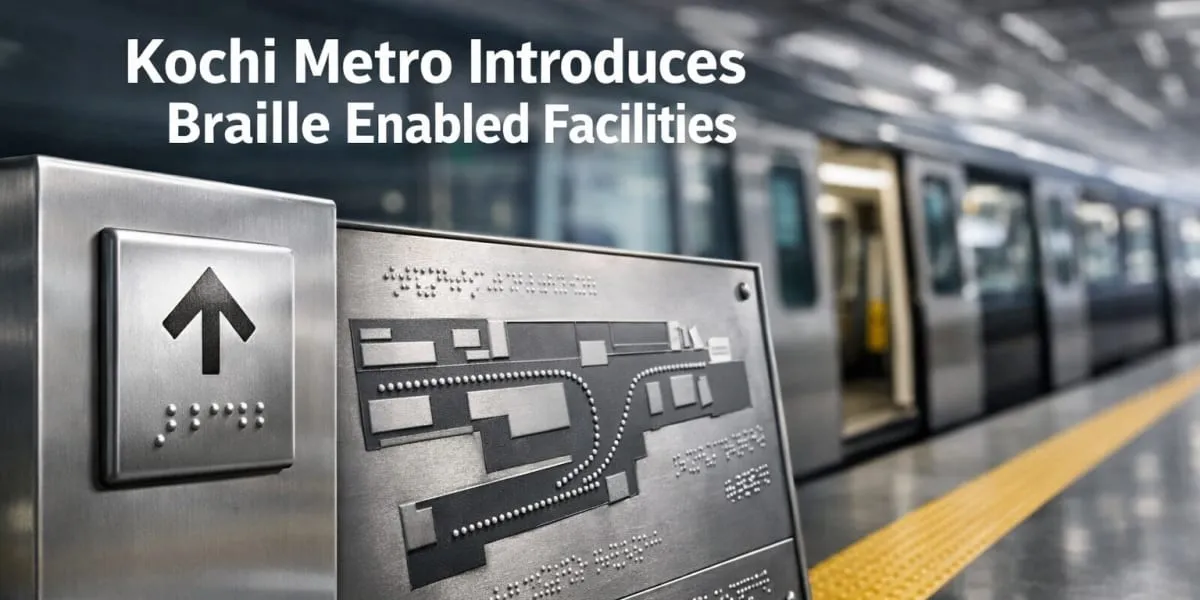
Kochi Metro Rail Limited (KMRL) has unveiled Braille-enabled facilities at Changampuzha Park metro station to make urban transport more inclusive. The project was implemented in collaboration with the Confederation of Indian Industry-Young Indians (CII-Young Indians) under Project Disha and was inaugurated by KMRL managing director Loknath Behera in the presence of CII-Young Indians representatives and Dr Reem S, a visually impaired commuter and assistant professor. The scheme aims to help visually impaired passengers navigate the station independently and with greater confidence.

The station has been equipped with a tactile Braille station map that enables understanding of the layout through touch, and Braille markings on handrails provide continuous wayfinding assistance. Key facilities have been identified with Braille signboards and new scripts have been installed at strategic points across the terminal, complementing tactile paths present since the metro's inception in 2017. Metro staff are described as accommodating and the measures are intended to work alongside human assistance.

The integrated system is designed to enable visually impaired passengers to plan journeys independently, reduce reliance on others for assistance, and move around the station with greater ease and assurance. The commuter who uses the service recommended regular public announcements to alert other passengers to tactile paths and Braille scripts so that they remain unblocked and suggested additional Braille scripts to help new users learn routes. Metro officials indicated that these operational suggestions will be taken up promptly.

Representatives of CII-Young Indians said they are considering extending Project Disha beyond Changampuzha Park station and that discussions with the metro team are under way to determine next steps. The ambition is to make the widely used public mobility system more inclusive and to normalise impairment in public spaces so that visually impaired commuters feel less dependent and less visible as a spectacle. The introduction of Braille-enabled facilities at the station is presented as a practical step towards those wider accessibility goals.

Kochi Metro Rail Limited (KMRL) has unveiled Braille-enabled facilities at Changampuzha Park metro station to make urban transport more inclusive. The project was implemented in collaboration with the Confederation of Indian Industry-Young Indians (CII-Young Indians) under Project Disha and was inaugurated by KMRL managing director Loknath Behera in the presence of CII-Young Indians representatives and Dr Reem S, a visually impaired commuter and assistant professor. The scheme aims to help visually impaired passengers navigate the station independently and with greater confidence. The station has been equipped with a tactile Braille station map that enables understanding of the layout through touch, and Braille markings on handrails provide continuous wayfinding assistance. Key facilities have been identified with Braille signboards and new scripts have been installed at strategic points across the terminal, complementing tactile paths present since the metro's inception in 2017. Metro staff are described as accommodating and the measures are intended to work alongside human assistance. The integrated system is designed to enable visually impaired passengers to plan journeys independently, reduce reliance on others for assistance, and move around the station with greater ease and assurance. The commuter who uses the service recommended regular public announcements to alert other passengers to tactile paths and Braille scripts so that they remain unblocked and suggested additional Braille scripts to help new users learn routes. Metro officials indicated that these operational suggestions will be taken up promptly. Representatives of CII-Young Indians said they are considering extending Project Disha beyond Changampuzha Park station and that discussions with the metro team are under way to determine next steps. The ambition is to make the widely used public mobility system more inclusive and to normalise impairment in public spaces so that visually impaired commuters feel less dependent and less visible as a spectacle. The introduction of Braille-enabled facilities at the station is presented as a practical step towards those wider accessibility goals.

Next Story
Infrastructure Urban

India Expands Semiconductor Training To 500 Institutions

Under the Chips to Startups programme of the India Semiconductor Mission, the Union minister responsible for Railways, Information and Broadcasting, and Electronics and IT reported notable progress in talent development. He indicated that over the past four years substantial steps have been taken towards a 10-year target of training 85,000 engineers in semiconductor design. World-class EDA tools have been deployed in 315 academic institutions across the country to provide students with practical exposure to chip design. These EDA tools are supported by leading global firms and are accessible t..

Next Story
Infrastructure Urban

Delhi Institutions Support India Semiconductor Mission

The Government of India has prioritised talent development through training, upskilling and workforce development under the Chips to Startups initiative of the India Semiconductor Mission, with officials noting progress in four years towards a 10-year target of training 85,000 engineers in semiconductor design. Electronic design automation tools provided by Synopsys, Cadence, Siemens, Renesas, Ansys and AMD have been deployed in 315 academic institutions, enabling students to gain practical chip design experience. Chips have been fabricated and tested at the Semiconductor Laboratory, Mohali, a..

Next Story
Infrastructure Urban

NHA Announces Winners Of NHCX Hackathon At IIT Hyderabad

The National Health Authority (NHA) has concluded the NHCX Hackathon under the Ayushman Bharat Digital Mission (ABDM) to stimulate innovation around the National Health Claims Exchange (NHCX). The winning teams presented their solutions at the NHCX Innovation Meet held at IIT Hyderabad during a two-day event in March 2026 that also served as the hackathon grand finale. The hackathon itself ran from 22 to 28 February 2026 and aimed to accelerate paperless, transparent claims processing across India. The event was organised with a range of ecosystem partners, including the Insurance Regulatory a..

Advertisement

Subscribe to Our Newsletter

Get daily newsletters around different themes from Construction world.

STAY CONNECTED

Advertisement

Advertisement

Advertisement