+
Land and Cost Sharing Stall Shivamogga Rail Projects
RAILWAYS & METRO RAIL

Land and Cost Sharing Stall Shivamogga Rail Projects

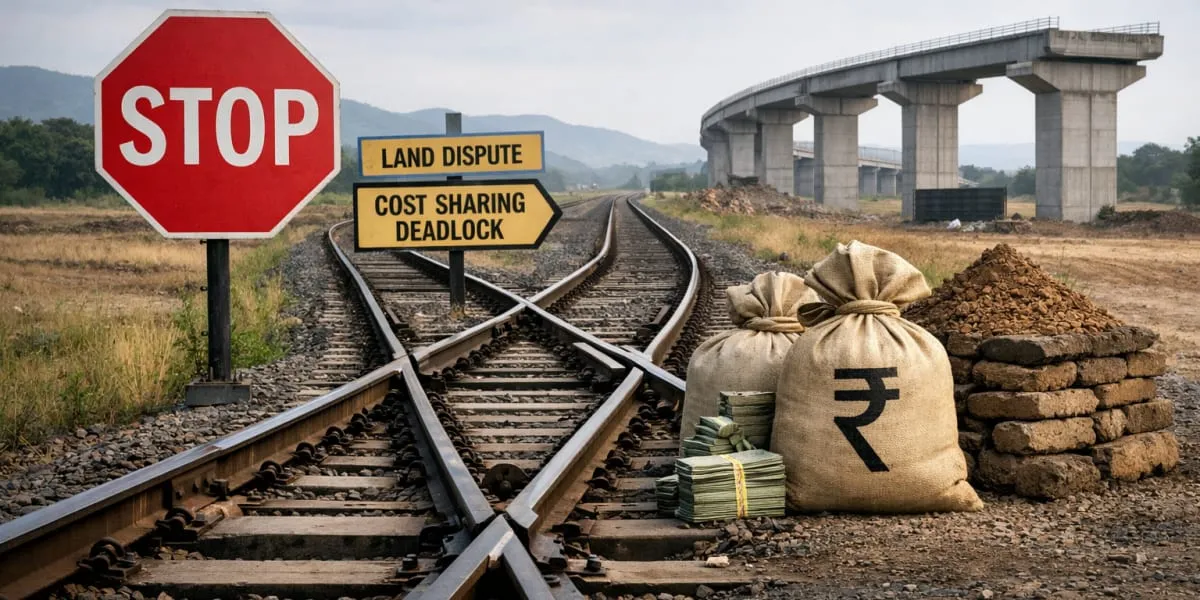
Two major railway line projects meant to improve connectivity in central Karnataka and the Malnad region remain stalled amid land acquisition and cost sharing disputes. The schemes comprise a new Shivamogga to Harihara line and a Shivamogga to Ranebennur line via Shikaripura, both intended to shorten travel, strengthen passenger links and facilitate freight movement to industrial centres. Both projects were sanctioned under a 50:50 cost sharing model between Indian Railways and the state government, making state cooperation essential.

The Shivamogga–Harihara route measures 79 km and was sanctioned to provide a shorter rail link between Malnad and central Karnataka. The project requires 488 hectares of land but no land has been handed over so far and the state government has not committed its share of funding, effectively stalling the work. With no land acquisition the project has not moved beyond sanction and continued delay is likely to push up costs given rising land prices and construction expenses.

The Shivamogga–Ranebennur new line via Shikaripura stretches 96 km and is similarly structured on a 50:50 funding basis intended to integrate Shivamogga with north Karnataka. Out of 559 hectares required for the alignment 226 hectares have been acquired while 333 hectares remain pending and railway authorities have indicated that large scale civil works cannot proceed until the remaining land is handed over. Though this project has recorded partial progress it remains far from full scale implementation.

Railway officials have reiterated in parliamentary responses that under the cost sharing arrangement the state must provide land free of cost and bear half of the project expenditure, a requirement that has not been fulfilled. Local industry representatives have emphasised that the lines will help firms in the region connect with Mumbai and north India for both trade and passenger purposes and urged prompt action. Officials and stakeholders indicate that resolution of land and funding issues is essential to prevent further escalation of time and cost.

Two major railway line projects meant to improve connectivity in central Karnataka and the Malnad region remain stalled amid land acquisition and cost sharing disputes. The schemes comprise a new Shivamogga to Harihara line and a Shivamogga to Ranebennur line via Shikaripura, both intended to shorten travel, strengthen passenger links and facilitate freight movement to industrial centres. Both projects were sanctioned under a 50:50 cost sharing model between Indian Railways and the state government, making state cooperation essential. The Shivamogga–Harihara route measures 79 km and was sanctioned to provide a shorter rail link between Malnad and central Karnataka. The project requires 488 hectares of land but no land has been handed over so far and the state government has not committed its share of funding, effectively stalling the work. With no land acquisition the project has not moved beyond sanction and continued delay is likely to push up costs given rising land prices and construction expenses. The Shivamogga–Ranebennur new line via Shikaripura stretches 96 km and is similarly structured on a 50:50 funding basis intended to integrate Shivamogga with north Karnataka. Out of 559 hectares required for the alignment 226 hectares have been acquired while 333 hectares remain pending and railway authorities have indicated that large scale civil works cannot proceed until the remaining land is handed over. Though this project has recorded partial progress it remains far from full scale implementation. Railway officials have reiterated in parliamentary responses that under the cost sharing arrangement the state must provide land free of cost and bear half of the project expenditure, a requirement that has not been fulfilled. Local industry representatives have emphasised that the lines will help firms in the region connect with Mumbai and north India for both trade and passenger purposes and urged prompt action. Officials and stakeholders indicate that resolution of land and funding issues is essential to prevent further escalation of time and cost.

Next Story
Resources

Deepak Halder Appointed CEO Of Sarvottam India

Sarvottam India has appointed Deepak Halder as its Chief Executive Officer. With over 23 years of professional experience, including nearly two decades in the real estate sector, Halder brings extensive leadership and strategic expertise to the organisation. Halder began his career in real estate in 2007 and has held senior leadership roles with developers such as Bestech Group, Paras Buildtech, Hero Realty, ATS Infrastructure and Rajdarbar Group. During his career, he has been involved in strategic expansion, brand positioning, major project launches and revenue growth across residential and..

Next Story
Real Estate

India Drives APAC Office Leasing Growth in 2025: Colliers

Office demand across Asia Pacific’s 11 major markets reached 9.8 million sq m (105.5 million sq ft) in 2025, marking an 11 per cent year-on-year increase, according to Colliers’ Asia Pacific Office Market Insights February 2026 report. India, Mainland China and Japan accounted for over 90 per cent of the region’s total demand during the year, with India emerging as the dominant leasing market.India alone contributed nearly 68 per cent of total office leasing across the region and accounted for 55 per cent of new office supply among the top 11 APAC markets in 2025. The report highlights t..

Next Story
Infrastructure Urban

Ramky Infra Wins Rs 14.01 Billion Dighi Port Project

Ramky Infrastructure has secured an EPC contract worth Rs 14.01 billion from Maharashtra Industrial Township Limited (MITL) for infrastructure development works at the Dighi Port Industrial Area (DPIA) Phase 1 under the Delhi Mumbai Industrial Corridor (DMIC). The contract value includes GST and revenues from operations and maintenance (O&M).The project will be executed within 930 days from the appointed date, followed by a four-year O&M period starting from the commercial operation date (COD), with the possibility of extension through mutual agreement.MITL is a special purpose vehicle..

Advertisement

Subscribe to Our Newsletter

Get daily newsletters around different themes from Construction world.

STAY CONNECTED

Advertisement

Advertisement

Advertisement

Open In App