Maharashtra Government clears broad gauge metro project
RAILWAYS & METRO RAIL

Maharashtra Government clears broad gauge metro project

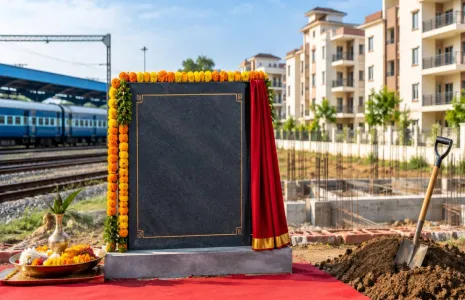
The Maharashtra Cabinet has cleared the Rs.3,336 million broad- gauge (BG) metro proposal of Maha Metro, the state’s metro rail project company. It will now be sent to the Central Government for its approval. The project aims to provide high-speed connectivity to satellite towns around Nagpur, such as—Narkhed, Wardha, Bhandara and Ramtek. 

Once implemented, metro coaches would run on Indian Railways’ track—the first ever such service to be introduced in India. Hailed as one of the most ambitious projects proposed by Maha Metro, it is expected to change the transportation pattern in Nagpur and neighbouring areas. It will utilise the existing infrastructure of Indian Railways by providing air-conditioned, faster, reliable and comfortable services between Nagpur and the four satellite towns. 

In July 2018, an MoU was signed between Indian Railways and Maha Metro to link the railway line to metro coaches on the BG network and create a mass rapid transit system (MRTS) in Nagpur city.

This facility is expected to act as feeder service to the Nagpur Metro and will help increase its present ridership. It will also reduce dependency on private vehicles and transportation services and traffic congestion, further reducing accidents and pollution. The total distance covered by the project, involving all the four routes, is 265-km.

The Maha Metro trains will run at a speed of 120 kmph. The coaches will be equipped with all comforts for the commuters between the four locations. Initially, four trains will be put to service to connect the four locations. The number will be subsequently increased to eight after a certain period of time.

KFW, the international funding agency, that had also funded Maha Metro’s Phase 1, has agreed to finance the BG metro project to the tune of Rs.3,052 million of the total project cost of Rs.3,336 million.

Of the remaining amount, the Maharashtra government would also provide 50 per cent of the strategic debt (SD) of the Government of India (Rs.71 million) and 100 per cent (Rs.142 million) of the SD incurred by the state. Thus, collectively, an amount of `213 million would be sanctioned by the state government and the rest will be borne by the Centre.


The Maharashtra Cabinet has cleared the Rs.3,336 million broad- gauge (BG) metro proposal of Maha Metro, the state’s metro rail project company. It will now be sent to the Central Government for its approval. The project aims to provide high-speed connectivity to satellite towns around Nagpur, such as—Narkhed, Wardha, Bhandara and Ramtek. Once implemented, metro coaches would run on Indian Railways’ track—the first ever such service to be introduced in India. Hailed as one of the most ambitious projects proposed by Maha Metro, it is expected to change the transportation pattern in Nagpur and neighbouring areas. It will utilise the existing infrastructure of Indian Railways by providing air-conditioned, faster, reliable and comfortable services between Nagpur and the four satellite towns. In July 2018, an MoU was signed between Indian Railways and Maha Metro to link the railway line to metro coaches on the BG network and create a mass rapid transit system (MRTS) in Nagpur city.This facility is expected to act as feeder service to the Nagpur Metro and will help increase its present ridership. It will also reduce dependency on private vehicles and transportation services and traffic congestion, further reducing accidents and pollution. The total distance covered by the project, involving all the four routes, is 265-km.The Maha Metro trains will run at a speed of 120 kmph. The coaches will be equipped with all comforts for the commuters between the four locations. Initially, four trains will be put to service to connect the four locations. The number will be subsequently increased to eight after a certain period of time.KFW, the international funding agency, that had also funded Maha Metro’s Phase 1, has agreed to finance the BG metro project to the tune of Rs.3,052 million of the total project cost of Rs.3,336 million.Of the remaining amount, the Maharashtra government would also provide 50 per cent of the strategic debt (SD) of the Government of India (Rs.71 million) and 100 per cent (Rs.142 million) of the SD incurred by the state. Thus, collectively, an amount of `213 million would be sanctioned by the state government and the rest will be borne by the Centre.

Next Story
Real Estate

RBI Rate Cut Boosts Confidence Across Housing Market

Industry Context and Market DynamicsThe real estate industry has welcomed the RBI’s rate cut as a timely boost to affordability and demand. With home prices having risen steadily across major markets, even a marginal reduction in interest rates meaningfully strengthens purchasing power, especially for first-time and mid-income buyers.Ashish Jerath, President – Sales & Marketing, Smartworld Developers, observes:“The RBI’s 25-basis-point cut, bringing the repo rate down to 5.25%, is a timely boost for the real estate sector. Lower interest rates reduce borrowing costs, enabling homeb..

Next Story
Infrastructure Transport

BMC Resumes Rs 170 Billion Road Works, Targets 80 per cent By Jan 2026

Following the withdrawal of the southwest monsoon in October, the Brihanmumbai Municipal Corporation (BMC) has restarted work on 645 roads—covering 297.49 kilometres—under its large-scale concretisation programme. Data shows that more than 60 per cent of the resumed works are located in the western suburbs. Officials said the civic body aims to complete concretisation on 80 per cent of the roads where fresh work has begun by January 2026. Launched in 2022, the Rs 170 billion project seeks to concretise 700 kilometres of roads across Mumbai. All civil works were halted during the monsoon ..

Next Story
Infrastructure Urban

India Pushes Digital Shift In Urban Land Mapping

The Department of Land Resources (DoLR) under the Ministry of Rural Development has convened a National Symposium on NAKSHA – the National Geospatial Knowledge-based Land Survey of Urban Habitations – to advance India’s transition to modern, technology-driven land mapping. Speaking at the inaugural session, Secretary Manoj Joshi underscored the urgent need to move revenue departments away from outdated, tape-based methods and rough hand-drawn sketches. He stressed that adopting latitude–longitude-based digital mapping and GIS-linked registration systems is essential for economic stabi..

Advertisement

Subscribe to Our Newsletter

Get daily newsletters around different themes from Construction world.

STAY CONNECTED

Advertisement

Advertisement

Advertisement

Advertisement

Open In App