+
Mumbai Ahmedabad Bullet Train Lays Foundation for High Speed Rail
RAILWAYS & METRO RAIL

Mumbai Ahmedabad Bullet Train Lays Foundation for High Speed Rail

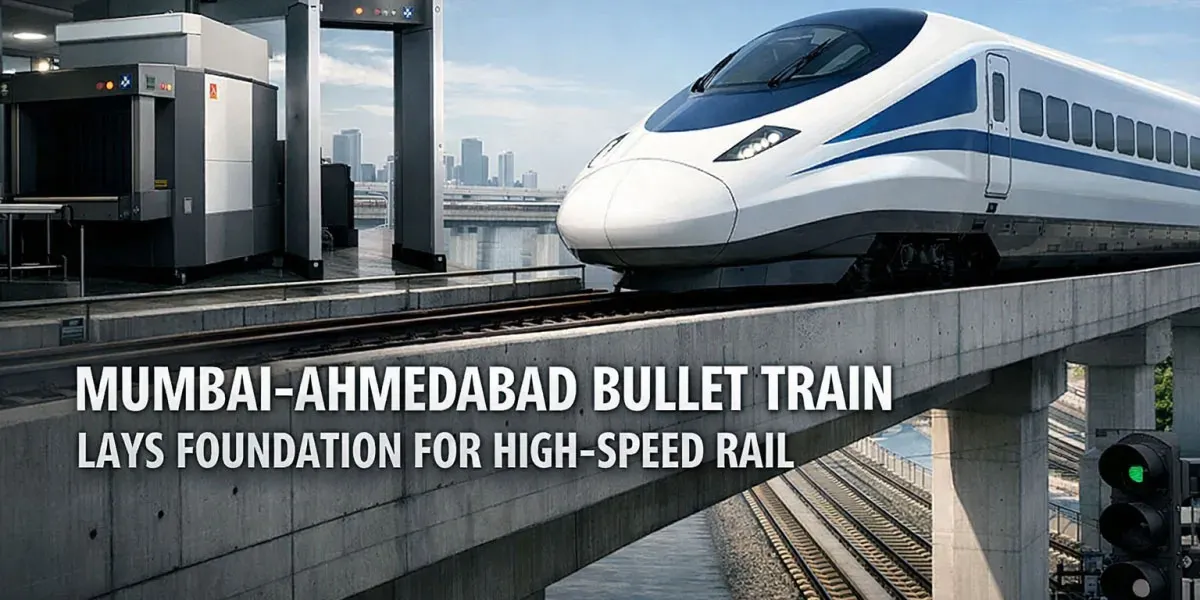
The Mumbai-Ahmedabad High Speed Rail Project (MAHSR) covering 508 km is being executed with assistance from the Government of Japan and is planned on an elevated viaduct. Station designs include controlled entry points, baggage scanners, Door Frame Metal Detectors (DFMDs) and Closed Circuit Television (CCTV) surveillance to enhance security. The project aims to develop capacity in track construction, advanced signalling, rolling stock manufacturing and project management for future high speed corridors.

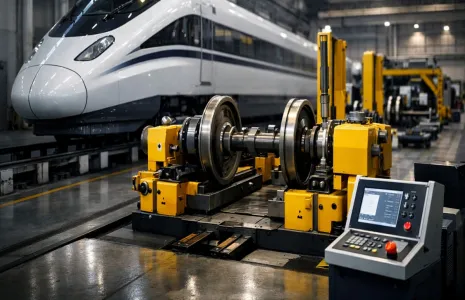
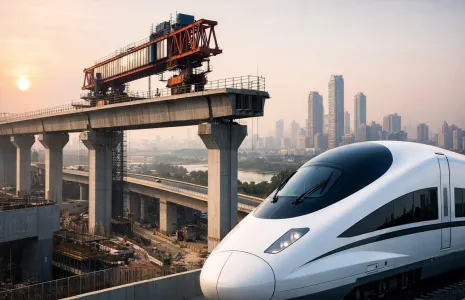
Indigenisation has progressed in long span steel truss girders, heavy machinery for full span launching and specialised slab track materials, strengthening domestic manufacturing. Indian agencies in collaboration with the Indian Institute of Technology Delhi are conducting dynamic analysis and traction modelling, and an indigenous Rail Turnover Prevention Device has been introduced to improve safety. Innovations include a full span launching method for 40 metre prestressed box girders weighing about 1,000 t, indigenous noise barriers and an underground station foundation designed for a future 90 metre building.

Approximately 1,000 engineers and skilled workers have been trained in Japanese methodology, supported by a dedicated track training facility at Surat and supervised track works. Geo technical investigations have been carried out generally at 100 metre intervals and a new geo tech laboratory has been established to guard against geological surprises. Civil works have progressed with entire land of 1,389.5 ha acquired, all 1,651 utilities shifted and foundation works completed at eight stations while work continues at several others.

Progress includes foundations, piers and girder launching in Gujarat and Maharashtra, seventeen river bridges completed and about four point eight km of an undersea tunnel between Ghansoli and Shilphata finished. Expenditure of Rs 86,939 crore to 31.12.2025 equates to Rs 869.39 bn and Dedicated Freight Corridors being developed at a cost of Rs 1,24,005 crore amount to Rs 1,240.05 bn, with the eastern corridor commissioned and most of the western corridor operational. The experience gained is expected to strengthen planning, decision making and domestic manufacture for India’s future high speed rail network.

The Mumbai-Ahmedabad High Speed Rail Project (MAHSR) covering 508 km is being executed with assistance from the Government of Japan and is planned on an elevated viaduct. Station designs include controlled entry points, baggage scanners, Door Frame Metal Detectors (DFMDs) and Closed Circuit Television (CCTV) surveillance to enhance security. The project aims to develop capacity in track construction, advanced signalling, rolling stock manufacturing and project management for future high speed corridors.Indigenisation has progressed in long span steel truss girders, heavy machinery for full span launching and specialised slab track materials, strengthening domestic manufacturing. Indian agencies in collaboration with the Indian Institute of Technology Delhi are conducting dynamic analysis and traction modelling, and an indigenous Rail Turnover Prevention Device has been introduced to improve safety. Innovations include a full span launching method for 40 metre prestressed box girders weighing about 1,000 t, indigenous noise barriers and an underground station foundation designed for a future 90 metre building.Approximately 1,000 engineers and skilled workers have been trained in Japanese methodology, supported by a dedicated track training facility at Surat and supervised track works. Geo technical investigations have been carried out generally at 100 metre intervals and a new geo tech laboratory has been established to guard against geological surprises. Civil works have progressed with entire land of 1,389.5 ha acquired, all 1,651 utilities shifted and foundation works completed at eight stations while work continues at several others.Progress includes foundations, piers and girder launching in Gujarat and Maharashtra, seventeen river bridges completed and about four point eight km of an undersea tunnel between Ghansoli and Shilphata finished. Expenditure of Rs 86,939 crore to 31.12.2025 equates to Rs 869.39 bn and Dedicated Freight Corridors being developed at a cost of Rs 1,24,005 crore amount to Rs 1,240.05 bn, with the eastern corridor commissioned and most of the western corridor operational. The experience gained is expected to strengthen planning, decision making and domestic manufacture for India’s future high speed rail network.

Next Story
Real Estate

Casagrand Launches Keystone In Tiruppur

Casagrand has launched Casagrand Keystone, a gated residential development at Rakkiyapalayam, off Avinashi Road, in Tiruppur. Spread across 2.2 acres, the B+G+5 structure comprises 142 units of 2 and 3 BHK homes, supported by 48 indoor and outdoor amenities. The project is introduced at a starting price of Rs 5,199 per sq. ft. The development allocates 1.3 acres to open space, including a central park of about 24,500 sq. ft. A 6,800 sq. ft. clubhouse includes a multipurpose hall, mini theatre and indoor recreation facilities. Other amenities include a 5,100 sq. ft. swimming pool, poolside par..

Next Story
Real Estate

Premium homes account for half of India’s housing sales in 2025

Knight Frank India, in its latest report on India’s office and residential property market, has highlighted a significant shift in housing demand, with homes priced above Rs 10 million accounting for 50 per cent of total residential sales across the top eight cities in 2025. The findings underscore the growing dominance of premium housing in the country’s real estate landscape.Out of 348,247 residential units sold during the year, approximately 175,091 units were in the Rs 10 million-plus category, marking a 14 per cent year-on-year increase. The data reflects changing buyer preferences, w..

Next Story
Infrastructure Energy

Xbattery launches XB-5K energy storage system for homes, offices

Xbattery, a Hyderabad-based deep-tech company specialising in next-generation energy storage and battery management technologies, has introduced its flagship XB-5K, a scalable 5kWh energy storage system designed for homes and offices in India.The XB-5K is built on the company’s indigenously developed BharatBMS platform, described as India’s first universal high-voltage battery management system architecture aimed at reducing import dependence and improving after-sales service capabilities. The launch comes as India seeks to strengthen domestic manufacturing and address reliance on imported..

Advertisement

Subscribe to Our Newsletter

Get daily newsletters around different themes from Construction world.

STAY CONNECTED

Advertisement

Advertisement

Advertisement

Open In App