+
Pune Double-Decker Metro Flyover On Nagar Road To Ease Traffic
RAILWAYS & METRO RAIL

Pune Double-Decker Metro Flyover On Nagar Road To Ease Traffic

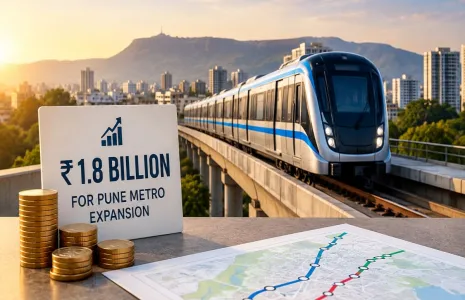
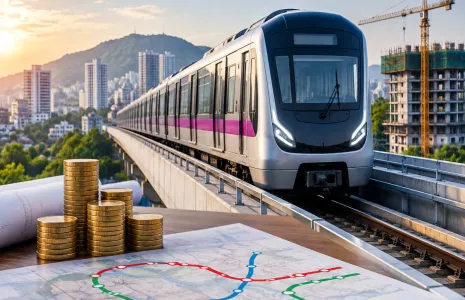
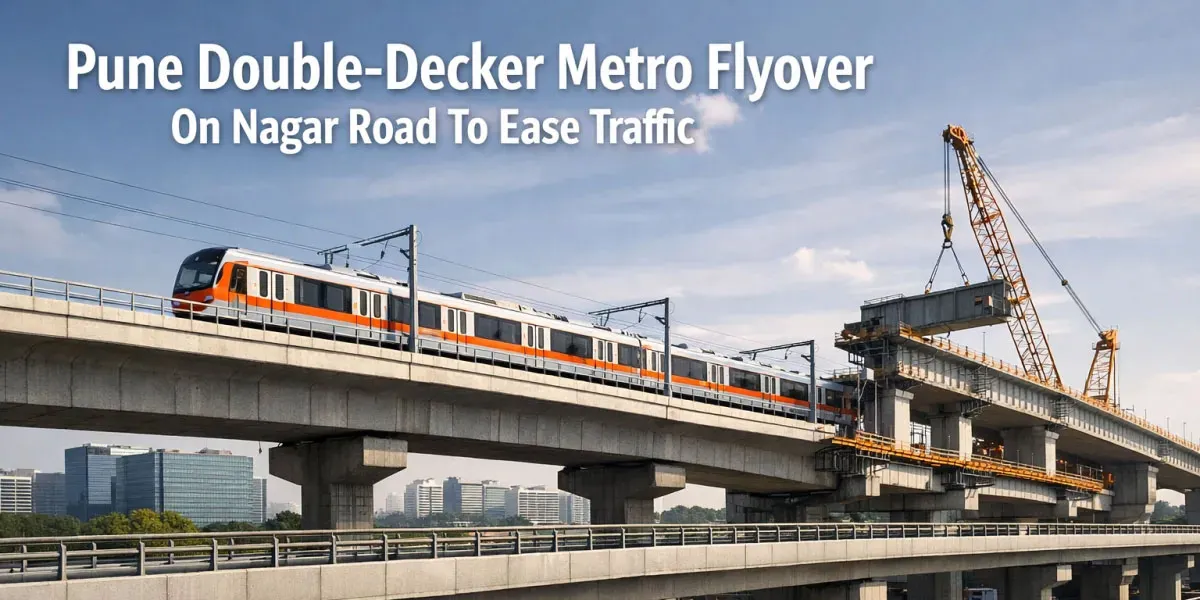
Traffic on Nagar Road in Pune has long been a daily problem for commuters and office workers, with long jams slowing travel between the city and surrounding areas. To tackle this, Pune Metro has begun work on a new four point seven kilometre double-decker elevated corridor that will combine a six-lane flyover with a Metro line above it. The project is intended to reduce road congestion while expanding public transport links for residential, commercial and information technology zones.

Construction has started from Ramwadi and officials have indicated that stations will be built above the flyovers, with platforms, concourse girders and deck slabs provided at each location. The design follows other double-decker stretches in the city at Karve Road and Ganeshkhind Road, where parts remain under construction. Engineers plan the work to avoid disturbance to existing roads, railways, utilities and nearby structures, with suitable safety and protection arrangements to be put in place.

The corridor will run from Ramwadi to Tuljabhavani Nagar and will connect with the planned Kharadi bypass station and a spur towards Pune Airport at Viman Nagar. The first level will carry a six-lane elevated road constructed with a clearance of at least five point five metres to safely accommodate the Metro above. The elevated road is being built for six lanes at present but it can be widened to eight lanes if traffic increases.

The work is part of a wider programme to expand the Metro network after approval last June for extensions of the Vanaz to Ramwadi line. The Ramwadi to Tuljabhavani stretch will have four new stations named Vimannagar, Somnathnagar, Kharadi Bypass and Tuljabhavani. Pune Metro operates on two main routes, Vanaz to Ramwadi and Pimpri Chinchwad to Swargate, and extensions are under way to Bhakti Shakti and Katraj. The Vanaz line is being extended by one point one kilometre to add two stations at Kothrud Depot and Chandni Chowk, with a small flyover at the first level.

Traffic on Nagar Road in Pune has long been a daily problem for commuters and office workers, with long jams slowing travel between the city and surrounding areas. To tackle this, Pune Metro has begun work on a new four point seven kilometre double-decker elevated corridor that will combine a six-lane flyover with a Metro line above it. The project is intended to reduce road congestion while expanding public transport links for residential, commercial and information technology zones. Construction has started from Ramwadi and officials have indicated that stations will be built above the flyovers, with platforms, concourse girders and deck slabs provided at each location. The design follows other double-decker stretches in the city at Karve Road and Ganeshkhind Road, where parts remain under construction. Engineers plan the work to avoid disturbance to existing roads, railways, utilities and nearby structures, with suitable safety and protection arrangements to be put in place. The corridor will run from Ramwadi to Tuljabhavani Nagar and will connect with the planned Kharadi bypass station and a spur towards Pune Airport at Viman Nagar. The first level will carry a six-lane elevated road constructed with a clearance of at least five point five metres to safely accommodate the Metro above. The elevated road is being built for six lanes at present but it can be widened to eight lanes if traffic increases. The work is part of a wider programme to expand the Metro network after approval last June for extensions of the Vanaz to Ramwadi line. The Ramwadi to Tuljabhavani stretch will have four new stations named Vimannagar, Somnathnagar, Kharadi Bypass and Tuljabhavani. Pune Metro operates on two main routes, Vanaz to Ramwadi and Pimpri Chinchwad to Swargate, and extensions are under way to Bhakti Shakti and Katraj. The Vanaz line is being extended by one point one kilometre to add two stations at Kothrud Depot and Chandni Chowk, with a small flyover at the first level.

Next Story
Infrastructure Urban

Implementation Status of Jal Jeevan Mission

Since August 2019 the Government has implemented Jal Jeevan Mission to provide assured potable water through household tap connections in rural India. At the start of the mission only 32.3 million (mn) rural households, representing 16.7 per cent, were reported to have tap water connections. States and union territories have reported that 125.8 mn additional rural households have since been provided with tap connections. As a result, of about 193.6 mn rural households roughly 158.2 mn, or 81.71 per cent, are reported to have tap water supply at home.\n\nThe State, district and village level st..

Next Story
Infrastructure Urban

Jal Jeevan Mission Reaches Eighty One Per Cent Rural Coverage

The Government reported substantial progress under the Jal Jeevan Mission, launched in August 2019 to provide tap water to every rural household. At launch only 32.3 million (mn) rural households had tap connections and states and Union territories reported provision of 125.8 mn additional households by March 2026. Consequently, out of about 193.6 mn rural households around 158.2 mn, or 81.71 per cent, are reported to have tap water at home. The Finance Minister announced extension of the mission until 2028 in the 2025-26 budget speech. The Swachh Bharat Mission Grameen, launched in October 20..

Next Story
Infrastructure Urban

Empowering Local Governance for Sustainable Rural Water Supply

The Ministry of Jal Shakti has aligned the Jal Jeevan Mission (JJM) with the 73rd Amendment to strengthen village level planning and community ownership of water supply. Gram Panchayats, village water and sanitation committees and Pani Samitis are to plan, implement, manage and maintain piped water systems, with gram sabha processes formalising handover and oversight. Implementation support agencies including non government organisations, community based organisations and self help groups have been empanelled to train local committees and promote women participation. Under JJM, the department ..

Advertisement

Subscribe to Our Newsletter

Get daily newsletters around different themes from Construction world.

STAY CONNECTED

Advertisement

Advertisement

Advertisement