RailTech Policy And E?RCT System Launched Under 52 Reforms
RAILWAYS & METRO RAIL

RailTech Policy And E?RCT System Launched Under 52 Reforms

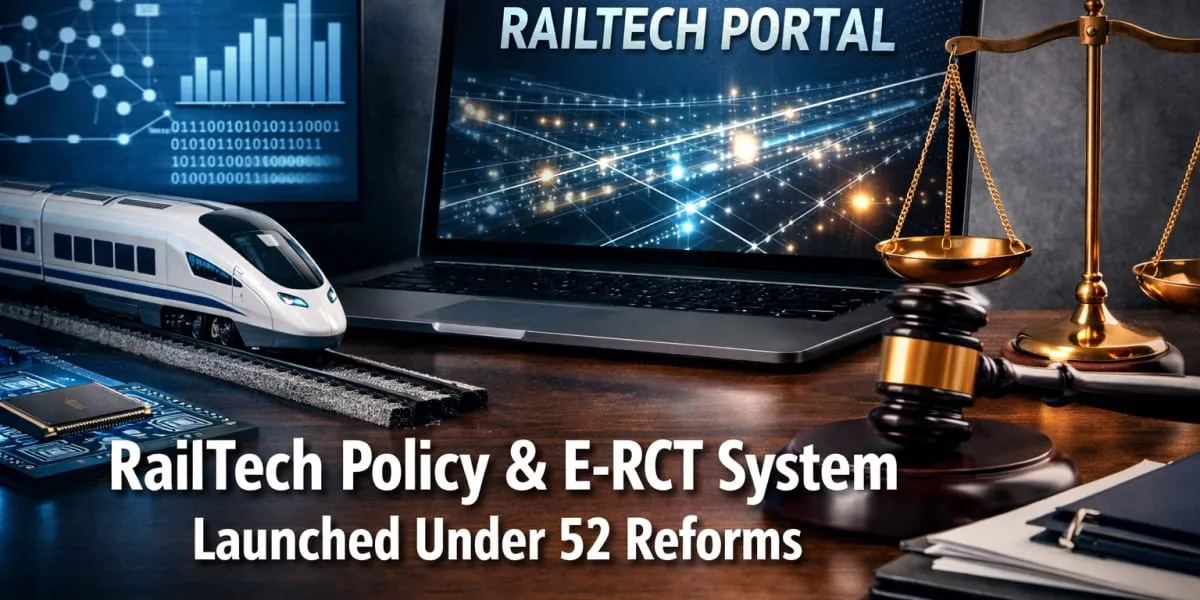
Ashwini Vaishnaw, the Union Minister for Railways and for Electronics and Information Technology, announced a RailTech policy and the complete digitisation of the Railway Claims Tribunal as part of the 52 Reforms in 52 Weeks initiative. The policy will engage innovators, startups, industry and academic institutions through a dedicated RailTech portal and simplify proposal submission and selection. It is intended to create a transparent, innovation driven framework focused on trial and adoption of new technologies.

The portal will allow innovators and departmental users to initiate challenges with a single stage submission and will increase the scale up grant more than three times while doubling the maximum prototype grant. The Railways will support up to 50 per cent of development costs for viable proposals and place long term orders for successful solutions. The policy adapts features from defence and electronics models to remove procedural bottlenecks.

Priority areas include AI based elephant intrusion detection, fire detection in coaches, drone based broken rail detection and rail stress monitoring, as well as sensor based load calculation for parcel vans. The policy also covers solar panels on coaches, AI based coach cleaning monitoring and AI enabled pension and dispute resolution systems. The aim is to move successful innovations into regular operational and administrative use.

The e RCT system will enable end to end computerisation of the Railway Claims Tribunal (RCT) to permit e filing, online hearings and real time case tracking remotely. With 23 benches nationwide the reform seeks to remove jurisdictional barriers so claimants can file electronically while travelling or after reaching their destination. The minister indicated that within 12 months all benches will be fully digitised and AI enabled case management will accelerate disposal.

The integrated platform will support 24x7 e filing, a centralised case information system and a document management system with digitally signed records. Hybrid hearings and digital notifications are expected to reduce adjournments, lower costs and improve access to orders and judgements. If successful, the model could be extended to other tribunals to enhance transparency and citizen centric justice delivery.

Ashwini Vaishnaw, the Union Minister for Railways and for Electronics and Information Technology, announced a RailTech policy and the complete digitisation of the Railway Claims Tribunal as part of the 52 Reforms in 52 Weeks initiative. The policy will engage innovators, startups, industry and academic institutions through a dedicated RailTech portal and simplify proposal submission and selection. It is intended to create a transparent, innovation driven framework focused on trial and adoption of new technologies. The portal will allow innovators and departmental users to initiate challenges with a single stage submission and will increase the scale up grant more than three times while doubling the maximum prototype grant. The Railways will support up to 50 per cent of development costs for viable proposals and place long term orders for successful solutions. The policy adapts features from defence and electronics models to remove procedural bottlenecks. Priority areas include AI based elephant intrusion detection, fire detection in coaches, drone based broken rail detection and rail stress monitoring, as well as sensor based load calculation for parcel vans. The policy also covers solar panels on coaches, AI based coach cleaning monitoring and AI enabled pension and dispute resolution systems. The aim is to move successful innovations into regular operational and administrative use. The e RCT system will enable end to end computerisation of the Railway Claims Tribunal (RCT) to permit e filing, online hearings and real time case tracking remotely. With 23 benches nationwide the reform seeks to remove jurisdictional barriers so claimants can file electronically while travelling or after reaching their destination. The minister indicated that within 12 months all benches will be fully digitised and AI enabled case management will accelerate disposal. The integrated platform will support 24x7 e filing, a centralised case information system and a document management system with digitally signed records. Hybrid hearings and digital notifications are expected to reduce adjournments, lower costs and improve access to orders and judgements. If successful, the model could be extended to other tribunals to enhance transparency and citizen centric justice delivery.

Next Story
Infrastructure Urban

Lemon Tree Hotels Signs Resort In Lonavala Maharashtra

Lemon Tree Hotels Limited (LTHL) has signed a licence agreement for Lemon Tree Resort in Lonavala, Maharashtra, with the asset to be managed by Carnation Hotels Private Limited, a wholly owned subsidiary of LTHL. The resort will offer 50 well appointed rooms and will include a restaurant, banquet, meeting room, swimming pool, spa and fitness centre. The company described the addition as part of its strategy to expand branded resort offerings in key getaway destinations. Lonavala, located in the Sahyadri hills, is a popular leisure destination in western India known for scenic landscapes and a ..

Next Story
Infrastructure Urban

Kalai Chettinad Art And Architecture Festival At The Lotus Palace

The Lotus Palace Chettinad will host Kalai, the Chettinad Art and Architecture Festival, a four-day, three-night immersive celebration of the artistic legacy of Chettinad from three to six April 2026. The event has been organised by Apeejay Surrendra Park Hotels Limited (ASPHL) and will take place across restored heritage properties in Chettinad. It will be designed to offer guests a layered experience of place, structure and story that connects art, architecture and living traditions. The festival aims to present a confluence of global influences and local aesthetics. Kalai has been curated i..

Next Story
Infrastructure Energy

SJVN Reaches One bn Units At 1,000 MW Bikaner Solar Project

SJVN Limited (SJVN) has reached a milestone with its 1,000 megawatt (MW) Bikaner Solar Power Project by generating one bn units of electricity on 20 March 2026. The achievement underscores the company's role in supplying clean and sustainable energy to the national grid. The generation milestone was recorded within months of the project commencing operations and highlights rapid performance from the new facility. The Bikaner project, located in Bikaner district of Rajasthan, has been developed and implemented by SJVN Green Energy Limited (SGEL) under the Central Public Sector Undertaking Schem..

Advertisement

Subscribe to Our Newsletter

Get daily newsletters around different themes from Construction world.

STAY CONNECTED

Advertisement

Advertisement

Advertisement