Railway Board Orders Enhanced Monitoring of 11 Long-Distance Trains
RAILWAYS & METRO RAIL

Railway Board Orders Enhanced Monitoring of 11 Long-Distance Trains

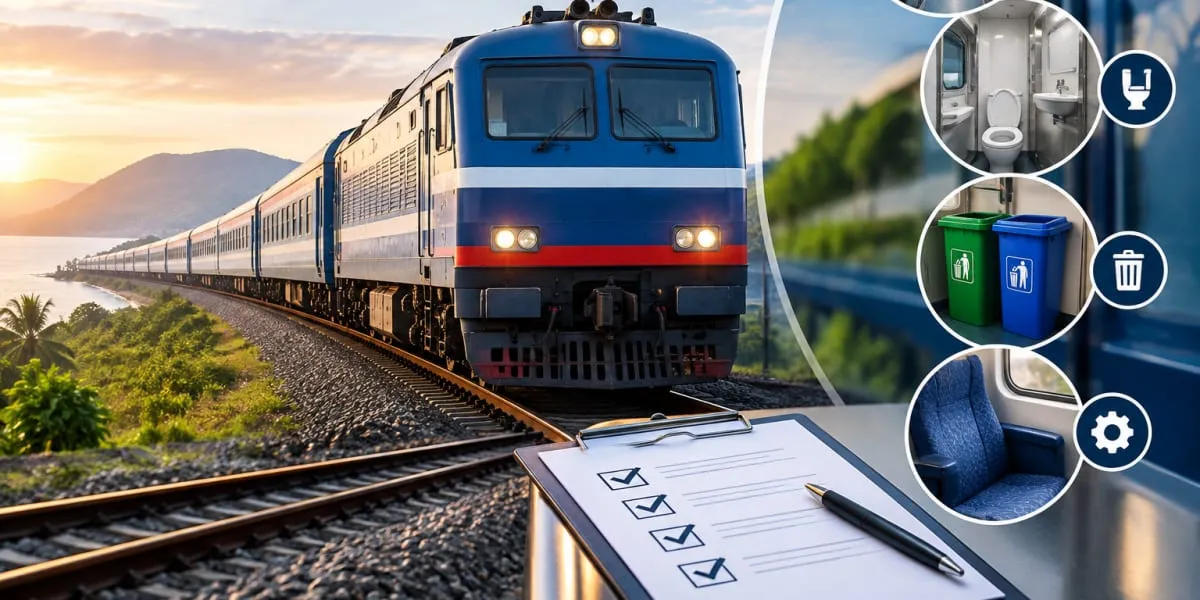
The Railway Board has ordered enhanced monitoring of 11 long-distance trains with journey durations exceeding 40 hours, directing railway zones to maintain cleanliness, passenger amenities and serviceability throughout each journey. The measures will cover housekeeping, toilets, waste management and minor coach deficiencies from the originating station to the destination.

The identified services include the Vivek Express between Dibrugarh and Kanniyakumari, which covers 4,158 km and has a turnaround time of 170 hours; the Awadh Assam Express between Dibrugarh and Lalgarh, covering 3,117 km in 148 hours; and the RKMP-Agartala Express, covering 2,490 km in 121 hours. Other named trains are the ADI-SHC Express, DNR-SMVB Superfast Express, Pune-SOU Express, Amrapali Express and Jhelum Express.

The Railway Board has assigned maintenance supervisors and Coaching Depot Officers (CDOs) responsibility for the trains, while zonal railway officers will review cleanliness, passenger complaints and their redressal weekly. The performance of On-Board Housekeeping Services (OBHS) agencies will also be tracked through the CMM portal and Rail Madad, allowing complaints to be traced and agency performance to be assessed.

Clean Train Station (CTS) points along the routes will be provided with adequate manpower, consumables and equipment. OBHS personnel will receive training to undertake petty repairs, while dedicated plumbers, electrical staff and other maintenance workers can be deployed for urgent requirements. Deficiencies will be communicated to CTS points before a train arrives, and bio-toilets will be checked at base depots and en-route locations.

The framework provides for garbage collection every two hours across coaches, including General Seating and General Second Class coaches, with waste handed over at nominated disposal points. Time-stamped photographs of coaches and toilets will be taken during inspections, and spare rakes will be made available for intensive cleaning when necessary. Divisional Railway Managers will oversee performance, analyse recurring complaints and ensure corrective action, with further trains to be added to the scheme subsequently.

The Railway Board has ordered enhanced monitoring of 11 long-distance trains with journey durations exceeding 40 hours, directing railway zones to maintain cleanliness, passenger amenities and serviceability throughout each journey. The measures will cover housekeeping, toilets, waste management and minor coach deficiencies from the originating station to the destination. The identified services include the Vivek Express between Dibrugarh and Kanniyakumari, which covers 4,158 km and has a turnaround time of 170 hours; the Awadh Assam Express between Dibrugarh and Lalgarh, covering 3,117 km in 148 hours; and the RKMP-Agartala Express, covering 2,490 km in 121 hours. Other named trains are the ADI-SHC Express, DNR-SMVB Superfast Express, Pune-SOU Express, Amrapali Express and Jhelum Express. The Railway Board has assigned maintenance supervisors and Coaching Depot Officers (CDOs) responsibility for the trains, while zonal railway officers will review cleanliness, passenger complaints and their redressal weekly. The performance of On-Board Housekeeping Services (OBHS) agencies will also be tracked through the CMM portal and Rail Madad, allowing complaints to be traced and agency performance to be assessed. Clean Train Station (CTS) points along the routes will be provided with adequate manpower, consumables and equipment. OBHS personnel will receive training to undertake petty repairs, while dedicated plumbers, electrical staff and other maintenance workers can be deployed for urgent requirements. Deficiencies will be communicated to CTS points before a train arrives, and bio-toilets will be checked at base depots and en-route locations. The framework provides for garbage collection every two hours across coaches, including General Seating and General Second Class coaches, with waste handed over at nominated disposal points. Time-stamped photographs of coaches and toilets will be taken during inspections, and spare rakes will be made available for intensive cleaning when necessary. Divisional Railway Managers will oversee performance, analyse recurring complaints and ensure corrective action, with further trains to be added to the scheme subsequently.

Related Stories

Gold Stories

Next Story
Building Material

PureSil Paints Develops Mineral Coatings from Industrial Waste

PureSil Paints, a brand of Relic Coatings LLP, has developed an indigenous mineral-based coating technology aimed at reducing dependence on petrochemical-derived raw materials in the paints and coatings industry. Its proprietary Silicification Technology uses agricultural and industrial by-products to manufacture architectural coatings as an alternative to conventional acrylic paints.Developed in-house by Dr Nikhil Dhote, Founder and Chief Technologist, Relic Coatings LLP, the technology uses silicate binders derived from upcycled rice husk ash and industrial coal fly ash. The formulation is d..
Next Story
Infrastructure Energy

Vedanta Eyes AI to Accelerate Mineral Exploration

Vedanta Group is exploring the use of artificial intelligence (AI) to significantly improve efficiency in mineral exploration, geological analysis and resource modelling. The company aims to reduce exploration processes that traditionally take three to four months to just six to seven days through AI-driven technologies.The proposed approach involves AI-led geological analysis and mineral block modelling to accelerate mineral resource assessment and support faster, more cost-efficient development of domestic mineral reserves. The initiative aligns with India's growing focus on critical mineral..

Next Story
Technology

NXP Launches Unified Robotics Platform for Physical AI

NXP Semiconductors has launched a unified robotics platform designed to accelerate the development and deployment of trusted physical artificial intelligence (AI) systems. Built on the company's neural axis architecture, the platform integrates AI processing, connectivity, motor control, security and energy management within a common hardware and software ecosystem.The platform combines an open-source, modular software development kit (SDK) with pre-validated reference designs, enabling developers to build robotic systems more efficiently. It supports development ranging from individual subsys..

Advertisement

Subscribe to Our Newsletter

Get daily newsletters around different themes from Construction world.

STAY CONNECTED

Advertisement

SPECIAL OFFER
QR Code