+
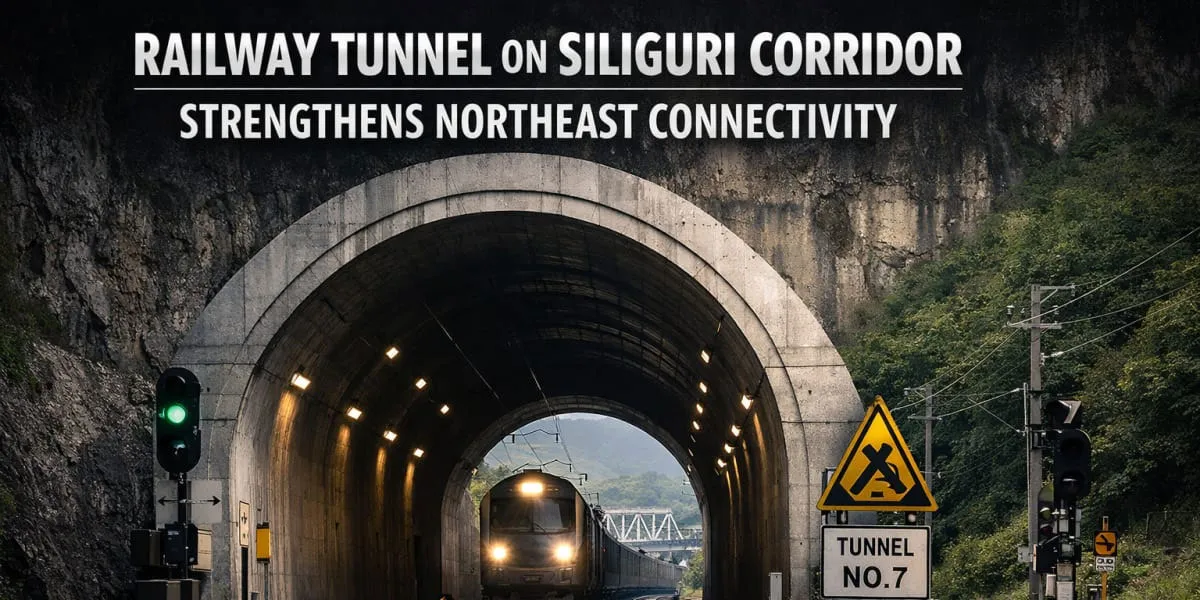
Railway Tunnel on Siliguri Corridor Strengthens Northeast Connectivity
RAILWAYS & METRO RAIL

Railway Tunnel on Siliguri Corridor Strengthens Northeast Connectivity

The Assam chief minister said that a new railway tunnel on the Siliguri corridor will strengthen the northeast region's connectivity with the rest of the country. He described the project as a strategic infrastructure intervention intended to create a more dependable transport link through the narrow corridor that connects the seven sister states with mainland India. The announcement underlined the state government's commitment to improving physical links and integrating transport networks across the region.

The tunnel is expected to enhance the speed and reliability of rail services and to reduce logistical bottlenecks that have historically affected trade and passenger movement in the area. Improved rail connectivity is anticipated to facilitate smoother movement of essential commodities and to support supply chains that serve both urban and rural markets. Officials indicated that the design will aim to ensure resilience against weather disruptions and to promote year round operations.

Authorities said the tunnel will have wider strategic implications for regional integration and national cohesion by improving access to remote districts and by enabling greater flows of people and investment. Enhanced connectivity may foster tourism growth, support local industries and encourage private and public sector investment in infrastructure and services. Observers noted that such projects are likely to have multiplier effects on employment and skill development within neighbouring communities.

The chief minister referred to ongoing coordination between state and central agencies to expedite clearances and to align budgets without specifying a timeline. Officials emphasised the importance of complementary works such as upgrades to feeder lines, stations and road links that will be necessary to fully realise the tunnel's benefits. The administration said it will monitor progress and seek to ensure that local stakeholders are engaged during construction so that long term socioeconomic gains accrue to the region.

The Assam chief minister said that a new railway tunnel on the Siliguri corridor will strengthen the northeast region's connectivity with the rest of the country. He described the project as a strategic infrastructure intervention intended to create a more dependable transport link through the narrow corridor that connects the seven sister states with mainland India. The announcement underlined the state government's commitment to improving physical links and integrating transport networks across the region. The tunnel is expected to enhance the speed and reliability of rail services and to reduce logistical bottlenecks that have historically affected trade and passenger movement in the area. Improved rail connectivity is anticipated to facilitate smoother movement of essential commodities and to support supply chains that serve both urban and rural markets. Officials indicated that the design will aim to ensure resilience against weather disruptions and to promote year round operations. Authorities said the tunnel will have wider strategic implications for regional integration and national cohesion by improving access to remote districts and by enabling greater flows of people and investment. Enhanced connectivity may foster tourism growth, support local industries and encourage private and public sector investment in infrastructure and services. Observers noted that such projects are likely to have multiplier effects on employment and skill development within neighbouring communities. The chief minister referred to ongoing coordination between state and central agencies to expedite clearances and to align budgets without specifying a timeline. Officials emphasised the importance of complementary works such as upgrades to feeder lines, stations and road links that will be necessary to fully realise the tunnel's benefits. The administration said it will monitor progress and seek to ensure that local stakeholders are engaged during construction so that long term socioeconomic gains accrue to the region.

Next Story
Infrastructure Urban

Implementation Status of Jal Jeevan Mission

Since August 2019 the Government has implemented Jal Jeevan Mission to provide assured potable water through household tap connections in rural India. At the start of the mission only 32.3 million (mn) rural households, representing 16.7 per cent, were reported to have tap water connections. States and union territories have reported that 125.8 mn additional rural households have since been provided with tap connections. As a result, of about 193.6 mn rural households roughly 158.2 mn, or 81.71 per cent, are reported to have tap water supply at home.\n\nThe State, district and village level st..

Next Story
Infrastructure Urban

Jal Jeevan Mission Reaches Eighty One Per Cent Rural Coverage

The Government reported substantial progress under the Jal Jeevan Mission, launched in August 2019 to provide tap water to every rural household. At launch only 32.3 million (mn) rural households had tap connections and states and Union territories reported provision of 125.8 mn additional households by March 2026. Consequently, out of about 193.6 mn rural households around 158.2 mn, or 81.71 per cent, are reported to have tap water at home. The Finance Minister announced extension of the mission until 2028 in the 2025-26 budget speech. The Swachh Bharat Mission Grameen, launched in October 20..

Next Story
Infrastructure Urban

Empowering Local Governance for Sustainable Rural Water Supply

The Ministry of Jal Shakti has aligned the Jal Jeevan Mission (JJM) with the 73rd Amendment to strengthen village level planning and community ownership of water supply. Gram Panchayats, village water and sanitation committees and Pani Samitis are to plan, implement, manage and maintain piped water systems, with gram sabha processes formalising handover and oversight. Implementation support agencies including non government organisations, community based organisations and self help groups have been empanelled to train local committees and promote women participation. Under JJM, the department ..

Advertisement

Subscribe to Our Newsletter

Get daily newsletters around different themes from Construction world.

STAY CONNECTED

Advertisement

Advertisement

Advertisement