+
Railways Expands Freight Corridors and Boosts Freight Capacity
RAILWAYS & METRO RAIL

Railways Expands Freight Corridors and Boosts Freight Capacity

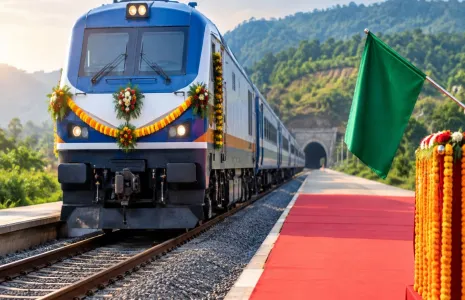
The Ministry of Railways has made significant progress in infrastructure development, with 96.4% of the Dedicated Freight Corridors (DFC) commissioned. The Eastern DFC (Ludhiana to Sonnagar, 1,337 km) and the Western DFC (JNPT to Dadri, 1,506 km) are now largely operational, with the remaining sections under development. Additionally, Detailed Project Reports (DPRs) are being examined for three new DFCs: East-Coast (Kharagpur to Vijayawada), East-West (Palghar-Bhusawal-Nagpur-Kharagpur-Dankuni), and North-South (Vijayawada-Nagpur-Itarsi). The final approval for these projects will depend on factors like feasibility, viability, and funding.

The DFC initiative has significantly improved freight transport, increasing the number of daily trains from 247 in 2023-24 to 371 in February 2025, enhancing efficiency and reducing logistics costs. The increased freight capacity has also improved railway earnings.

To modernise infrastructure, the Railways has implemented various initiatives, including the Rashtriya Rail Sanraksha Kosh (RRSK), which has been extended beyond 2021-22 with a Rs 450 billion budgetary support. Significant upgrades include interlocking systems at 6,623 stations, advanced signaling, level crossing interlocking, and the deployment of Kavach, India’s indigenous Automatic Train Protection (ATP) system. Rolling stock modernization includes acquiring high-powered locomotives and designing higher-capacity wagons for improved efficiency.

The introduction of Gati Shakti Multi-Modal Cargo Terminals (GCTs) has also strengthened freight handling, with 97 terminals commissioned and 277 proposals approved. These terminals, equipped with mechanised loading/unloading, have enhanced cargo movement.

The Ministry remains committed to infrastructure expansion, modernisation, and freight capacity enhancement to boost operational efficiency and support India’s growing logistics needs.

(PIB)
             

The Ministry of Railways has made significant progress in infrastructure development, with 96.4% of the Dedicated Freight Corridors (DFC) commissioned. The Eastern DFC (Ludhiana to Sonnagar, 1,337 km) and the Western DFC (JNPT to Dadri, 1,506 km) are now largely operational, with the remaining sections under development. Additionally, Detailed Project Reports (DPRs) are being examined for three new DFCs: East-Coast (Kharagpur to Vijayawada), East-West (Palghar-Bhusawal-Nagpur-Kharagpur-Dankuni), and North-South (Vijayawada-Nagpur-Itarsi). The final approval for these projects will depend on factors like feasibility, viability, and funding.The DFC initiative has significantly improved freight transport, increasing the number of daily trains from 247 in 2023-24 to 371 in February 2025, enhancing efficiency and reducing logistics costs. The increased freight capacity has also improved railway earnings.To modernise infrastructure, the Railways has implemented various initiatives, including the Rashtriya Rail Sanraksha Kosh (RRSK), which has been extended beyond 2021-22 with a Rs 450 billion budgetary support. Significant upgrades include interlocking systems at 6,623 stations, advanced signaling, level crossing interlocking, and the deployment of Kavach, India’s indigenous Automatic Train Protection (ATP) system. Rolling stock modernization includes acquiring high-powered locomotives and designing higher-capacity wagons for improved efficiency.The introduction of Gati Shakti Multi-Modal Cargo Terminals (GCTs) has also strengthened freight handling, with 97 terminals commissioned and 277 proposals approved. These terminals, equipped with mechanised loading/unloading, have enhanced cargo movement.The Ministry remains committed to infrastructure expansion, modernisation, and freight capacity enhancement to boost operational efficiency and support India’s growing logistics needs.(PIB)             

Next Story
Infrastructure Urban

Implementation Status of Jal Jeevan Mission

Since August 2019 the Government has implemented Jal Jeevan Mission to provide assured potable water through household tap connections in rural India. At the start of the mission only 32.3 million (mn) rural households, representing 16.7 per cent, were reported to have tap water connections. States and union territories have reported that 125.8 mn additional rural households have since been provided with tap connections. As a result, of about 193.6 mn rural households roughly 158.2 mn, or 81.71 per cent, are reported to have tap water supply at home.\n\nThe State, district and village level st..

Next Story
Infrastructure Urban

Jal Jeevan Mission Reaches Eighty One Per Cent Rural Coverage

The Government reported substantial progress under the Jal Jeevan Mission, launched in August 2019 to provide tap water to every rural household. At launch only 32.3 million (mn) rural households had tap connections and states and Union territories reported provision of 125.8 mn additional households by March 2026. Consequently, out of about 193.6 mn rural households around 158.2 mn, or 81.71 per cent, are reported to have tap water at home. The Finance Minister announced extension of the mission until 2028 in the 2025-26 budget speech. The Swachh Bharat Mission Grameen, launched in October 20..

Next Story
Infrastructure Urban

Empowering Local Governance for Sustainable Rural Water Supply

The Ministry of Jal Shakti has aligned the Jal Jeevan Mission (JJM) with the 73rd Amendment to strengthen village level planning and community ownership of water supply. Gram Panchayats, village water and sanitation committees and Pani Samitis are to plan, implement, manage and maintain piped water systems, with gram sabha processes formalising handover and oversight. Implementation support agencies including non government organisations, community based organisations and self help groups have been empanelled to train local committees and promote women participation. Under JJM, the department ..

Advertisement

Subscribe to Our Newsletter

Get daily newsletters around different themes from Construction world.

STAY CONNECTED

Advertisement

Advertisement

Advertisement