

+
Stalin Urges Centre To Release Railway Funds
RAILWAYS & METRO RAIL

Stalin Urges Centre To Release Railway Funds

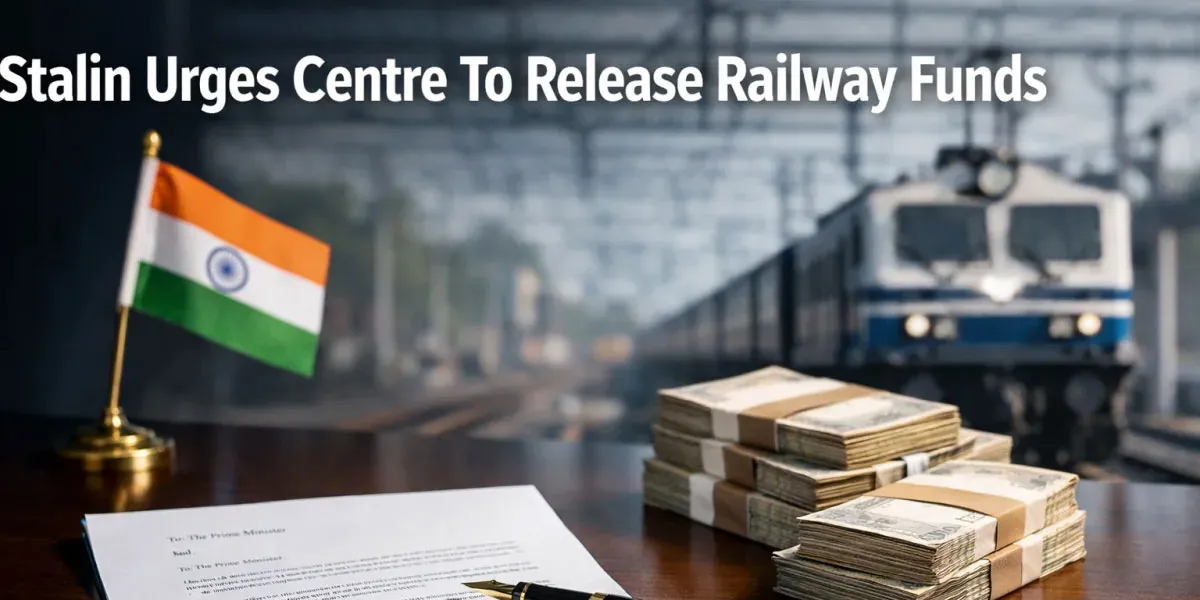
Chief Minister M K Stalin wrote to the Prime Minister seeking full and priority release of funds to ensure smooth land acquisition and timely payment of compensation for railway projects in Tamil Nadu. The appeal followed public comments by the Union Railways Minister that delays were caused by inadequate state cooperation in land matters. The chief minister requested that allocations be made in lump sums to avoid piecemeal funding.

He noted that the Railways had not sanctioned funds for acquiring 931.52 hectares out of a total of 2,500.61 hectares required for various projects despite administrative approval. Administrative sanction for two projects covering 296.02 hectares of private land is now under process following receipt of revised land plan schedules. Of the remaining 1,273.05 hectares pertaining to 19 major ongoing projects, land acquisition has been completed for 1,198.02 hectares, which have been handed over to the Railways and represent 94 per cent of that tranche.

Land acquisition has been completed for schemes including Tindivanam-Nagari, Madurai-Thoothukudi via Aruppukottai Phase I, Nagercoil-Eraniel double line, Mannargudi-Needamangalam and the Chennai Beach-Korukkupet third and fourth lines. The chief minister flagged that funds released by the Ministry of Railways are often disbursed in a piecemeal manner for individual projects, which he said severely hampers progress. He argued that staggered releases have caused disruptions, prolonged uncertainty for affected landowners and delays in project execution.

The letter highlighted that Rs 2.898 bn remains to be released for acquiring 16.86 hectares for the doubling of the Thiruvananthapuram-Kanniyakumari section, a major scheme monitored through the Prime Minister's Gati Shakti Portal (PMG). The chief minister urged a lump sum and timely allocation for land acquisition to enable uninterrupted and faster completion of critical works. He also sought revival of the Thoothukudi-Madurai via Aruppukottai and Tindivanam-Tiruvannamalai new line projects and requested sanctioning of additional projects in line with Tamil Nadu's economic stature and developmental requirements.

Chief Minister M K Stalin wrote to the Prime Minister seeking full and priority release of funds to ensure smooth land acquisition and timely payment of compensation for railway projects in Tamil Nadu. The appeal followed public comments by the Union Railways Minister that delays were caused by inadequate state cooperation in land matters. The chief minister requested that allocations be made in lump sums to avoid piecemeal funding. He noted that the Railways had not sanctioned funds for acquiring 931.52 hectares out of a total of 2,500.61 hectares required for various projects despite administrative approval. Administrative sanction for two projects covering 296.02 hectares of private land is now under process following receipt of revised land plan schedules. Of the remaining 1,273.05 hectares pertaining to 19 major ongoing projects, land acquisition has been completed for 1,198.02 hectares, which have been handed over to the Railways and represent 94 per cent of that tranche. Land acquisition has been completed for schemes including Tindivanam-Nagari, Madurai-Thoothukudi via Aruppukottai Phase I, Nagercoil-Eraniel double line, Mannargudi-Needamangalam and the Chennai Beach-Korukkupet third and fourth lines. The chief minister flagged that funds released by the Ministry of Railways are often disbursed in a piecemeal manner for individual projects, which he said severely hampers progress. He argued that staggered releases have caused disruptions, prolonged uncertainty for affected landowners and delays in project execution. The letter highlighted that Rs 2.898 bn remains to be released for acquiring 16.86 hectares for the doubling of the Thiruvananthapuram-Kanniyakumari section, a major scheme monitored through the Prime Minister's Gati Shakti Portal (PMG). The chief minister urged a lump sum and timely allocation for land acquisition to enable uninterrupted and faster completion of critical works. He also sought revival of the Thoothukudi-Madurai via Aruppukottai and Tindivanam-Tiruvannamalai new line projects and requested sanctioning of additional projects in line with Tamil Nadu's economic stature and developmental requirements.

Next Story
Infrastructure Urban

Implementation Status of Jal Jeevan Mission

Since August 2019 the Government has implemented Jal Jeevan Mission to provide assured potable water through household tap connections in rural India. At the start of the mission only 32.3 million (mn) rural households, representing 16.7 per cent, were reported to have tap water connections. States and union territories have reported that 125.8 mn additional rural households have since been provided with tap connections. As a result, of about 193.6 mn rural households roughly 158.2 mn, or 81.71 per cent, are reported to have tap water supply at home.\n\nThe State, district and village level st..

Next Story
Infrastructure Urban

Jal Jeevan Mission Reaches Eighty One Per Cent Rural Coverage

The Government reported substantial progress under the Jal Jeevan Mission, launched in August 2019 to provide tap water to every rural household. At launch only 32.3 million (mn) rural households had tap connections and states and Union territories reported provision of 125.8 mn additional households by March 2026. Consequently, out of about 193.6 mn rural households around 158.2 mn, or 81.71 per cent, are reported to have tap water at home. The Finance Minister announced extension of the mission until 2028 in the 2025-26 budget speech. The Swachh Bharat Mission Grameen, launched in October 20..

Next Story
Infrastructure Urban

Empowering Local Governance for Sustainable Rural Water Supply

The Ministry of Jal Shakti has aligned the Jal Jeevan Mission (JJM) with the 73rd Amendment to strengthen village level planning and community ownership of water supply. Gram Panchayats, village water and sanitation committees and Pani Samitis are to plan, implement, manage and maintain piped water systems, with gram sabha processes formalising handover and oversight. Implementation support agencies including non government organisations, community based organisations and self help groups have been empanelled to train local committees and promote women participation. Under JJM, the department ..

Advertisement

Subscribe to Our Newsletter

Get daily newsletters around different themes from Construction world.

STAY CONNECTED

Advertisement

Advertisement

Advertisement