Wabtec Unveils First Simandou Locomotive for Guinea Rail
RAILWAYS & METRO RAIL

Wabtec Unveils First Simandou Locomotive for Guinea Rail

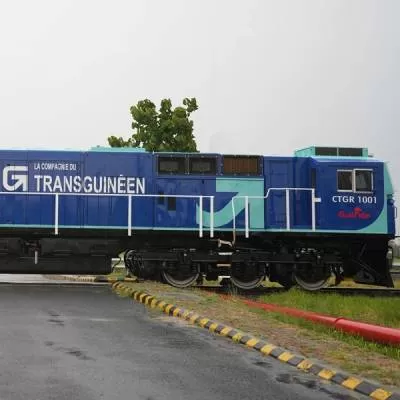
Wabtec Corporation and Rio Tinto SimFer, a joint venture of the Republic of Guinea, Rio Tinto, and Chalco Iron Ore Holdings (CIOH), have unveiled the first ES43ACi Evolution Series locomotive for the TransGuinéen Railway. The milestone marks a major step in the development of the Simandou iron ore project—Africa’s largest mining and infrastructure investment.

The locomotive, produced as part of SimFer’s 2024 order, will support rail operations linking the high-grade Simandou iron ore reserves in southeastern Guinea to international markets. The 600-km multi-use railway will connect the mines to a coastal export terminal in Forécariah prefecture.

“This locomotive symbolises a pivotal step in connecting Simandou to the world and creating opportunity for Guinea,” said Charles Zimmermann, Global Head of Projects, Rio Tinto. “Its arrival supports our goal of delivering Guinea’s iron to global markets efficiently and sustainably.”

The unveiling was attended by officials from Guinea, India, and the US, alongside representatives from Indian Railways, Wabtec, and Rio Tinto SimFer. The locomotive, painted in blue and turquoise livery of La Compagnie de TransGuinéen, is the first of several units to be deployed for this large-scale infrastructure venture.

“This is a proud moment for our global team,” said Mpilo Dlamini, Regional VP, Wabtec Sub-Saharan Africa. “The ES43ACi is purpose-built to withstand demanding high-temperature conditions and will play a key role in transporting Simandou’s high-grade ore while supporting local economic development.”

Manufactured at Wabtec’s plant in Marhowra, India, the locomotive boasts a 4,500 HP Evolution Series diesel engine designed in the US, offering industry-leading fuel efficiency and heavy-haul performance. This represents Wabtec India’s largest-ever export order for heavy-haul locomotives.

With an estimated 1.5 billion tonnes of high-grade iron ore reserves, the Simandou project is expected to significantly boost Guinea’s economic output, infrastructure capabilities, and global role in mineral exports.

Wabtec Corporation and Rio Tinto SimFer, a joint venture of the Republic of Guinea, Rio Tinto, and Chalco Iron Ore Holdings (CIOH), have unveiled the first ES43ACi Evolution Series locomotive for the TransGuinéen Railway. The milestone marks a major step in the development of the Simandou iron ore project—Africa’s largest mining and infrastructure investment.The locomotive, produced as part of SimFer’s 2024 order, will support rail operations linking the high-grade Simandou iron ore reserves in southeastern Guinea to international markets. The 600-km multi-use railway will connect the mines to a coastal export terminal in Forécariah prefecture.“This locomotive symbolises a pivotal step in connecting Simandou to the world and creating opportunity for Guinea,” said Charles Zimmermann, Global Head of Projects, Rio Tinto. “Its arrival supports our goal of delivering Guinea’s iron to global markets efficiently and sustainably.”The unveiling was attended by officials from Guinea, India, and the US, alongside representatives from Indian Railways, Wabtec, and Rio Tinto SimFer. The locomotive, painted in blue and turquoise livery of La Compagnie de TransGuinéen, is the first of several units to be deployed for this large-scale infrastructure venture.“This is a proud moment for our global team,” said Mpilo Dlamini, Regional VP, Wabtec Sub-Saharan Africa. “The ES43ACi is purpose-built to withstand demanding high-temperature conditions and will play a key role in transporting Simandou’s high-grade ore while supporting local economic development.”Manufactured at Wabtec’s plant in Marhowra, India, the locomotive boasts a 4,500 HP Evolution Series diesel engine designed in the US, offering industry-leading fuel efficiency and heavy-haul performance. This represents Wabtec India’s largest-ever export order for heavy-haul locomotives.With an estimated 1.5 billion tonnes of high-grade iron ore reserves, the Simandou project is expected to significantly boost Guinea’s economic output, infrastructure capabilities, and global role in mineral exports.

Next Story
Infrastructure Urban

Mount Expands Tumkur Facility with New Automated Panel, PEB Lines

Mount Roofing & Structures Private Limited, one of India's fastest-growing manufacturers in PUF and a leading solutions provider across pre-engineered building (PEB) and polycarbonate sheets, simultaneously inaugurated its second fully automated continuous sandwich panel manufacturing line and a new PEB manufacturing plant at its integrated campus in Tumkur.The milestone expansion, part of a total investment of Rs 250 crore, marks a significant advancement in the company's commitment to engineered performance, manufacturing scale, and industrial growth. The integrated facility spans approx..

Next Story
Infrastructure Transport

India Becomes First to Produce Bio-Bitumen for Roads

India has become the first country in the world to commercially produce bio-bitumen for use in road construction, according to Road, Transport and Highways Minister Nitin Gadkari. Bitumen, a black and viscous hydrocarbon derived from crude oil, is a key binding material in road building, and the bio-based alternative is expected to significantly improve the sector’s environmental footprint.Addressing the CSIR Technology Transfer Ceremony in New Delhi, Mr Gadkari congratulated Council of Scientific and Industrial Research on achieving the milestone, noting that the initiative would help curb ..

Next Story
Infrastructure Urban

HILT Policy Seen Boosting Telangana Revenue Sharply

The Hyderabad Industrial Land Transformation (HILT) Policy is expected to generate around Rs 1.08 billion in revenue for the Telangana state exchequer, according to Deputy Chief Minister Bhatti Vikramarka Mallu. Speaking in the Telangana Legislative Assembly, he said the policy would be implemented within a six-month timeframe in a transparent manner, with uniform rules applicable to all stakeholders. Mr Vikramarka noted that without the HILT Policy, the state would have earned only about Rs 1.2 million per acre. Under the new framework, however, revenue is projected to rise sharply to Rs 70 ..

Advertisement

Subscribe to Our Newsletter

Get daily newsletters around different themes from Construction world.

STAY CONNECTED

Advertisement

Advertisement

Advertisement

Advertisement

Open In App