Environmental Clearances for Ports Extended to 20 Years
PORTS & SHIPPING

Environmental Clearances for Ports Extended to 20 Years

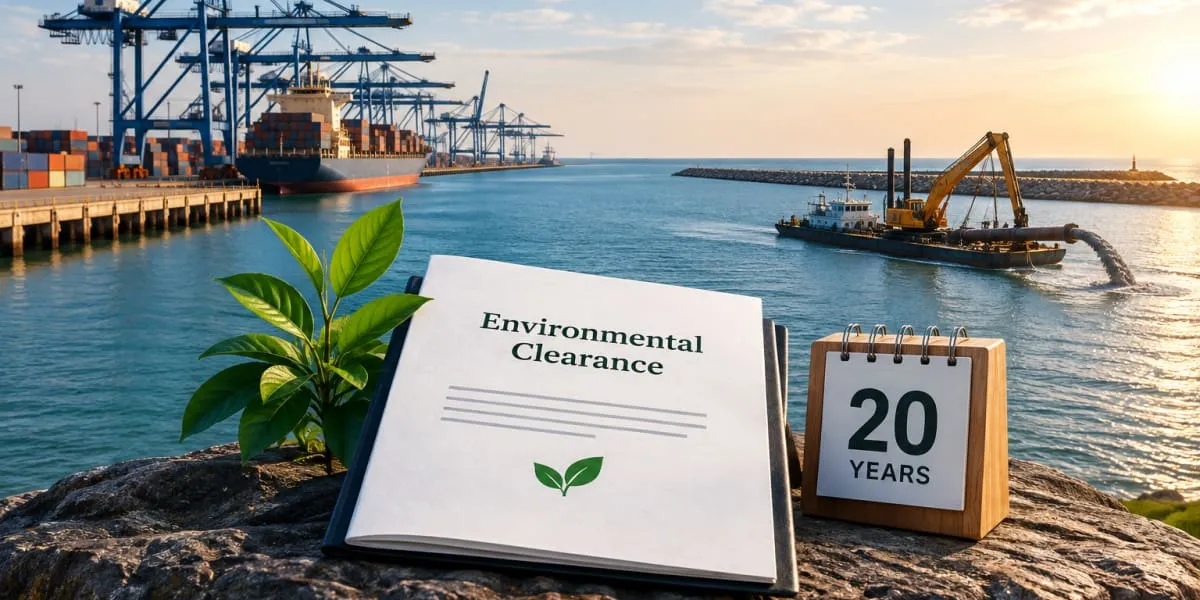
The Union environment ministry has extended the validity of environmental clearances for ports, harbours, breakwaters and dredging projects from 10 years to 20 years. The period can be extended by five years on two occasions, bringing the framework closer to the arrangements applicable to mining projects.

The change was notified through a gazette dated September 21 and also applies to environmental clearances issued previously. Officials said the extension was intended to improve ease of business and address the long gestation periods associated with port and related infrastructure projects.

The ministry said it had reviewed the issue after receiving a request to rationalise the validity period for clearances granted to ports and harbours. Sectoral expert and advisory committees considered the existing period insufficient. A draft notification had initially proposed a 15-year validity period, with a further five-year extension, but stakeholder consultations led to a broader review.

The shipping ministry had requested that the clearance period be aligned with the project period or 30 years, whichever was longer, citing the framework for mining projects. Following further deliberation, the expert advisory committee recommended a 20-year validity period, with a five-year extension beyond that term and the possibility of a second five-year extension in deserving cases.

The ministry said additional environmental safeguards would have to be incorporated into the Environmental Management Plan when a second extension was granted. Projects would also remain subject to annual compliance reporting, allowing authorities to take action if environmental conditions were breached.

Environmental lawyer Ritwick Dutta said the longer validity period need not create additional environmental risks because completed projects would continue to submit annual compliance reports. He said the change would primarily provide port developers with a wider period in which to begin or complete projects, while retaining regulatory oversight through environmental monitoring.

The Union environment ministry has extended the validity of environmental clearances for ports, harbours, breakwaters and dredging projects from 10 years to 20 years. The period can be extended by five years on two occasions, bringing the framework closer to the arrangements applicable to mining projects. The change was notified through a gazette dated September 21 and also applies to environmental clearances issued previously. Officials said the extension was intended to improve ease of business and address the long gestation periods associated with port and related infrastructure projects. The ministry said it had reviewed the issue after receiving a request to rationalise the validity period for clearances granted to ports and harbours. Sectoral expert and advisory committees considered the existing period insufficient. A draft notification had initially proposed a 15-year validity period, with a further five-year extension, but stakeholder consultations led to a broader review. The shipping ministry had requested that the clearance period be aligned with the project period or 30 years, whichever was longer, citing the framework for mining projects. Following further deliberation, the expert advisory committee recommended a 20-year validity period, with a five-year extension beyond that term and the possibility of a second five-year extension in deserving cases. The ministry said additional environmental safeguards would have to be incorporated into the Environmental Management Plan when a second extension was granted. Projects would also remain subject to annual compliance reporting, allowing authorities to take action if environmental conditions were breached. Environmental lawyer Ritwick Dutta said the longer validity period need not create additional environmental risks because completed projects would continue to submit annual compliance reports. He said the change would primarily provide port developers with a wider period in which to begin or complete projects, while retaining regulatory oversight through environmental monitoring.

Related Stories

Gold Stories

Next Story
Building Material

From Rough to Refined: How Modern Plastering Is Changing Wall Finishes

When Rohan first walked into his newly constructed home, he imagined what it would become—a warm living room, a bright bedroom, and walls smooth enough to complement his carefully chosen interiors.But there was one problem.The walls didn't look anything like the finished home he had imagined.They were uneven in places, rough to the touch, and covered with visible patches and minor surface imperfections. Rohan initially thought paint would fix everything.His contractor had a different answer.“Before the paint, we need to get the plastering right.”That conversation made Rohan realise somet..

Next Story
Infrastructure Urban

Embraer to Acquire 51 Per Cent Stake in Mahindra Aerospace Arm

Brazilian aerospace major Embraer will acquire a 51 per cent equity stake in Novavayu Aerospace, a step-down subsidiary of Mahindra and Mahindra, under an Investment Agreement notified by the automobile company in an exchange filing. The transaction will give Embraer control of the aerospace business. Following completion of the acquisition, Novavayu Aerospace will cease to be a wholly owned subsidiary and become an associate of Mahindra Defence Systems, which is a step-down wholly owned subsidiary of Mahindra and Mahindra. The agreement is expected to be completed on or before December 1. Mah..

Next Story
Infrastructure Urban

RBI Opens Special Dollar Window for Three State-Run OMCs

The Reserve Bank of India (RBI) has opened a special facility to meet the entire daily US dollar requirements of three public sector oil marketing companies (OMCs), in a move aimed at easing pressure on the Indian rupee. The facility will take effect on October 12, 2026, and remain available until further notice. Indian Oil Corporation, Hindustan Petroleum Corporation and Bharat Petroleum Corporation are eligible to use the arrangement. Under the facility, the RBI will sell US dollars to the three companies through designated banks, allowing them to meet their oil-import payments without sourc..

Advertisement

Subscribe to Our Newsletter

Get daily newsletters around different themes from Construction world.

STAY CONNECTED

Advertisement

SPECIAL OFFER
QR Code