





DRDO And Navy Complete Maiden Salvo Launch Of NASM-SR
DEFENSE

DRDO And Navy Complete Maiden Salvo Launch Of NASM-SR

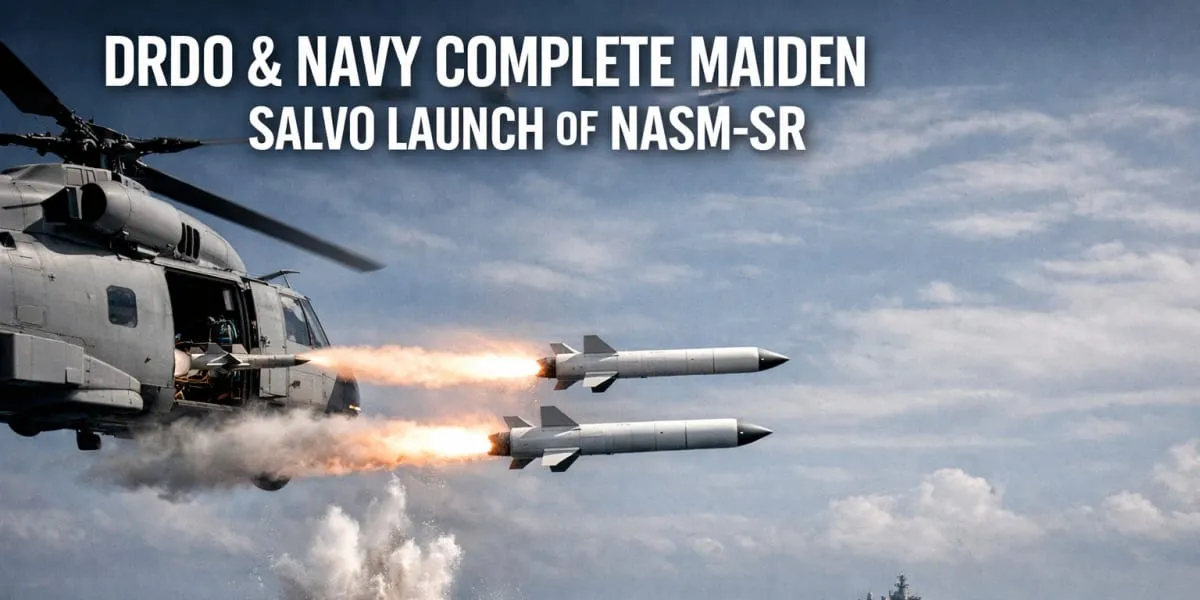
Defence Research and Development Organisation (DRDO) and the Indian Navy have successfully conducted the maiden salvo launch of the Naval Anti-ship Missile-Short Range (NASM-SR) from a naval helicopter off the coast of Odisha in the Bay of Bengal. During the trial two missiles were launched in quick succession from the same helicopter, marking the first salvo launch of an advanced air-launched anti-ship missile system. All test objectives were fully met according to data captured by range tracking instruments such as radar, electro-optical systems and telemetry deployed by the Integrated Test Range (ITR), Chandipur. The trial demonstrated both salvo launch capability and waterline hit performance under instrumented test conditions.

The launches were witnessed by senior scientists from DRDO, users' representatives from the Indian Navy and the Indian Air Force and Development-cum-Production Partners (DcPP). Test monitoring employed multiple tracking and measurement systems to corroborate performance parameters and trajectory data, with telemetry providing real-time mission diagnostics and recovery of post-flight data for analysis. The integrated instrumentation suite enabled validation of guidance, control and seeker performance across flight phases.

The NASM-SR employs a solid propulsion booster and a long-burn sustainer to achieve the required flight profile. Critical subsystems developed indigenously include the seeker, an integrated avionics module, advanced navigation and guidance using a fibre-optic gyroscope-based Inertial Navigation System (INS) and a radio-altimeter, together with control and guidance algorithms, a high-bandwidth two-way data link and jet-vane control. These elements were developed by multiple DRDO laboratories and Indian industry partners to meet mission reliability and accuracy requirements.

The missile system was led by Research Centre Imarat in Hyderabad in collaboration with Defence Research and Development Laboratory, Hyderabad; High Energy Materials Research Laboratory, Pune; Terminal Ballistics Research Laboratory, Chandigarh; and ITR Chandipur. Production is underway through DcPP with support from Indian industries and start-ups. Raksha Mantri Rajnath Singh complimented DRDO, the armed services and industry partners for the successful validation and indicated the development will further enhance defence capabilities, while the Secretary Department of Defence R&D and Chairman DRDO congratulated the teams involved.

Defence Research and Development Organisation (DRDO) and the Indian Navy have successfully conducted the maiden salvo launch of the Naval Anti-ship Missile-Short Range (NASM-SR) from a naval helicopter off the coast of Odisha in the Bay of Bengal. During the trial two missiles were launched in quick succession from the same helicopter, marking the first salvo launch of an advanced air-launched anti-ship missile system. All test objectives were fully met according to data captured by range tracking instruments such as radar, electro-optical systems and telemetry deployed by the Integrated Test Range (ITR), Chandipur. The trial demonstrated both salvo launch capability and waterline hit performance under instrumented test conditions. The launches were witnessed by senior scientists from DRDO, users' representatives from the Indian Navy and the Indian Air Force and Development-cum-Production Partners (DcPP). Test monitoring employed multiple tracking and measurement systems to corroborate performance parameters and trajectory data, with telemetry providing real-time mission diagnostics and recovery of post-flight data for analysis. The integrated instrumentation suite enabled validation of guidance, control and seeker performance across flight phases. The NASM-SR employs a solid propulsion booster and a long-burn sustainer to achieve the required flight profile. Critical subsystems developed indigenously include the seeker, an integrated avionics module, advanced navigation and guidance using a fibre-optic gyroscope-based Inertial Navigation System (INS) and a radio-altimeter, together with control and guidance algorithms, a high-bandwidth two-way data link and jet-vane control. These elements were developed by multiple DRDO laboratories and Indian industry partners to meet mission reliability and accuracy requirements. The missile system was led by Research Centre Imarat in Hyderabad in collaboration with Defence Research and Development Laboratory, Hyderabad; High Energy Materials Research Laboratory, Pune; Terminal Ballistics Research Laboratory, Chandigarh; and ITR Chandipur. Production is underway through DcPP with support from Indian industries and start-ups. Raksha Mantri Rajnath Singh complimented DRDO, the armed services and industry partners for the successful validation and indicated the development will further enhance defence capabilities, while the Secretary Department of Defence R&D and Chairman DRDO congratulated the teams involved.

Next Story
Real Estate

Nila Spaces Lists VIDA on Alt DRX, Enables Fractional Ownership

Nila Spaces has listed its GIFT City residential project VIDA on Alt DRX, marking the first tokenised asset under the platform’s “Gujarat Tri-City Investment Opportunity.” The move enables retail investors to participate in premium real estate across Ahmedabad, Gandhinagar and GIFT City starting from the equivalent of 1 sq ft ownership.The initiative aims to address traditional barriers in residential real estate investment, including high entry costs, low liquidity and lengthy transaction cycles. By enabling fractional ownership, the model reduces entry thresholds from Rs 7.5 million–..

Next Story
Real Estate

Mindspace REIT Reports Strong FY26 Performance

Mindspace Business Parks REIT reported a strong performance for Q4 FY26 and FY26, supported by robust leasing activity, rising occupancy and improved financial metrics across its portfolio.Portfolio committed occupancy increased by 1.2 per cent QoQ to 95.7 per cent, while the REIT achieved gross leasing of 3.5 million sq ft in Q4 FY26 and 7.1 million sq ft for the full year. Pre-leasing remained strong, with nearly 2.0 million sq ft secured at Mindspace Madhapur, Hyderabad, reflecting sustained demand from global occupiers.Revenue from operations rose 31.0 per cent YoY to Rs 8.88 billion in Q4..

Next Story
Infrastructure Urban

MMRDA Allocates BKC Land for Health, Education Projects

The Mumbai Metropolitan Region Development Authority (MMRDA) has allocated land parcels at Bandra-Kurla Complex (BKC) to healthcare and education institutions, with a total investment exceeding Rs 5.8 billion, as per updates shared on its official social media handles.A 10,026.44 sq m (2.5-acre) plot in the G-Block has been allotted to Jupiter Lifeline Hospitals through a bidding process. The project, with a construction potential of 20,052.88 sq m, has secured a bid of around Rs 3.54 billion and will house a multi-specialty hospital.Additionally, a 5,117.85 sq m plot has been allotted to D. Y..

Advertisement

Subscribe to Our Newsletter

Get daily newsletters around different themes from Construction world.

STAY CONNECTED

Advertisement

Advertisement

Advertisement











