India Aims for Self-Reliance, Global Hub Status in Ammunition: Rajnath Singh
DEFENSE

India Aims for Self-Reliance, Global Hub Status in Ammunition: Rajnath Singh

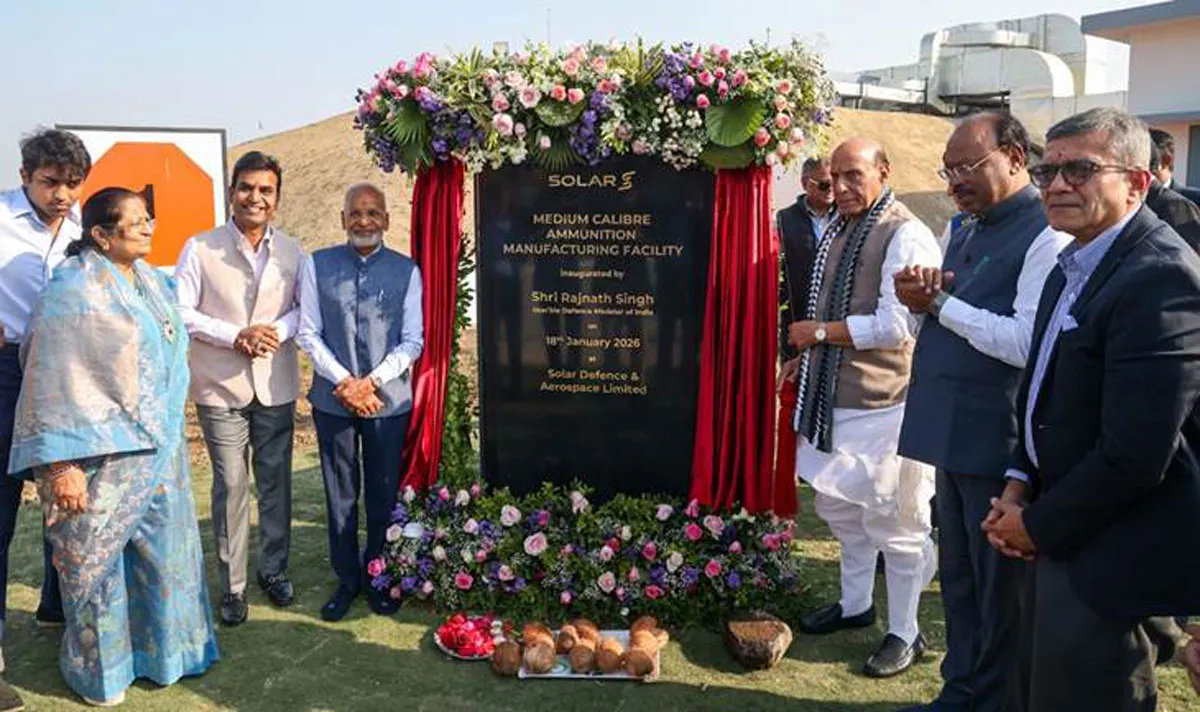
Raksha Mantri Rajnath Singh has reaffirmed the Government’s commitment to achieving Aatmanirbharta in ammunition manufacturing and positioning India as a global production hub in the defence sector. He was speaking after inaugurating a Medium Calibre Ammunition Manufacturing Facility at Solar Defence & Aerospace n Nagpur, Maharashtra, on January 19, 2026.
Recalling a period when ammunition shortages adversely affected India’s defence preparedness, Rajnath Singh said the experience underscored the critical need for self-reliance in defence production. He stated that under the leadership of Prime Minister Narendra Modi, the Government has taken sustained steps to ensure that such vulnerabilities are eliminated through indigenous manufacturing.
The newly inaugurated facility is a fully automated plant for the production of 30 mm ammunition, which is extensively used by the Indian Army and the Indian Navy. During his visit, the Raksha Mantri also reviewed the Pinaka rocket manufacturing facility and flagged off the first tranche of Guided Pinaka rockets being exported to Armenia, marking a significant milestone in India’s defence exports.
Commending the growing role of the private sector, Rajnath Singh said India is steadily advancing in ammunition production by manufacturing reliable, high-quality defence products. He highlighted the induction of the indigenously developed Multi-Mode Hand Grenade, manufactured by the private sector and handed over to the Indian Army in 2021, as a key achievement. The Raksha Mantri also cited the successful operational use of Nagastra drones, developed by the Solar Group, during Operation Sindoor, noting that their precision strikes demonstrated strong indigenous technological capability.
He further referred to the successful test launch of the ‘Bhargavastra’ Counter Drone System developed by the company, saying it showcased the technological strength of India’s private defence industry. With exports of Pinaka missiles now underway, Rajnath Singh said India is rapidly transitioning from being a major defence importer to an emerging exporter.
Describing Operation Sindoor as a reminder of the importance of self-reliance, the Raksha Mantri said modern warfare is becoming increasingly complex and multi-dimensional, extending beyond traditional battlefields to areas such as technology, supply chains, trade and information. He stressed that a robust defence industrial base is essential in this evolving security environment and called for greater private sector participation in defence manufacturing and research and development to meet future challenges.

Raksha Mantri Rajnath Singh has reaffirmed the Government’s commitment to achieving Aatmanirbharta in ammunition manufacturing and positioning India as a global production hub in the defence sector. He was speaking after inaugurating a Medium Calibre Ammunition Manufacturing Facility at Solar Defence & Aerospace n Nagpur, Maharashtra, on January 19, 2026.Recalling a period when ammunition shortages adversely affected India’s defence preparedness, Rajnath Singh said the experience underscored the critical need for self-reliance in defence production. He stated that under the leadership of Prime Minister Narendra Modi, the Government has taken sustained steps to ensure that such vulnerabilities are eliminated through indigenous manufacturing.The newly inaugurated facility is a fully automated plant for the production of 30 mm ammunition, which is extensively used by the Indian Army and the Indian Navy. During his visit, the Raksha Mantri also reviewed the Pinaka rocket manufacturing facility and flagged off the first tranche of Guided Pinaka rockets being exported to Armenia, marking a significant milestone in India’s defence exports.Commending the growing role of the private sector, Rajnath Singh said India is steadily advancing in ammunition production by manufacturing reliable, high-quality defence products. He highlighted the induction of the indigenously developed Multi-Mode Hand Grenade, manufactured by the private sector and handed over to the Indian Army in 2021, as a key achievement. The Raksha Mantri also cited the successful operational use of Nagastra drones, developed by the Solar Group, during Operation Sindoor, noting that their precision strikes demonstrated strong indigenous technological capability.He further referred to the successful test launch of the ‘Bhargavastra’ Counter Drone System developed by the company, saying it showcased the technological strength of India’s private defence industry. With exports of Pinaka missiles now underway, Rajnath Singh said India is rapidly transitioning from being a major defence importer to an emerging exporter.Describing Operation Sindoor as a reminder of the importance of self-reliance, the Raksha Mantri said modern warfare is becoming increasingly complex and multi-dimensional, extending beyond traditional battlefields to areas such as technology, supply chains, trade and information. He stressed that a robust defence industrial base is essential in this evolving security environment and called for greater private sector participation in defence manufacturing and research and development to meet future challenges.

Next Story
Infrastructure Transport

Indian Railways Steps Up Track Modernisation, Safety Drive

Indian Railways has made significant strides in modernising its track infrastructure and strengthening safety standards through sustained investment and focused execution over the past eleven years. These initiatives have played a crucial role in enabling safer, faster and more reliable train operations across the national network.During the financial year 2024–25, track renewal works were completed across 6,851 track kilometres. In the current financial year 2025–26, more than 7,500 track kilometres are undergoing renewal, while plans are in place to cover 7,900 track kilometres in 2026..

Next Story
Infrastructure Transport

PM Modi Dedicates Rs 8.30 Bn Waterways, Rail Projects in Bengal

Prime Minister Narendra Modi inaugurated, laid the foundation stone of and flagged off multiple development projects worth more than Rs 8.30 billion at Singur in Hooghly district, West Bengal, giving a major boost to rail and inland waterways infrastructure in the state. The projects are aimed at strengthening multimodal connectivity, improving cargo movement and accelerating regional economic growth.Addressing the gathering, the Prime Minister said that after visiting Malda a day earlier, he was pleased to interact with people in Hooghly. He emphasised that the development of eastern India is..

Next Story
Infrastructure Urban

Dr Jitendra Singh Launches India’s First Open-Sea Fish Farming Project

Union Minister of State (Independent Charge) for Science & Technology and Earth Sciences, Dr Jitendra Singh, launched India’s first-ever open-sea Marine Fish Farming project in the Andaman Sea, marking a major milestone in harnessing the country’s vast ocean resources for economic growth. The project was inaugurated at North Bay, Vijaya Puram, during the Minister’s field visit to the open waters of the Andaman Sea.Describing the initiative as a significant step towards realising the Blue Economy vision articulated by Prime Minister Narendra Modi, Dr Jitendra Singh said the project re..

Advertisement

Subscribe to Our Newsletter

Get daily newsletters around different themes from Construction world.

STAY CONNECTED

Advertisement

Advertisement

Advertisement

Advertisement

Open In App