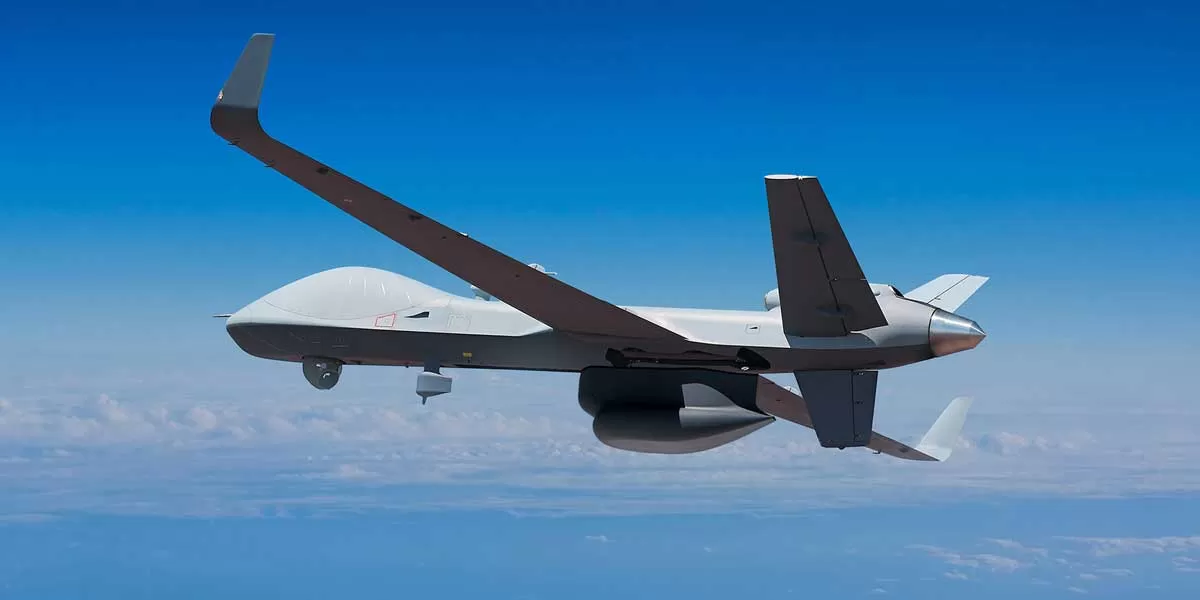
India inks $4 billion deal for 31 predator drones from General Atomics
DEFENSE

India inks $4 billion deal for 31 predator drones from General Atomics

India has signed a $4 billion agreement with the United States to procure 31 Predator MQ-9B drones from American defense manufacturer General Atomics under the foreign military sales program. This acquisition aims to bolster the combat and surveillance capabilities of the Indian military, particularly along the nation’s contested borders with China.

The signing ceremony, held in New Delhi, was attended by senior Indian defence and strategic officials, marking a significant milestone in Indo-US military cooperation. In addition to the purchase, the Defence Ministry and General Atomics Global India signed a contract for performance-based logistics, ensuring depot-level maintenance, repair, and overhaul services within India.

Last week, the Cabinet Committee on Security, led by Prime Minister Narendra Modi, approved the deal for the MQ-9B drones, following an earlier approval by the Ministry of Defence in June 2023 through a government-to-government arrangement.

The agreement covers 15 Sea Guardian drones for the Indian Navy and 16 Sky Guardians for the Indian Army and Air Force. The Indian Army and Air Force are expected to station their drones at air bases in Sarsawa and Gorakhpur, Uttar Pradesh, providing critical coverage across the Line of Actual Control (LAC) from Ladakh to Arunachal Pradesh.

The Indian Navy will deploy 15 drones to enhance maritime surveillance and reconnaissance in the Indian Ocean Region (IOR). These drones are designed to support unmanned patrols, anti-submarine warfare, and over-the-horizon targeting operations, ensuring broader maritime security.

With an endurance of over 36 hours and an operational altitude exceeding 40,000 feet, the Predator drones can be armed with Hellfire missiles and precision-guided bombs. Their versatility makes them valuable assets for intelligence, surveillance, reconnaissance (ISR) missions, and targeted combat operations.

This purchase strengthens India’s surveillance capabilities along key borders and maritime zones, deepening defense cooperation with the U.S. amidst evolving regional security challenges. (Business Standard)

India has signed a $4 billion agreement with the United States to procure 31 Predator MQ-9B drones from American defense manufacturer General Atomics under the foreign military sales program. This acquisition aims to bolster the combat and surveillance capabilities of the Indian military, particularly along the nation’s contested borders with China. The signing ceremony, held in New Delhi, was attended by senior Indian defence and strategic officials, marking a significant milestone in Indo-US military cooperation. In addition to the purchase, the Defence Ministry and General Atomics Global India signed a contract for performance-based logistics, ensuring depot-level maintenance, repair, and overhaul services within India. Last week, the Cabinet Committee on Security, led by Prime Minister Narendra Modi, approved the deal for the MQ-9B drones, following an earlier approval by the Ministry of Defence in June 2023 through a government-to-government arrangement. The agreement covers 15 Sea Guardian drones for the Indian Navy and 16 Sky Guardians for the Indian Army and Air Force. The Indian Army and Air Force are expected to station their drones at air bases in Sarsawa and Gorakhpur, Uttar Pradesh, providing critical coverage across the Line of Actual Control (LAC) from Ladakh to Arunachal Pradesh. The Indian Navy will deploy 15 drones to enhance maritime surveillance and reconnaissance in the Indian Ocean Region (IOR). These drones are designed to support unmanned patrols, anti-submarine warfare, and over-the-horizon targeting operations, ensuring broader maritime security. With an endurance of over 36 hours and an operational altitude exceeding 40,000 feet, the Predator drones can be armed with Hellfire missiles and precision-guided bombs. Their versatility makes them valuable assets for intelligence, surveillance, reconnaissance (ISR) missions, and targeted combat operations. This purchase strengthens India’s surveillance capabilities along key borders and maritime zones, deepening defense cooperation with the U.S. amidst evolving regional security challenges. (Business Standard)

Next Story
Infrastructure Transport

Kavach 4.0 Commissioned on Delhi–Mumbai and Delhi–Howrah

"Kavach version four has been commissioned on 1,452 route km, covering the high density Delhi–Mumbai and Delhi–Howrah corridors. The rollout included laying 8,570 km of optical fibre, installation of 1,100 telecom towers, deployment of trackside equipment over 6,776 RKm and establishment of 767 station data centres. Trackside implementation has been taken up on 24,427 RKm covering Golden Quadrilateral, Golden Diagonal and High Density Network sections. The programme aims to strengthen signalling and train protection on key routes.Kavach is an indigenously developed automatic train protecti..

Next Story
Infrastructure Transport

Railways Advance Kalyan–Murbad Line And Mumbai Capacity Expansion

"Indian Railways is advancing multiple rail infrastructure projects in Maharashtra, including the sanctioned Kalyan–Murbad new line and sizable investments under the Mumbai Urban Transport Project and the Mumbai–Ahmedabad High Speed Rail project. The Kalyan–Murbad 28 km new line has been sanctioned at Rs 8.36 billion (bn) on a 50:50 cost-sharing basis with the Government of Maharashtra and has been declared a Special Railway Project for land acquisition; proposals covering 214 hectares are at various stages of acquisition. Budgetary outlay for projects falling fully or partly in Maharash..

Next Story
Infrastructure Urban

Parliamentary Panel Flags Funding Gaps in Heavy Industries

"The Department-Related Parliamentary Standing Committee on Industry (Rajya Sabha) presented its 332nd report on the Demands for Grants 2026-27 of the Ministry of Heavy Industries (MHI). Figures converted from crore and lakh are expressed in million (mn). The Budget Estimates 2026-27 for the Ministry stand at Rs 79,399 mn against a projected requirement of Rs 94,843.2 mn, a shortfall of about 16 per cent, with revenue at Rs 79,370.8 mn and capital compressed to Rs 28.2 mn from Rs 5,020 mn.The committee flagged recurring BE-to-RE compression and declining revised estimate utilisation, and calle..

Advertisement

Subscribe to Our Newsletter

Get daily newsletters around different themes from Construction world.

STAY CONNECTED

Advertisement

Advertisement

Advertisement