
Goa Eyes Critical Mineral Recovery From Iron Ore Dumps
WATER & WASTE

Goa Eyes Critical Mineral Recovery From Iron Ore Dumps

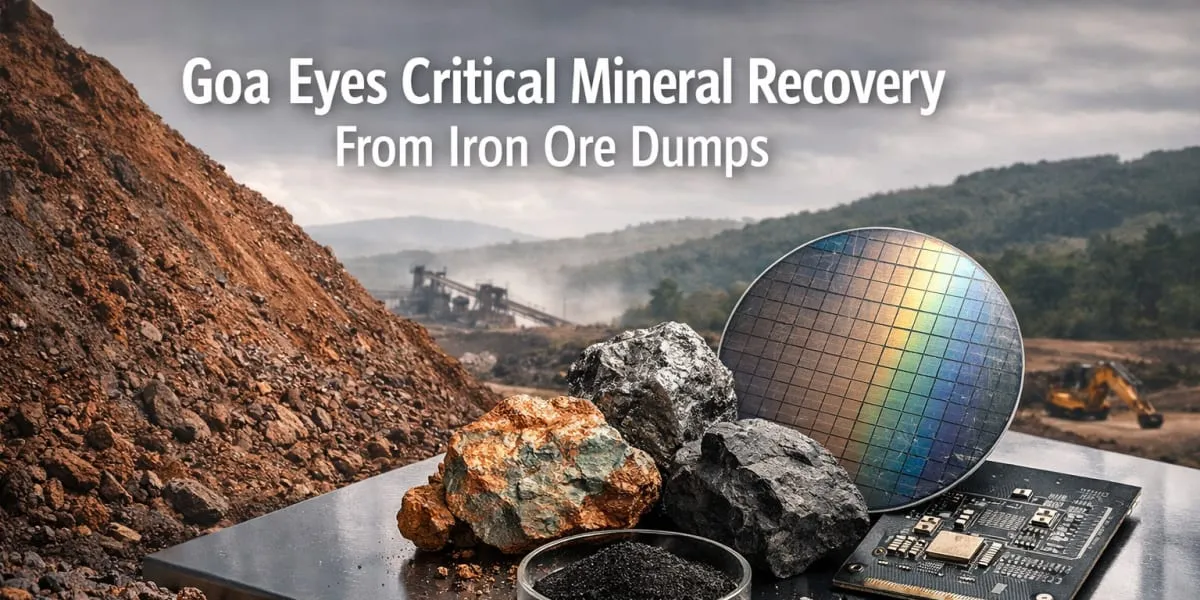
Goa has launched an initiative to recover critical minerals from legacy iron ore dumps, aiming to convert waste into a resource while addressing environmental liabilities. The initiative focuses on identifying and extracting valuable constituents left in tailings and overburden that can support local industry and reduce import dependence. Officials framed the plan as part of a wider effort to rehabilitate former mining landscapes and secure materials vital for technology and manufacturing.

Work will begin with systematic mapping and sampling of dump sites to establish resource quality and quantity, followed by pilot beneficiation and reprocessing trials. The state administration intends to engage technical partners and research institutions to apply proven extraction and ore treatment methods suited to small and medium scale operations. Environmental safeguards will be integrated into operations to prevent contamination and to ensure responsible reuse of rehabilitated land. Priority will be given to sites with minimal social disruption and clear land tenure.

The programme is expected to create skilled employment opportunities and to stimulate ancillary services in transport, processing and waste management. Recovering materials in situ will shorten value chains and could foster local fabrication activities that add value before products leave the region. The approach aims to reduce the long term footprint of mining legacies while generating revenue that can be directed to community development and environmental restoration.

Regulatory oversight and monitoring frameworks will be central to implementation, with clear standards for waste handling and water management to be enforced. The state will seek investment and technology partnerships to scale successful pilots into sustained operations that balance economic and ecological objectives. Stakeholder consultation and transparent reporting have been identified as necessary steps before wider roll out. Authorities will publish progress reports and environmental audits to maintain public confidence.

"Join industry leaders at RAHSTA Expo, India's premier platform for roads, highways and traffic infrastructure. Register now to explore innovations, network with experts and shape the future of mobility."

Goa has launched an initiative to recover critical minerals from legacy iron ore dumps, aiming to convert waste into a resource while addressing environmental liabilities. The initiative focuses on identifying and extracting valuable constituents left in tailings and overburden that can support local industry and reduce import dependence. Officials framed the plan as part of a wider effort to rehabilitate former mining landscapes and secure materials vital for technology and manufacturing. Work will begin with systematic mapping and sampling of dump sites to establish resource quality and quantity, followed by pilot beneficiation and reprocessing trials. The state administration intends to engage technical partners and research institutions to apply proven extraction and ore treatment methods suited to small and medium scale operations. Environmental safeguards will be integrated into operations to prevent contamination and to ensure responsible reuse of rehabilitated land. Priority will be given to sites with minimal social disruption and clear land tenure. The programme is expected to create skilled employment opportunities and to stimulate ancillary services in transport, processing and waste management. Recovering materials in situ will shorten value chains and could foster local fabrication activities that add value before products leave the region. The approach aims to reduce the long term footprint of mining legacies while generating revenue that can be directed to community development and environmental restoration. Regulatory oversight and monitoring frameworks will be central to implementation, with clear standards for waste handling and water management to be enforced. The state will seek investment and technology partnerships to scale successful pilots into sustained operations that balance economic and ecological objectives. Stakeholder consultation and transparent reporting have been identified as necessary steps before wider roll out. Authorities will publish progress reports and environmental audits to maintain public confidence.

Next Story
Infrastructure Transport

Railways To Operate Over 300 Special Trains For Rath Yatra

Union Railway Minister Ashwini Vaishnaw announced that Indian Railways (IR) will operate more than 300 special trains for the annual Jagannath Rath Yatra in Odisha and over 100 special trains during the Onam festival in Keralam. He flagged off the Nanded–Mumbai and Tanakpur–Nanded Express trains and inaugurated the extension of the Tanakpur–Pilibhit service up to Shahjahanpur via video conference from Rail Sadan in Bhubaneswar. He noted that the summer season, which concluded on 30 June, had seen a record 15,000 special trains. Vaishnaw stated that the newly launched services are intende..

Next Story
Infrastructure Transport

Vande Bharat Express To Start From Tripura Soon

Tripura Chief Minister Manik Saha said the Vande Bharat Express will commence operations from Tripura in the coming days after he flagged off the Agartala–Karimganj MEMU service at Agartala Railway Station. He recalled the rail history of the state, noting that a metre-gauge service first arrived in 1964 and that broad gauge reached Agartala in 2008 following national projects and later upgrades under the Act East policy. The event was described as a milestone for regional connectivity and the MEMU was presented as the first electric passenger train to originate from Tripura.\n\nSaha said he..

Next Story
Infrastructure Urban

MEMU Suspension Disrupts Commuters Between Vadodara And Dahod

The Vadodara–Dahod Mainline Electric Multiple Unit (MEMU) service has been temporarily suspended for 26 days after its rake was diverted to Odisha to manage the surge in passenger traffic during the annual Rath Yatra in Puri. Indian Railways redeployed several MEMU rakes from different zones to meet the additional travel demand for the festival scheduled from the seventh of July to the second of August. As a result, train numbers 69233 and 69234 operating between Vadodara and Dahod will remain cancelled for the duration. Railway authorities advised passengers to use alternative train service..

Advertisement

Subscribe to Our Newsletter

Get daily newsletters around different themes from Construction world.

STAY CONNECTED

Advertisement

Advertisement

Advertisement