Govt Pushes River-Linking Plan to Tackle Water Imbalance, Floods
WATER & WASTE

Govt Pushes River-Linking Plan to Tackle Water Imbalance, Floods

The Government of India is progressing with its National Perspective Plan (NPP) for Inter-Linking of Rivers (ILR) to transfer water from surplus to deficit basins. The National Water Development Agency (NWDA) is spearheading the programme.

Under the NPP, 30 ILR projects have been identified—14 under the Himalayan component and 16 under the Peninsular component. So far, 11 Detailed Project Reports (DPRs), 26 Feasibility Reports (FRs), and 30 Pre-Feasibility Reports (PFRs) have been completed.

The Ken-Betwa Link Project (KBLP) is the first ILR project under implementation. Approved in December 2021 at an estimated cost of Rs 446.05 billion, it is being developed with Rs 393.17 billion in central support through a Special Purpose Vehicle, the Ken Betwa Link Project Authority (KBLPA). Construction of the Daudhan Dam, a key component, has been awarded, and a Project Management Consultant has been appointed.

The ILR programme aims to divert floodwaters from surplus rivers to drought-prone areas, helping mitigate both floods and water scarcity. It is also expected to recharge groundwater and support irrigation infrastructure.

In parallel, the government continues to support state-led flood management initiatives. Through the Flood Management Programme (FMP), now part of the Flood Management and Border Areas Programme (FMBAP), central assistance is provided for flood control, anti-erosion, drainage, and sea protection works. The FMBAP has been extended until 2026.

Under FMP, 48 projects worth Rs 18.66 billion have been approved, with Rs 9.24 billion released to Bihar. Additionally, the Ministry of Jal Shakti has urged all states to implement flood plain zoning as a key non-structural measure to reduce flood impact.

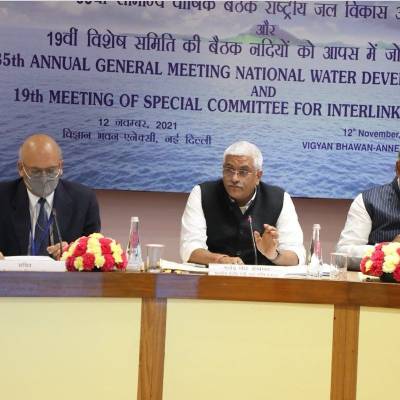
This information was shared by the Minister of State for Jal Shakti, Shri Raj Bhushan Choudhary, in a written reply to the Lok Sabha.

News source: PIB

The Government of India is progressing with its National Perspective Plan (NPP) for Inter-Linking of Rivers (ILR) to transfer water from surplus to deficit basins. The National Water Development Agency (NWDA) is spearheading the programme.Under the NPP, 30 ILR projects have been identified—14 under the Himalayan component and 16 under the Peninsular component. So far, 11 Detailed Project Reports (DPRs), 26 Feasibility Reports (FRs), and 30 Pre-Feasibility Reports (PFRs) have been completed.The Ken-Betwa Link Project (KBLP) is the first ILR project under implementation. Approved in December 2021 at an estimated cost of Rs 446.05 billion, it is being developed with Rs 393.17 billion in central support through a Special Purpose Vehicle, the Ken Betwa Link Project Authority (KBLPA). Construction of the Daudhan Dam, a key component, has been awarded, and a Project Management Consultant has been appointed.The ILR programme aims to divert floodwaters from surplus rivers to drought-prone areas, helping mitigate both floods and water scarcity. It is also expected to recharge groundwater and support irrigation infrastructure.In parallel, the government continues to support state-led flood management initiatives. Through the Flood Management Programme (FMP), now part of the Flood Management and Border Areas Programme (FMBAP), central assistance is provided for flood control, anti-erosion, drainage, and sea protection works. The FMBAP has been extended until 2026.Under FMP, 48 projects worth Rs 18.66 billion have been approved, with Rs 9.24 billion released to Bihar. Additionally, the Ministry of Jal Shakti has urged all states to implement flood plain zoning as a key non-structural measure to reduce flood impact.This information was shared by the Minister of State for Jal Shakti, Shri Raj Bhushan Choudhary, in a written reply to the Lok Sabha.News source: PIB

Next Story
Infrastructure Transport

Kavach 4.0 Commissioned on Delhi–Mumbai and Delhi–Howrah

"Kavach version four has been commissioned on 1,452 route km, covering the high density Delhi–Mumbai and Delhi–Howrah corridors. The rollout included laying 8,570 km of optical fibre, installation of 1,100 telecom towers, deployment of trackside equipment over 6,776 RKm and establishment of 767 station data centres. Trackside implementation has been taken up on 24,427 RKm covering Golden Quadrilateral, Golden Diagonal and High Density Network sections. The programme aims to strengthen signalling and train protection on key routes.Kavach is an indigenously developed automatic train protecti..

Next Story
Infrastructure Transport

Railways Advance Kalyan–Murbad Line And Mumbai Capacity Expansion

"Indian Railways is advancing multiple rail infrastructure projects in Maharashtra, including the sanctioned Kalyan–Murbad new line and sizable investments under the Mumbai Urban Transport Project and the Mumbai–Ahmedabad High Speed Rail project. The Kalyan–Murbad 28 km new line has been sanctioned at Rs 8.36 billion (bn) on a 50:50 cost-sharing basis with the Government of Maharashtra and has been declared a Special Railway Project for land acquisition; proposals covering 214 hectares are at various stages of acquisition. Budgetary outlay for projects falling fully or partly in Maharash..

Next Story
Infrastructure Urban

Parliamentary Panel Flags Funding Gaps in Heavy Industries

"The Department-Related Parliamentary Standing Committee on Industry (Rajya Sabha) presented its 332nd report on the Demands for Grants 2026-27 of the Ministry of Heavy Industries (MHI). Figures converted from crore and lakh are expressed in million (mn). The Budget Estimates 2026-27 for the Ministry stand at Rs 79,399 mn against a projected requirement of Rs 94,843.2 mn, a shortfall of about 16 per cent, with revenue at Rs 79,370.8 mn and capital compressed to Rs 28.2 mn from Rs 5,020 mn.The committee flagged recurring BE-to-RE compression and declining revised estimate utilisation, and calle..

Advertisement

Subscribe to Our Newsletter

Get daily newsletters around different themes from Construction world.

STAY CONNECTED

Advertisement

Advertisement

Advertisement