AFCM Unveils 2035 Regional Decarbonisation Roadmap for Cement Sector
Cement

AFCM Unveils 2035 Regional Decarbonisation Roadmap for Cement Sector

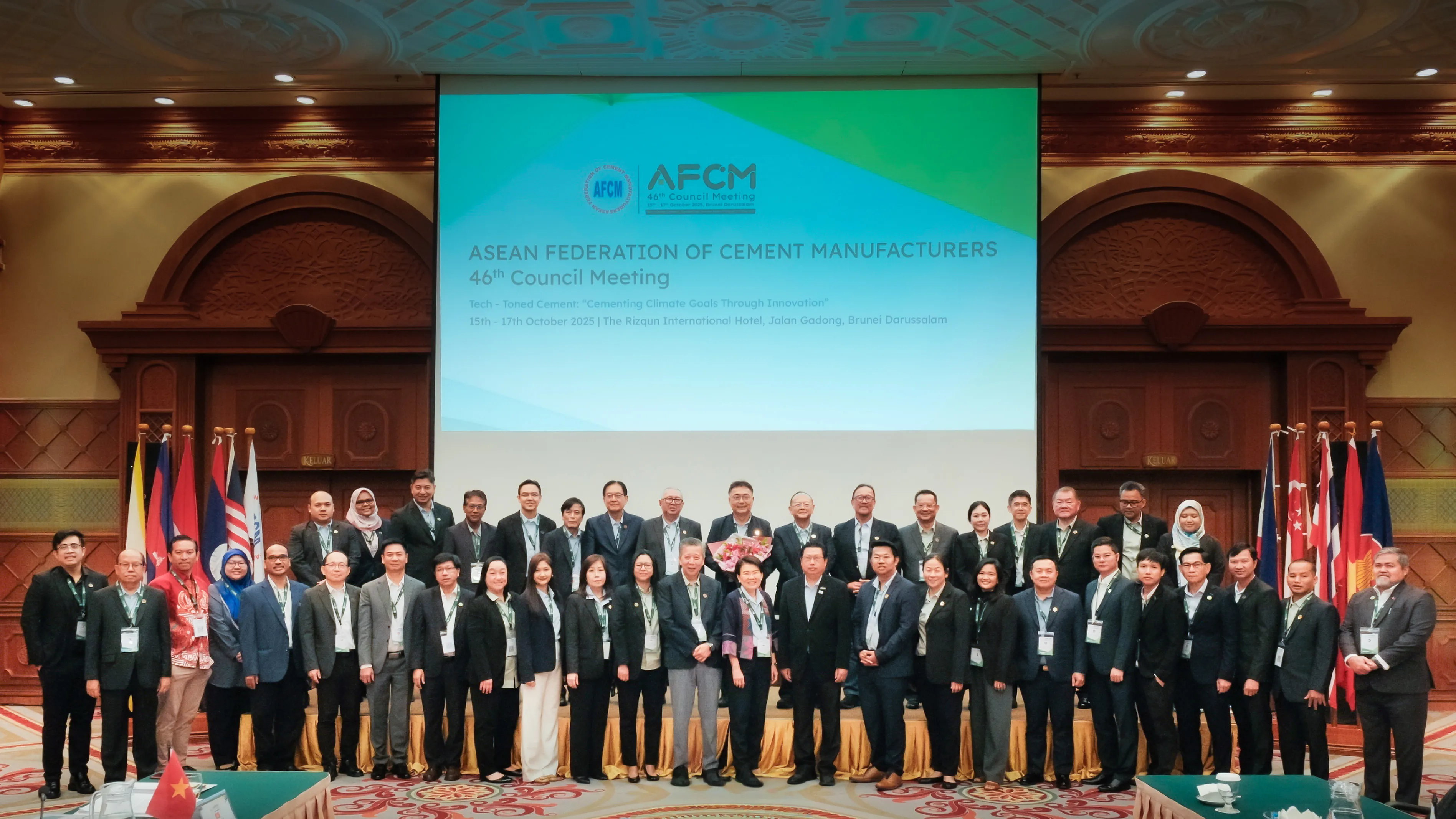
The ASEAN Federation of Cement Manufacturers (AFCM) has formally launched the 2035 AFCM Decarbonisation Roadmap, becoming the first regional bloc in the world to introduce a unified decarbonisation strategy for the cement sector. The announcement was made at the 46th AFCM Council Meeting in Brunei Darussalam, chaired by Dr Chana Poomee, and attended by leaders and representatives of cement associations from all eight AFCM member countries. The launch comes as global attention intensifies ahead of COP30 in Brazil, where climate action is expected to be a central priority.
Cement production remains integral to infrastructure and economic development across the ASEAN region, yet it is also a major contributor to CO? emissions. The 2035 AFCM Decarbonisation Roadmap signals a collective regional commitment to accelerating emissions reduction in alignment with national climate policies and global sustainability goals, reinforcing AFCM’s leadership in the transition to low carbon cement production.
Dr Chana Poomee, AFCM President and Chairman of the Thai Cement Manufacturers Association (TCMA), described the roadmap as a landmark achievement for the region’s cement industry. He noted that the shared framework would support systematic CO? reduction, strengthen regional competitiveness and enhance ASEAN’s contribution to global climate objectives.
Developed with strong support from the Global Cement and Concrete Association (GCCA), the 2035 Roadmap sets out a comprehensive transition pathway anchored around four strategic pillars:
• Expansion of low carbon cement enabled by performance-based standards;
• Transition to clean and renewable energy across production processes, alongside improved thermal and electrical efficiency;
• Deployment of advanced decarbonisation technologies, including Carbon Capture, Utilisation and Storage (CCUS); and
• Development of new supplementary cementitious materials to support next-generation low carbon cement products.
Dr Chana urged all AFCM members to treat the roadmap as a coordinated regional strategy for sustainable growth. At the ASEAN level, the measures outlined have the potential to reduce up to 38 million tonnes of CO2 by 2035. While the roadmap sets a collective vision, it acknowledges the diversity of national conditions, recognising that each member country will set its own targets based on regulatory frameworks, industrial maturity and technological capacity. One key early-action priority is the reduction and phasedown of Ordinary Portland Cement (OPC), providing an immediate opportunity for substantial emissions cuts.
Cement associations from Brunei Darussalam, Cambodia, Indonesia, Malaysia, the Philippines, Singapore, Thailand and Vietnam expressed strong support for the roadmap and reaffirmed their commitment to advancing decarbonisation within their national contexts. Members emphasised the need for supportive policies, expanded use of alternative fuels, improved energy efficiency, accelerated adoption of advanced technologies and greater promotion of low carbon cement and concrete solutions. They also recognised that specific decarbonisation pathways will vary based on each country’s energy mix, material availability, policy environment and market readiness.
“The 2035 AFCM Decarbonisation Roadmap presents a significant opportunity to enhance regional competitiveness, drive sustainable development and unlock substantial economic benefits. Government support, including policy adaptation, will be essential for effective implementation. Through collaboration, innovation and collective action, AFCM can accelerate the adoption of low carbon technologies, attract green investment, create new economic opportunities and build a resilient, future-ready cement industry that contributes meaningfully to global decarbonisation,” Dr Chana concluded.
The issuer is solely responsible for the content of this announcement.

The ASEAN Federation of Cement Manufacturers (AFCM) has formally launched the 2035 AFCM Decarbonisation Roadmap, becoming the first regional bloc in the world to introduce a unified decarbonisation strategy for the cement sector. The announcement was made at the 46th AFCM Council Meeting in Brunei Darussalam, chaired by Dr Chana Poomee, and attended by leaders and representatives of cement associations from all eight AFCM member countries. The launch comes as global attention intensifies ahead of COP30 in Brazil, where climate action is expected to be a central priority.Cement production remains integral to infrastructure and economic development across the ASEAN region, yet it is also a major contributor to CO? emissions. The 2035 AFCM Decarbonisation Roadmap signals a collective regional commitment to accelerating emissions reduction in alignment with national climate policies and global sustainability goals, reinforcing AFCM’s leadership in the transition to low carbon cement production.Dr Chana Poomee, AFCM President and Chairman of the Thai Cement Manufacturers Association (TCMA), described the roadmap as a landmark achievement for the region’s cement industry. He noted that the shared framework would support systematic CO? reduction, strengthen regional competitiveness and enhance ASEAN’s contribution to global climate objectives.Developed with strong support from the Global Cement and Concrete Association (GCCA), the 2035 Roadmap sets out a comprehensive transition pathway anchored around four strategic pillars:• Expansion of low carbon cement enabled by performance-based standards;• Transition to clean and renewable energy across production processes, alongside improved thermal and electrical efficiency;• Deployment of advanced decarbonisation technologies, including Carbon Capture, Utilisation and Storage (CCUS); and• Development of new supplementary cementitious materials to support next-generation low carbon cement products.Dr Chana urged all AFCM members to treat the roadmap as a coordinated regional strategy for sustainable growth. At the ASEAN level, the measures outlined have the potential to reduce up to 38 million tonnes of CO2 by 2035. While the roadmap sets a collective vision, it acknowledges the diversity of national conditions, recognising that each member country will set its own targets based on regulatory frameworks, industrial maturity and technological capacity. One key early-action priority is the reduction and phasedown of Ordinary Portland Cement (OPC), providing an immediate opportunity for substantial emissions cuts.Cement associations from Brunei Darussalam, Cambodia, Indonesia, Malaysia, the Philippines, Singapore, Thailand and Vietnam expressed strong support for the roadmap and reaffirmed their commitment to advancing decarbonisation within their national contexts. Members emphasised the need for supportive policies, expanded use of alternative fuels, improved energy efficiency, accelerated adoption of advanced technologies and greater promotion of low carbon cement and concrete solutions. They also recognised that specific decarbonisation pathways will vary based on each country’s energy mix, material availability, policy environment and market readiness.“The 2035 AFCM Decarbonisation Roadmap presents a significant opportunity to enhance regional competitiveness, drive sustainable development and unlock substantial economic benefits. Government support, including policy adaptation, will be essential for effective implementation. Through collaboration, innovation and collective action, AFCM can accelerate the adoption of low carbon technologies, attract green investment, create new economic opportunities and build a resilient, future-ready cement industry that contributes meaningfully to global decarbonisation,” Dr Chana concluded.The issuer is solely responsible for the content of this announcement.

Next Story
Technology

VIAVI and QNu Labs Partner to Advance Quantum-Safe Network Security

Viavi Solutions Inc. (VIAVI) and QNu Labs have entered into a strategic partnership to develop quantum-safe security and advanced network intelligence technologies aimed at protecting critical infrastructure from emerging quantum threats. The partnership marks the first phase toward establishing a global industry consortium to accelerate open collaboration in quantum-secure communications across sectors.With the growth of quantum-safe technologies, ensuring resilience and reliability at the optical layer has become essential as quantum systems integrate with existing physical infrastructure. T..

Next Story
Infrastructure Urban

India, Russia Hold 22nd Defence Commission Meet in New Delhi

Raksha Mantri Rajnath Singh and Russia’s Defence Minister Mr Andrei Belousov co-chaired the 22nd India–Russia Inter-Governmental Commission on Military and Military Technical Cooperation (IRIGC-M&MTC) at the Manekshaw Centre in New Delhi on 4 December 2025. Both sides reaffirmed that the longstanding bilateral relationship is anchored in mutual trust, shared principles and deep respect. The meeting comes ahead of the 23rd India–Russia Annual Summit between Prime Minister Narendra Modi and President Vladimir Putin.During the session, Rajnath Singh reiterated India’s commitment t..

Next Story
Infrastructure Urban

ITU–TRAI Workshop on QoS and QoE Begins in Bhubaneswar

The Telecom Regulatory Authority of India (TRAI), in collaboration with the International Telecommunication Union (ITU), inaugurated the ITU–TRAI Workshop on Performance, Quality of Service and Quality of Experience in Bhubaneswar. The two-day international programme convened National Regulatory Authorities (NRAs), service providers and technical specialists from around the world to strengthen collaborative approaches to telecom service-quality frameworks. The inaugural ceremony featured a lamp-lighting, followed by a welcome address from Atul Kumar Chaudhary, Secretary, TRAI, and the inaugu..

Advertisement

Subscribe to Our Newsletter

Get daily newsletters around different themes from Construction world.

STAY CONNECTED

Advertisement

Advertisement

Advertisement

Advertisement

Get CW App