+
India to Seek Critical Minerals Deals With Brazil, Canada and Europe
COAL & MINING

India to Seek Critical Minerals Deals With Brazil, Canada and Europe

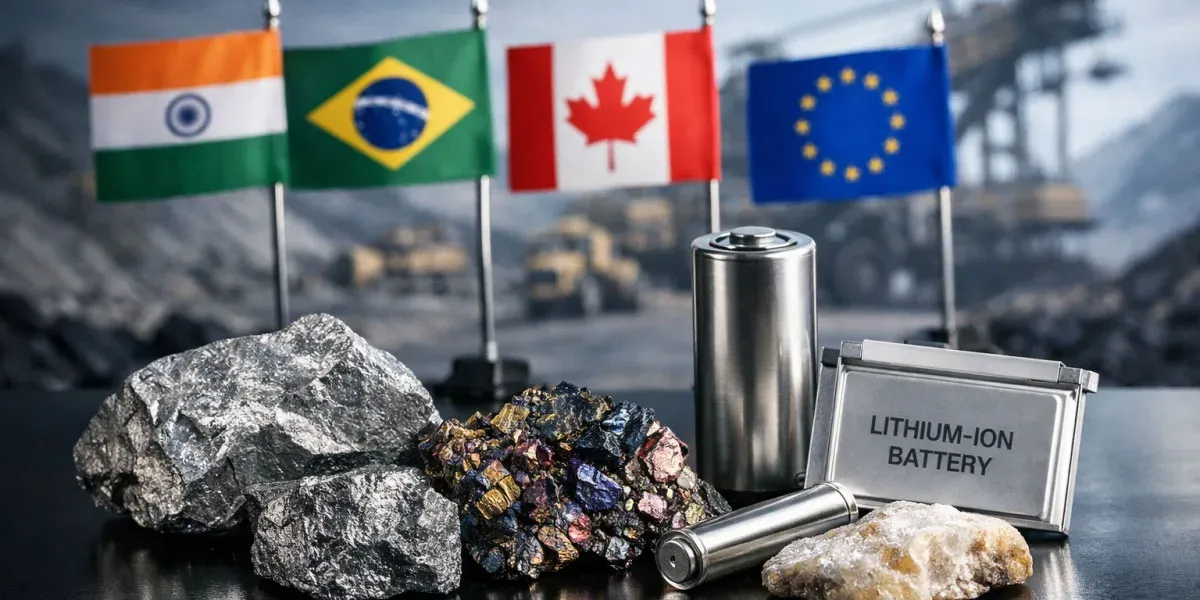
India is conducting talks with Brazil, Canada, France and the Netherlands to seek cooperative arrangements to explore, extract, process and recycle critical minerals. The discussions are focused on lithium and rare earths and also aim to secure access to mineral processing technologies. Sources declined to be identified because the negotiations remain confidential.

Officials said the push reflects concern over heavy reliance on China, which dominates global supplies of many minerals and holds advanced mining and processing capabilities. The outreach is part of a broader strategy to accelerate the energy transition and cut emissions while diversifying supply chains. Mining remains a lengthy undertaking as exploration alone typically runs five to seven years and often does not result in a viable mine.

India seeks to emulate elements of a critical minerals agreement signed with Germany in January that covers exploration, processing and recycling as well as the acquisition and development of mineral assets in both countries and in third countries. The Ministry of Mines is leading the effort and sources said talks with France, the Netherlands and Brazil are under way while an agreement with Canada is under active consideration. Canada's prime minister, Mark Carney, is likely to visit India in early March and to sign deals concerning uranium, energy, minerals and artificial intelligence, according to officials. Canada's Natural Resources Department referenced a January statement that both sides had agreed to formalise cooperation on critical minerals.

India has already signed pacts related to critical minerals with Argentina, Australia and Japan and is engaged in talks with Peru and Chile on broader bilateral arrangements. The expanding engagement coincides with recent discussions by finance ministers from major economies on reducing dependence on rare earths from China. In 2023 the government identified more than 20 minerals, including lithium, as critical to the energy transition and to meet rising demand from industry and infrastructure. Securing diverse sources and processing technology remains a strategic priority for policymakers.

India is conducting talks with Brazil, Canada, France and the Netherlands to seek cooperative arrangements to explore, extract, process and recycle critical minerals. The discussions are focused on lithium and rare earths and also aim to secure access to mineral processing technologies. Sources declined to be identified because the negotiations remain confidential. Officials said the push reflects concern over heavy reliance on China, which dominates global supplies of many minerals and holds advanced mining and processing capabilities. The outreach is part of a broader strategy to accelerate the energy transition and cut emissions while diversifying supply chains. Mining remains a lengthy undertaking as exploration alone typically runs five to seven years and often does not result in a viable mine. India seeks to emulate elements of a critical minerals agreement signed with Germany in January that covers exploration, processing and recycling as well as the acquisition and development of mineral assets in both countries and in third countries. The Ministry of Mines is leading the effort and sources said talks with France, the Netherlands and Brazil are under way while an agreement with Canada is under active consideration. Canada's prime minister, Mark Carney, is likely to visit India in early March and to sign deals concerning uranium, energy, minerals and artificial intelligence, according to officials. Canada's Natural Resources Department referenced a January statement that both sides had agreed to formalise cooperation on critical minerals. India has already signed pacts related to critical minerals with Argentina, Australia and Japan and is engaged in talks with Peru and Chile on broader bilateral arrangements. The expanding engagement coincides with recent discussions by finance ministers from major economies on reducing dependence on rare earths from China. In 2023 the government identified more than 20 minerals, including lithium, as critical to the energy transition and to meet rising demand from industry and infrastructure. Securing diverse sources and processing technology remains a strategic priority for policymakers.

Next Story
Infrastructure Energy

Jyoti Structures expands manufacturing capacity in Nashik

The announcement Jyoti Structures (JSL) reported steady operational performance in 2025, supported by stable project execution across its power transmission portfolio. The company commissioned galvanisation operations at its second Nashik manufacturing unit, adding 33,000 MT of annual capacity. This increased aggregate tower manufacturing capability at Nashik to approximately 69,000 MT per annum, aimed at improving fabrication accuracy, scheduling control and delivery predictability. JSL also expanded its workforce to over 750 employees, onboarding more than 70 engineers during the year. C..

Next Story
Infrastructure Energy

TSPL Mega Health Camp Reaches 338 Residents in Mansa

Talwandi Sabo Power (TSPL), Punjab’s largest and North India’s largest private thermal power plant, organised a Mega Health Camp at Village Raipur, Mansa, under its flagship healthcare initiative Project SEHAT. The camp benefitted 338 community members through free consultations and diagnostic services.A team comprising a General Physician, Gynaecologist, Dermatologist and Dentist provided medical advice and treatment. Beneficiaries received free diagnostic tests including BP, HB, blood sugar, malaria, dengue and blood group tests, along with free medicines.The camp was inaugurated by Vill..

Next Story
Infrastructure Transport

Mumbai Coastal Road Musical Path Plays Jai Ho

Mumbai inaugurated India’s first musical path on the Coastal Road that plays the song Jai Ho for motorists. The civic administration said the installation used Hungarian technology and that the intention was to implement the concept of Sangeet Marg in future projects. A senior official suggested implementing a pilot on the Samruddhi Expressway, which connects Mumbai and Nagpur. City officials described the inauguration as a symbolic demonstration of collaboration between municipal authorities and foreign partners. The inauguration was attended by the Consul General of Hungary Ferenc Jari, f..

Advertisement

Subscribe to Our Newsletter

Get daily newsletters around different themes from Construction world.

STAY CONNECTED

Advertisement

Advertisement

Advertisement

Open In App