Empowering Local Governance for Sustainable Rural Water Supply
WATER & WASTE

Empowering Local Governance for Sustainable Rural Water Supply

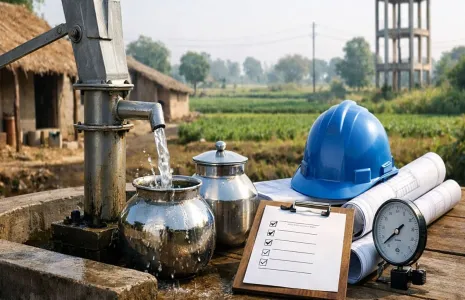
The Ministry of Jal Shakti has aligned the Jal Jeevan Mission (JJM) with the 73rd Amendment to strengthen village level planning and community ownership of water supply. Gram Panchayats, village water and sanitation committees and Pani Samitis are to plan, implement, manage and maintain piped water systems, with gram sabha processes formalising handover and oversight. Implementation support agencies including non government organisations, community based organisations and self help groups have been empanelled to train local committees and promote women participation.

Under JJM, the department issues completion certificates after tap connections are provided to all rural households and marks the village as Har Ghar Jal on the JJM information management system. The Gram Panchayat then certifies the village in a gram sabha and supporting records and a short video are uploaded to the dashboard. As reported by states, of around 0.274 million (mn) villages reported as Har Ghar Jal, around 0.181 million (mn) have been certified by Gram Sabhas.

Community contribution norms specify five per cent for north eastern, difficult, forested, water stressed and villages with more than 50 per cent SC or ST population and ten per cent for other villages. While preparing village action plans the ministry has advised dovetailing of resources from Finance Commission tied grants, JJM, Swachh Bharat Mission Grameen, the Mahatma Gandhi National Rural Employment Guarantee Scheme, local area development funds, district mineral funds, corporate social responsibility and community contributions. The aim is that communities will align resources to secure long term water security.

The Nal Jal Mitra Programme (NJMP) has been launched with the Ministry of Skill Development and Entrepreneurship to develop local operators able to carry out repairs and preventive maintenance as masons, plumbers, fitters, electricians and pump operators. For operational sustainability, states have been advised to adopt operation and maintenance policies including handover to Panchayats, user charges and financing for energy bills, skilling and deployment of local persons for water quality surveillance. The minister of state for Jal Shakti V. Somanna provided this information in a written reply in Rajya Sabha.

The Ministry of Jal Shakti has aligned the Jal Jeevan Mission (JJM) with the 73rd Amendment to strengthen village level planning and community ownership of water supply. Gram Panchayats, village water and sanitation committees and Pani Samitis are to plan, implement, manage and maintain piped water systems, with gram sabha processes formalising handover and oversight. Implementation support agencies including non government organisations, community based organisations and self help groups have been empanelled to train local committees and promote women participation. Under JJM, the department issues completion certificates after tap connections are provided to all rural households and marks the village as Har Ghar Jal on the JJM information management system. The Gram Panchayat then certifies the village in a gram sabha and supporting records and a short video are uploaded to the dashboard. As reported by states, of around 0.274 million (mn) villages reported as Har Ghar Jal, around 0.181 million (mn) have been certified by Gram Sabhas. Community contribution norms specify five per cent for north eastern, difficult, forested, water stressed and villages with more than 50 per cent SC or ST population and ten per cent for other villages. While preparing village action plans the ministry has advised dovetailing of resources from Finance Commission tied grants, JJM, Swachh Bharat Mission Grameen, the Mahatma Gandhi National Rural Employment Guarantee Scheme, local area development funds, district mineral funds, corporate social responsibility and community contributions. The aim is that communities will align resources to secure long term water security. The Nal Jal Mitra Programme (NJMP) has been launched with the Ministry of Skill Development and Entrepreneurship to develop local operators able to carry out repairs and preventive maintenance as masons, plumbers, fitters, electricians and pump operators. For operational sustainability, states have been advised to adopt operation and maintenance policies including handover to Panchayats, user charges and financing for energy bills, skilling and deployment of local persons for water quality surveillance. The minister of state for Jal Shakti V. Somanna provided this information in a written reply in Rajya Sabha.

Next Story
Real Estate

Loomcraft Enters South India with Kerala Store Launch

Loomcraft has launched its exclusive store in Kerala, marking its entry into South India and a key step in its nationwide expansion strategy. The move targets a region driven by tourism and premium real estate demand, where outdoor spaces play a central role in hospitality and residential experiences.Kerala’s growing base of luxury resorts, boutique hotels, villas and gated communities has created strong demand for specialised outdoor furniture. However, the region has remained underserved, with buyers relying on imports or generic products not suited to humid, coastal and monsoon-heavy cond..

Next Story
Building Material

Mild Steel Prices Seen Rising to Rs 61,000 Per Tonne

Mild steel prices in India, currently around Rs 58,000 per tonne, are expected to rise to nearly Rs 61,000 per tonne in April, indicating an increase of about Rs 3,000 per tonne. The anticipated rise reflects structural pressures driven by geopolitical tensions, energy constraints and limited raw material availability.Ongoing global conflict has disrupted energy markets, leading to LNG shortages that are affecting domestic steel production. Small and mid-sized manufacturers, particularly those dependent on gas-based processes, are witnessing production cuts due to constrained energy supply, re..

Next Story
Infrastructure Urban

Vedanta Expands Transgender Workforce to 75 Employees

Vedanta has strengthened its commitment to workplace inclusion by employing 75 transgender individuals across its businesses, including Vedanta Aluminium, Hindustan Zinc, Sesa Goa, FACOR and Cairn Oil & Gas. The initiative reflects sustained hiring efforts since 2022 to build equitable opportunities across operations, corporate and technical roles.Transgender employees are engaged in functions such as operations, finance, logistics, HR, CSR, healthcare and security, with provisions for internal mobility to support career progression. The company has implemented structured policies, includi..

Advertisement

Subscribe to Our Newsletter

Get daily newsletters around different themes from Construction world.

STAY CONNECTED

Advertisement

Advertisement

Advertisement