Jal Jeevan Mission Reaches Eighty One Per Cent Rural Coverage
WATER & WASTE

Jal Jeevan Mission Reaches Eighty One Per Cent Rural Coverage

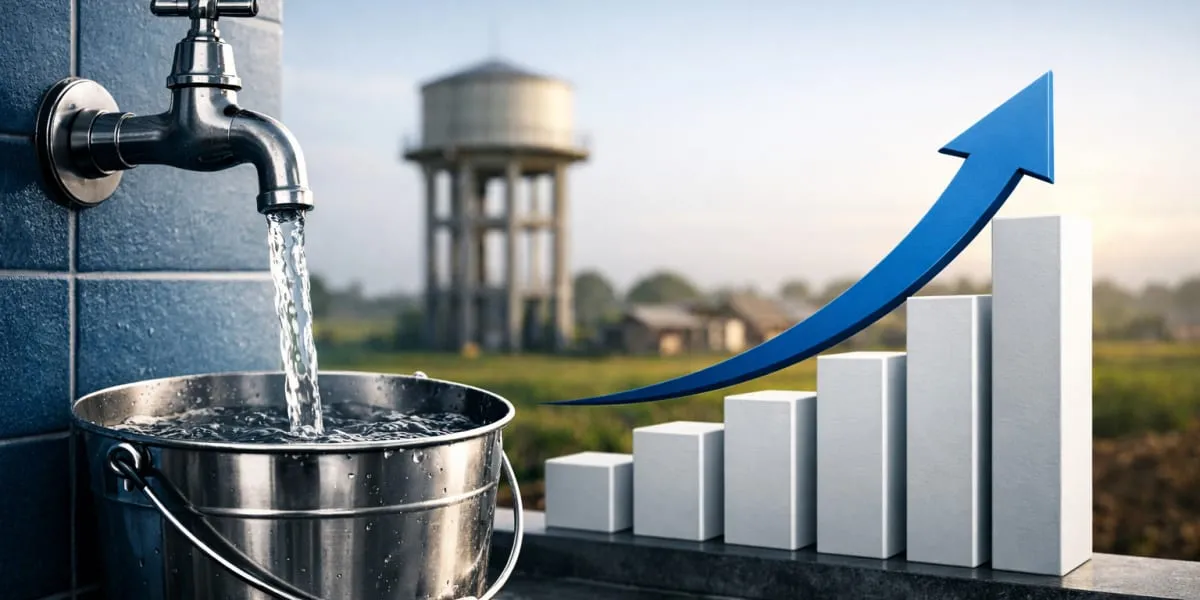
The Government reported substantial progress under the Jal Jeevan Mission, launched in August 2019 to provide tap water to every rural household. At launch only 32.3 million (mn) rural households had tap connections and states and Union territories reported provision of 125.8 mn additional households by March 2026. Consequently, out of about 193.6 mn rural households around 158.2 mn, or 81.71 per cent, are reported to have tap water at home. The Finance Minister announced extension of the mission until 2028 in the 2025-26 budget speech.

The Swachh Bharat Mission Grameen, launched in October 2014, was reported to have resulted in the construction of 100 mn individual household latrines between 2014-15 and 2019-20. Phase II, running from 2020-21 to 2026-27, focuses on ODF sustainability and solid and liquid waste management to achieve ODF Plus model villages. Out of 586,944 villages, 494,301, or 84 per cent, have declared themselves as ODF Plus as on 22.01.2026, and total construction since 2014 includes 120.3 mn individual household latrines and 0.268 mn community sanitary complexes.

Data recorded by states indicated that 0.528 mn villages are covered with solid waste management arrangements and 0.545 mn villages with liquid waste management arrangements. For 2026-27 the Department proposed Rs. 676.7 billion (bn) for the Jal Jeevan Mission and Rs. 71.92 bn for the Swachh Bharat Mission Grameen. A third party functionality assessment in 2024 found that 98.1 per cent of households in surveyed villages had tap connections, 87 per cent had received water in the previous week and 84 per cent received water as per schedule, while 80 per cent received the minimum 55 LPCD and 76 per cent of household tap connections were functional.

The Department established multi-level monitoring including linking Aadhaar of the head of household for targeted delivery, geo-tagging of assets, third-party inspections before payments and a sensor-based pilot for measurement of supplies, alongside district and gram panchayat dashboards and WASH experts to strengthen implementation. The information was provided by the Minister of State for Jal Shakti in a written reply to Rajya Sabha.

"Join industry leaders at RAHSTA Expo, India's premier platform for roads, highways and traffic infrastructure. Register now to explore innovations, network with experts and shape the future of mobility."

The Government reported substantial progress under the Jal Jeevan Mission, launched in August 2019 to provide tap water to every rural household. At launch only 32.3 million (mn) rural households had tap connections and states and Union territories reported provision of 125.8 mn additional households by March 2026. Consequently, out of about 193.6 mn rural households around 158.2 mn, or 81.71 per cent, are reported to have tap water at home. The Finance Minister announced extension of the mission until 2028 in the 2025-26 budget speech. The Swachh Bharat Mission Grameen, launched in October 2014, was reported to have resulted in the construction of 100 mn individual household latrines between 2014-15 and 2019-20. Phase II, running from 2020-21 to 2026-27, focuses on ODF sustainability and solid and liquid waste management to achieve ODF Plus model villages. Out of 586,944 villages, 494,301, or 84 per cent, have declared themselves as ODF Plus as on 22.01.2026, and total construction since 2014 includes 120.3 mn individual household latrines and 0.268 mn community sanitary complexes. Data recorded by states indicated that 0.528 mn villages are covered with solid waste management arrangements and 0.545 mn villages with liquid waste management arrangements. For 2026-27 the Department proposed Rs. 676.7 billion (bn) for the Jal Jeevan Mission and Rs. 71.92 bn for the Swachh Bharat Mission Grameen. A third party functionality assessment in 2024 found that 98.1 per cent of households in surveyed villages had tap connections, 87 per cent had received water in the previous week and 84 per cent received water as per schedule, while 80 per cent received the minimum 55 LPCD and 76 per cent of household tap connections were functional. The Department established multi-level monitoring including linking Aadhaar of the head of household for targeted delivery, geo-tagging of assets, third-party inspections before payments and a sensor-based pilot for measurement of supplies, alongside district and gram panchayat dashboards and WASH experts to strengthen implementation. The information was provided by the Minister of State for Jal Shakti in a written reply to Rajya Sabha.

Next Story
Real Estate

Pecan Realty Completes Rs 1.5 Billion Transactions

Pecan Realty has recently completed four institutional transactions worth over Rs 1.5 billion over the past two years, strengthening its position as an execution-led real estate platform. The deals include resolution-led acquisitions, structured finance transactions and capital partnerships across its development portfolio.The transactions covered acquisitions through the National Company Law Tribunal process and helped provide repayment or exits to both private and public sector lenders. The company said the deals demonstrate its ability to resolve complex project situations, work with instit..

Next Story
Real Estate

SNN Estates Expands North Bengaluru Housing Project

SNN Estates has announced an expansion of its SNN Estates Felicity residential project in North Bengaluru following strong buyer demand, with 75 per cent of the first-phase inventory sold within three days of launch.The developer will add 76 apartments in the new phase, taking the project's estimated revenue potential to around Rs 1,000 crore upon completion of Phase 2.Spread across 6.5 acres in Rachenahalli, near Manyata Tech Park, the project comprises 604 apartments in 1.5, 2, 2.5, 3 and 4 BHK configurations. The development includes a 50,000-sq-ft clubhouse with amenities such as sports co..

Next Story
Infrastructure Urban

SCG Drives ASEAN Industrial Transformation Strategy

SCG is strengthening its focus on ASEAN as a key growth region by advancing industrial transformation, enhancing competitiveness and building resilient regional value chains. Thammasak Sethaudom, President and Chief Executive Officer, SCG, highlighted the need for industries to continuously develop capabilities, strengthen resilience and deepen regional cooperation to achieve sustainable long-term growth.SCG views ASEAN as an important growth engine alongside China, supported by favourable demographics, trade connectivity and investment flows. With ASEAN’s GDP projected to grow by around 4.7..

Advertisement

Subscribe to Our Newsletter

Get daily newsletters around different themes from Construction world.

STAY CONNECTED

Advertisement

Advertisement

Advertisement